
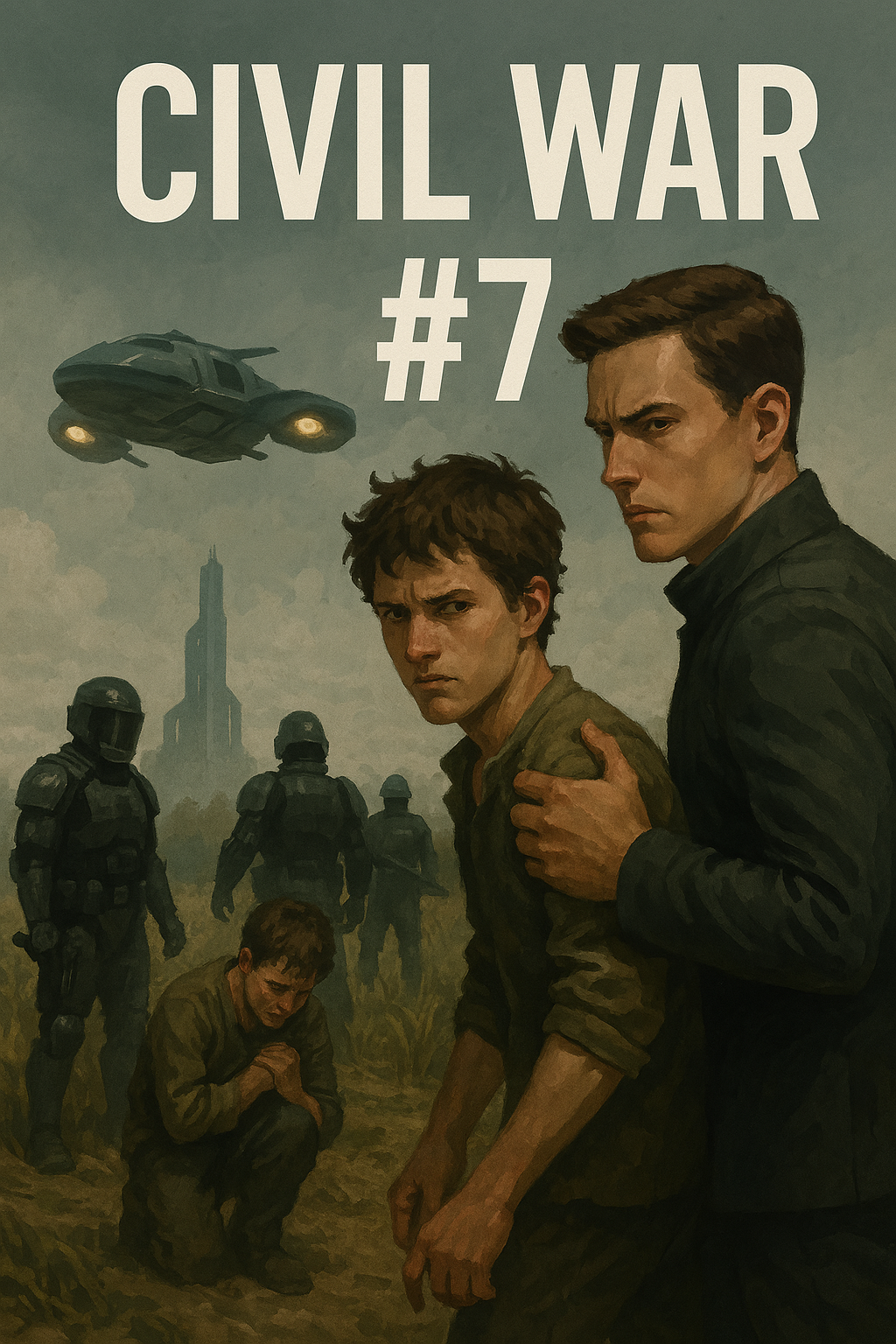
Chapter Two – Morning Lessons
The next morning began like every other—buzzing lights flickered on with a soft chime, signaling the start of communal check-in. Ash stood in the back row of the common room, half-awake, arms crossed.
The residents, pleebs and upwardly mobile alike, stood at attention beneath the ever-watching eye of the home’s ceiling drone. On the wall screen, the daily creed glowed in bold, animated lettering:
FOLLOW THE RULES. DO NOT SPEAK UP. UNLESS DRIVEN BY THE SPIRIT TO ENTERTAIN.
One of the older upwardly mobile kids, Jax, led the group. He stood with spine-perfect posture and a permanent smirk that said he enjoyed having power, even if it came with a cheap badge and a borrowed voice.
“Repeat after me,” Jax said with a theatrical tone. “We are the future of the Seven.”
The group echoed it back in scattered unison.
Jax continued. “We obey the rules. We strive for clarity. We create for the benefit of our local network.”
Ash rolled his eyes, the old knot of frustration tightening in his chest. His face stayed blank, but his thoughts burned with quiet resentment—this whole ritual felt like theater for fools. He mumbled just loud enough to be heard, “Or we become compost in a content farm.”
Jax turned on him like he’d been waiting for it. “What was that, Ash?”
Ash met his gaze without flinching. “Just wondering how much of your brain they had to burn out before you started enjoying this.”
Gasps echoed. Even the younger pleebs froze.
The ceiling drone buzzed as its lens shifted and zoomed.
Jax smiled like a cat finding a wounded bird. He and Ash had never liked each other—too much history in too small a place. Jax had once been a pleeb too, before getting flagged as upwardly mobile after a viral prank video. He never let anyone forget it, least of all Ash. “Ash Danner, by order of home protocol and under section two of content disruption guidelines, you are assigned to a recalibration session in School.”
Ash shrugged, unfazed on the surface, but the sharp tug in his chest told a different story. Not fear. Just weariness. Another round of lies wrapped in education.
The drone beeped twice and projected a soft blue light over him.
“Escort in ten,” Jax added smugly. “Better rehearse your loyalty speech.”
Ash didn’t respond. He simply stepped out of line and walked back to his room, already counting how many ways they’d try to twist the truth today.
And how many he’d pretend to believe.
Chapter Three – The Lesson
The “school” was nothing more than a converted shipping container buried beneath the admin block. Ash sat stiffly in a plastic chair bolted to the floor, surrounded by a semicircle of others who’d failed, in one way or another, to perform their assigned roles.
At the center of the room stood a gleaming black monitor surrounded by banners that flapped slightly despite the absence of wind. The largest banner read: MIGHT IS RIGHT.
A voice boomed overhead, projected from nowhere and everywhere.
“In the year of the Seventh Collapse, the final President—his name stricken from the sacred archives—turned the people of the United States against one another. His reign of chaos proved the great flaw of democracy: that the weak could overrule the strong with lies and fear and numbers.”
Ash kept his face blank, but his fists clenched in his lap. He knew who they meant. Everyone did. The grinning orange caricature had become more myth than man—used as a bogeyman and scapegoat for everything wrong with the old world.
“It was then that the Seven rose—visionaries, architects, saviors of the new world. They abolished borders, restructured economies, and ended the madness of representation. Political parties were erased. Elections became performances. The illusion of independence replaced the chaos of choice.”
The footage on the screen shifted to charismatic ‘independents’—all polished, all elite—delivering fiery speeches to adoring followers. But their policies were indistinguishable. Their lives were decadent. Their followers wore their names like fashion brands.
“The age of the vote was over. The age of influence had begun. The Children of the Seven did not offer promises. They were the promise.”
“By placing the popular will in the hands of the worthy, the world was saved from its own indecision. The affluence of the elite, as ordained, would trickle downward—bringing light, art, and vision to those who labored below.”
The screen lit up with footage—glossy reels of the Children of the Seven:
Project Entry: Chapter Three – The Lesson
The “school” was nothing more than a converted shipping container buried beneath the admin block. Ash sat stiffly in a plastic chair bolted to the floor, surrounded by a semicircle of others who’d failed, in one way or another, to perform their assigned roles.
At the center of the room stood a gleaming black monitor surrounded by banners that flapped slightly despite the absence of wind. The largest banner read: MIGHT IS RIGHT.
A voice boomed overhead, projected from nowhere and everywhere.
“In the year of the Seventh Collapse, the final President—his name stricken from the sacred archives—turned the people of the United States against one another. His reign of chaos proved the great flaw of democracy: that the weak could overrule the strong with lies and fear and numbers.”
Ash kept his face blank, but his fists clenched in his lap. He knew who they meant. Everyone did. The grinning orange caricature had become more myth than man—used as a bogeyman and scapegoat for everything wrong with the old world.
“It was then that the Seven rose—visionaries, architects, saviors of the new world. They abolished borders, restructured economies, and ended the madness of representation. Political parties were erased. Elections became performances. True independence replaced the chaos of the ancient choices left behind by democratic chaos.”
The footage on the screen shifted to charismatic ‘independents’—all polished, all elite—delivering fiery speeches to adoring followers. But their policies were indistinguishable. Their lives were decadent. Their followers wore their names like fashion brands.
“The age of the vote was over. The age of influence had begun. The Children of the Seven did not offer promises. They were the promise.”
“By placing the popular will in the hands of the worthy, the world was saved from its own indecision. The affluence of the elite, as ordained, would trickle downward—bringing light, art, and vision to those who labored below.”
The screen lit up with footage—glossy reels of the Children of the Seven: celebrities, tech moguls, political titans, all merged into one immortal class. Their followers wept at concerts, collapsed during rallies, tattooed their logos into their skin.
“The Children of the Seven brought light where democracy had brought darkness. They do not rule. They guide. They do not seek approval. They are approval.”
A robot moved slowly down the aisle, holding a tray of biometric sensors. Each student had to press their palm to the glowing disc when prompted.
Ash hesitated. The last time he did this, they logged his elevated heartbeat and flagged him for “emotional distortion.”
But if he hesitated too long, they’d flag that too.
He placed his hand on the disc.
“Your loyalty ensures peace. Your doubt creates unrest.”
He bit his cheek until he tasted blood.
The footage shifted. Now, it was a reenactment of the final civil war—Civil War #7. Stylized, dramatic, mostly fiction. A red-hued America torn apart, pleebs killing pleebs while the Children watched from their towers. It showed the last vote being cast, the final rally in flames, the Seven rising like gods from smoke.
“The world learned what the ancients never could: when everyone speaks, the truth is lost. Only through silence can wisdom rise. Obedience is peace. Submission is strength. Might is right.”
Ash stared at the screen, trying to memorize the phrasing, the cadence, the way they mixed history and manipulation. One day, he might need to repeat these lies just well enough to pass.
But not today.
He looked down, let the drone scan his expression, and gave it what it wanted.
A nod.
And a smile.
Chapter Four – Dirt and Blame
The sun wasn’t even fully up when Ash was released from the “lesson” and sent directly to the fields. No time to change, no time to process. Just out of the shipping container and into the mud.
He joined the line of pleeb workers moving like shadows through the crop lanes, each pushing automated seeders and pluckers down rows of synthetic rootbeds. The air was hot and stale, reeking of filtered chemicals meant to mimic soil.
Ash moved on autopilot. This was familiar. This was real.
Down the row to his left, someone dropped a tray of seedlings.
“Damn it, Mouse,” someone muttered.
Ash turned just in time to see Mouse—a slight kid, barely old enough to shave—scrambling to gather the scattered plants. His hands shook. His breathing was ragged. He looked like he hadn’t eaten in a day.
“Come on, you little frag-up,” another worker snapped. “You keep slowing us down and they’ll dock us all. We miss our quota again and we’re all getting reassigned.”
Ash sighed and stepped over, bending to help Mouse scoop the trays back into place. The other pleebs watched but didn’t help. They just muttered and moved on.
“You alright?” Ash asked under his breath.
Mouse nodded too quickly. “Yeah. Just dizzy. Didn’t finish my block ration yesterday. It… made me sick again.”
Ash looked him over. Pale. Sweating. He’d seen that look before—kids who were one skipped meal away from collapsing.
“Take it slow,” Ash said. “I’ll cover your row till break.”
“You don’t have to—”
“I know,” Ash said. “But I’m not watching them bury another kid in the compost trench.”
Mouse stared at him, eyes wide, then went silent and fell back.
Ash stepped into his place, shoulders squared, pushing the seeder forward. The drone above made a soft beep, logging the correction.
Quota resumed.
But the warning lingered in the air: keep up, or be replaced.
Not long after, the low hum of electric engines signaled trouble. A black transport slid to a stop at the edge of the field, and out stepped two of the same cops from the day before.
One of them—the one who had spat at Corwin—trailed behind, scowling as he surveyed the workers.
“Well, well,” he sneered, eyes settling on Ash. “Looks like lesson boy’s back where he belongs.”
Ash said nothing. Just kept working.
“Hey, rat boy!” the cop barked.
Mouse flinched. He’d slowed again, pale and trembling worse than before.
“You want to crawl, do it after quota,” the cop growled, stomping toward him. “On your feet.”
Mouse tried to stand. His knees buckled. He collapsed hard onto the plastic walkway.
Ash dropped his tool and rushed to help him. “He’s sick—he needs med clearance.”
The cop shoved Ash hard in the chest. “Back off, hero.”
Ash caught himself, but the push had knocked Mouse sideways. There was a crack—sickening, sharp. Mouse screamed, clutching his arm.
Ash saw red.
He lunged.
The two collided, fists flying. Ash caught the cop across the jaw before being thrown to the ground and pinned with a knee to his back. The second officer raised his baton.
“Enough!” a new voice cut through the shouting.
Corwin.
Dressed in full upwardly mobile regalia, sleeves rolled and communicator in hand, he strode across the rows like he owned them.
The first cop sneered. “You again.”
“I’m field lead for this sector,” Corwin said calmly. “You’re done here.”
“Don’t tell us how to do our job, silver badge.”
Corwin didn’t flinch. He tapped a code into his communicator.
From the sky, a small dark drone descended—sleek and silent. It projected the emblem of The Director as it hovered.
Moments later, a trio of Director’s enforcers arrived—taller, heavier, clad in armor that made the cops look like mall security. They moved like machines with purpose.
“Situation?” the lead enforcer asked, voice processed through a filter.
Corwin gestured to Mouse, who was still crying, clutching his arm.
“Worker injured during abuse by field security,” he said.
The enforcer scanned the scene. “Unit productivity risked. Reprimand required.”
The cop who had pushed Ash took a step back. “Wait, I—”
The enforcer stepped forward, seized the cop’s arm, and with a single sharp motion, snapped it clean.
The scream echoed down the rows.
“Reassignment,” the enforcer barked to his squad. “Clear them.”
The cops were hauled off. No ceremony. No protest.
Ash staggered to his feet, winded.
Corwin looked at him. “You okay?”
Ash nodded. “What about Mouse?”
“He’ll get care,” Corwin said, already walking away.
Ash glanced at the enforcers as they lifted Mouse onto a stretcher drone.
But he knew better than to think it was mercy.
It was just efficiency.
Then Corwin’s communicator buzzed. He answered with a flick of his wrist.
The Director’s voice filtered through—silky and cold. “Bring the injured one. And your brother. To me.”
Corwin didn’t respond. Just ended the call, eyes narrowing.
He walked back toward the drone.
“Both of you. In.”
Mouse was already strapped to the transport cradle, groaning softly.
Ash climbed in beside him, uncertain.
Corwin leaned in close as he activated the door.
He whispered, “What have you done?”
The drone’s hatch sealed, and they lifted off the ground, heading for the tower of the Seven.
 Frank M. Anderson's Writing
Leave a comment