
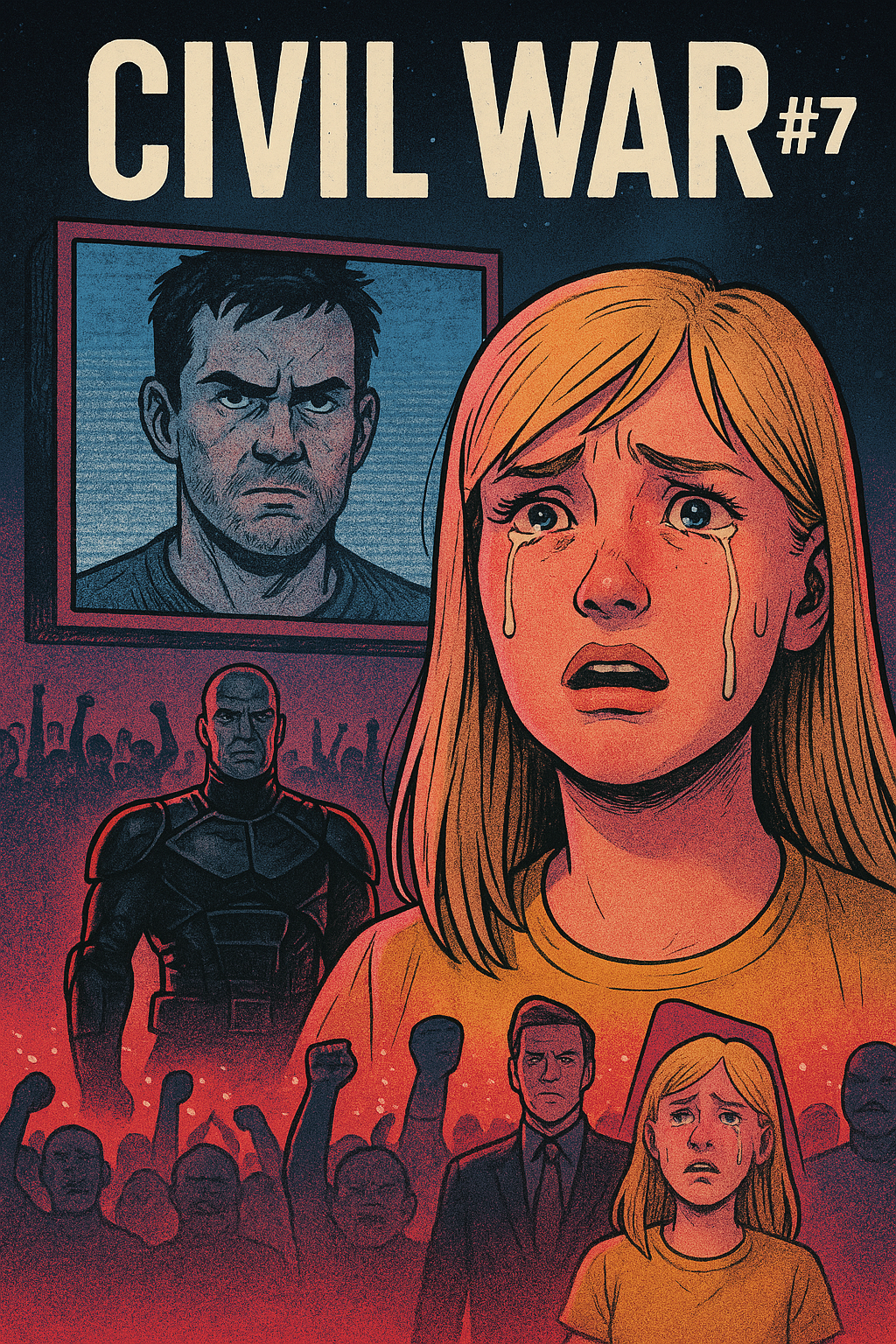
Ember’s voice filled the room and disappeared.
No echo. No feedback. No warmth.
She’d been singing for hours, guided only by blinking lights—green for pitch, red for error. The chamber was circular, sterile, humming like the inside of a sealed vault. It reminded her of the kind of room you went into when something needed to be extracted.
She lowered her arms slowly.
“Can I hear it back?” she asked.
Silence.
She looked up at the green light again. “Please. Just once.”
The light blinked red.
She exhaled hard and sat down on the bench at the wall’s edge. Her throat was raw. Her body ached. She’d been here for days, maybe longer. It was hard to tell—there were no clocks. No windows. Just work, and white, and waiting.
A woman entered. Silver coat, sharp cheekbones, expression unreadable. The kind of person who made decisions but never acknowledged your questions.
“Can I see the performance package?” Ember asked before the woman could even speak.
“No.”
“I’m the one performing with it.”
“You’re the voice,” the woman said, tapping her slate. “Not the story.”
Later, in a narrow hallway that led nowhere, Ember found the bot again—the one with the soft eyes.
She stepped in front of it, arms crossed.
“You know what’s in the package, don’t you?”
“I do.”
“They won’t tell me. Won’t show me. Won’t even let me see the stage.”
“They want your voice to feel… authentic.”
“Authentic?” she echoed. “This whole place is manufactured.”
The bot tilted its head.
“You are not wrong.”
She hesitated. “Are they mocking me?”
“They are framing you,” it said. “Framing you carefully.”
In her changing suite, Ember walked past a rack of performance outfits until her fingers brushed the only one assigned to her.
Red. Shimmering. High-collared, cut tight at the waist, the fabric reactive to light.
She hesitated before removing her robe.
The mirrors reflected her from every angle.
As she dressed, her movements slowed.
She pulled the fabric into place. It hugged her body in ways she didn’t like. Too tight. Too sculpted.
She adjusted the neckline. Again. And again.
Then she looked in the mirror—and remembered.
Another room. Years ago.
Cold. Bright. Not for performance.
Correction, her parents had called it. A small procedure. Necessary, they’d said. Something to help her be seen the way she felt. To make life easier.
It hadn’t made anything easier.
She looked back at herself now. The red dress. The lights. The glimmer.
She forced her hands still.
The door slid open.
“Stage call,” a voice said.
Through the translucent panel at the edge of the stage, she could see them:
The upwardly mobile. Dressed in luminous silks, seated in glowing rows that pulsed with soft music. They were already laughing.
Behind them, in the shadows, corralled by baton-wielding bots, were the pleebs.
Tightly packed. Barely visible.
Muted.
She turned to the bot, standing beside her one last time.
“I don’t know if I can do this.”
The bot’s eyes dimmed slightly.
“You already are.”
The curtain of light parted.
The stage was vast—polished obsidian underfoot, haloed by columns of cascading data. Ember stepped forward, her heels clicking against the floor like she was trespassing in a museum.
Applause began before she reached the center. But it wasn’t for her. It was for the spectacle. For the show.
As she reached the spotlight, a massive curved screen ignited behind her.
Her face.
Ash’s face.
Clips of him fighting in the pit. Clips of her stream. Her voice saying, “I believe in him.”
Then the narration began:
“In the chaos of rebellion, love blooms—misguided and fragile.”
A montage followed. Manufactured moments. Images she’d never taken. Her and Ash edited into romantic frames, gazing at each other under conjured moonlight, standing hand in hand before a crowd.
The audience began to laugh.
Not cruelly.
Worse.
Amused.
Then came the chant:
“Rebel girl! Rebel girl!”
Mocking. Rhythmic. It echoed from the upwardly mobile seats.
Ember stood frozen.
On the screen behind her, her face was blushing, smiling. In real time, she was pale, locked in place.
She turned her eyes toward the pleeb section.
They weren’t chanting.
They weren’t smiling.
They were watching. Silent. Still. Held back by a wall of chrome-bodied guards with glowing arms crossed.
She couldn’t read their faces.
The music cue began. Her intro.
Her cue.
She swallowed, took a step forward.
And sang.
Chapter Seventeen – Broadcast
Ash stood behind the mirrored viewing panel, high above the main auditorium. Below him, Ember stood beneath blinding lights, her voice trembling as she tried to hold the performance together. The crowd of upwardly mobile jeered louder with every verse.
A sharp object flew through the air—silver and fast. It struck her in the shoulder. She fell.
Ash surged forward, but the thick pane held.
“Let me out,” he snapped. No response.
Ember lay on the stage floor, dress shimmering as she gasped in silent pain, blinking into the spotlight.
A beat of silence.
Then a glittering figure stepped onto the stage.
The main commentator.
He wore a mirrored cape and had clearly undergone extensive facial reconstruction—his features stretched between youthful smoothness and aged decay. He raised a jeweled hand and addressed the audience.
“Wasn’t that… dramatic? A fall worthy of the great stages of history!”
The crowd laughed and roared, forgetting their earlier amusement had caused it.
“But wait, darlings,” the commentator cooed. “Let us not forget who brought us this marvelous drama. Please welcome… the man of the hour—our Director.”
Thunderous applause.
The Director entered in his black armor, his stride slow, deliberate. He raised a single hand for silence. The crowd obeyed.
“Citizens of the Seven,” he began, his voice deep, measured, precise. “Tonight, you have seen a glimpse of chaos. A disruption to the divine order. And you must understand: there is only order—or there is rot.”
He paced slowly.
“We live in a world of absolutes. Of truth and falsehood. Of light and dark. Good… and evil.”
He turned toward Ember, still kneeling on the stage.
“And rebellion, no matter how lovely its voice, is evil.”
The crowd applauded.
Then the screen lit up behind him.
Ash’s face appeared.
A package played—images of Ash fighting, speaking, overlaid with government narration.
“Ash, pleeb worker turned revolutionary. Tied to the deadly explosion that rocked Sector 9. Intelligence indicates collaboration with resistance factions. His mission: destabilize from within.”
Ash’s breath caught. The explosion? The one from the first chapter? They were blaming him?
He had never even seen a real resistance cell. Only rumors. Ghost stories. A convenient scapegoat for state violence.
Then the Director turned back to the crowd.
“And yet—yet—we must speak of the true deception. The lie wrapped in red.”
Gasps from the audience. The camera zoomed in on Ember.
The Director stepped beside her.
“This girl—this performer you cheered—has hidden something from you. Something grotesque. Something unnatural.”
He raised his voice.
“She is not what she appears. Born… indistinct. A freak of biology. Male and female. Neither and both. Hidden. Covered. Until now.”
A sharp inhale from the auditorium.
“There are rules,” the Director hissed. “Sacred boundaries set by the Seven. Nature is chaos. But we—we—control it. We perfect it.”
He turned to the crowd again, voice like thunder.
“Let this be a lesson. Morality is not flexible. It is not soft. It is a blade. And tonight, we cut the rot.”
He gestured to the guards.
“Ember is hereby stripped of her protections and sentenced to the Killing Fields for acts of concealment, deception, and biological defilement.”
Ember did not scream. She only closed her eyes.
Ash, watching, trembled—not from fear, but from rage.
Because this wasn’t justice.
It was performance.
 Frank M. Anderson's Writing
Leave a comment