
The room was dim, washed in the pale flicker of a screen looping Ember’s performance. Over and over, Ash watched her sing—watched the object sail through the air and strike her in the chest, watched her crumple to the ground. The crowd laughed. The hosts chuckled, their voices slick with mockery.
Ash sat frozen. His jaw clenched tight, muscles twitching beneath the skin. His fists trembled against his thighs, knuckles white, bones threatening to break through flesh.
He couldn’t look away. Ember had sung with conviction, something painfully real. She had believed. And for that, they’d humiliated her. Torn her apart in front of millions.
He didn’t know what to feel most—anger, disgust, shame. Maybe it was fear. Maybe it was all of it, layered and suffocating.
No one deserved that. Not even someone he barely knew.
The feed shifted with a flicker.
Now it was him.
The moment from the pit. His face, swollen and leaking blood. The cop’s fists landing over and over.
Then the Director—calm, amused, watching.
The host’s voice dripped sarcasm: “A revolutionary? This guy?”
Ash lowered his eyes. His gut twisted. The shame dug in deeper, but beneath it something darker coiled.
The screen flickered again. A new package queued up. A cleaner edit, pristine and polished.
“Ash: the face of a growing problem among the pleebs. A reader of forbidden histories. A spark in dry kindling.”
Footage followed. Grainy shots of Ash reading in his room—pages from a banned book spread on the floor. His voice quietly narrating some old-world passage.
The scene cut. The fight with the cop, but the angles were wrong. It wasn’t what happened—it was what they wanted it to be.
Then the explosion. Replayed from overhead. The one that had shaken the commune weeks ago.
Another cut. Ash, walking away.
The implication was clear. Crafted.
“He walks among us. And he walks against us.”
Ash blinked slowly. His hands uncurled, then balled again.
None of it was real. At least, not like this.
There had never been whispers of rebellion in their commune. No coded messages. No secret meetings. Just kids chasing clout, dancing for likes. Cheap drama dressed up as dissent.
The real rebellion had always been somewhere else. Cities with fire in the streets and slogans painted on walls. Places where people did something.
Their commune? Just another stream of carefully curated nothing.
Until now.
He muttered, voice barely audible:
“They needed a face. They chose mine.”
His voice trembled—not from fury, but from something colder. A seed of fear twisting in his gut.
Because if they could fabricate all of this…
What else could they do?
He scanned the room. The silence felt wrong. Oppressive. Like it was trying to smother thought. He stared at the blank walls, sensing more than seeing the cameras hidden in corners, the microphones buried in the vents.
He didn’t trust the chair he sat on. Or the cot they gave him. Or the food. Or the air.
Even the memory of Ember falling—was it real? Was any of it?
He pressed his back to the cold metal wall, staring at the dim red glow of a standby light in the corner. Watching him. Recording him.
“No one to trust,” he whispered. “Not even my own thoughts.”
He curled his legs up, arms wrapped around his knees like a child hiding from a storm. But he wasn’t hiding. He was thinking.
Ash didn’t know what came next.
But he knew one thing:
He wasn’t going to play their fool for much longer.
Without warning, the mirrored wall in front of Ash shimmered and vanished, leaving nothing but the blinding flood of stage lights and noise.
He was already on stage.
His bench was gone, replaced by a platform. The crowd roared around him. He was flanked on one side by the commentator, glittering and electric, and on the other by the Director—silent, composed, unreadable.
Ash blinked in the sudden brightness.
The commentator stepped forward, microphone hovering.
“So, Ash, the pleeb-turned-punchline himself. How does it feel to be the face of a movement?”
Ash said nothing. His jaw clenched again.
“Oh, come now,” the commentator goaded. “Silent strength? Or just too stunned to speak?”
He laughed, and the audience laughed with him.
“Well, let’s move on to tonight’s real treat,” the commentator continued, arms sweeping toward the horizon of the stage. “Director, if you please—our Battle-a-thon!”
With a sharp hiss, the walls around them began to pull back.
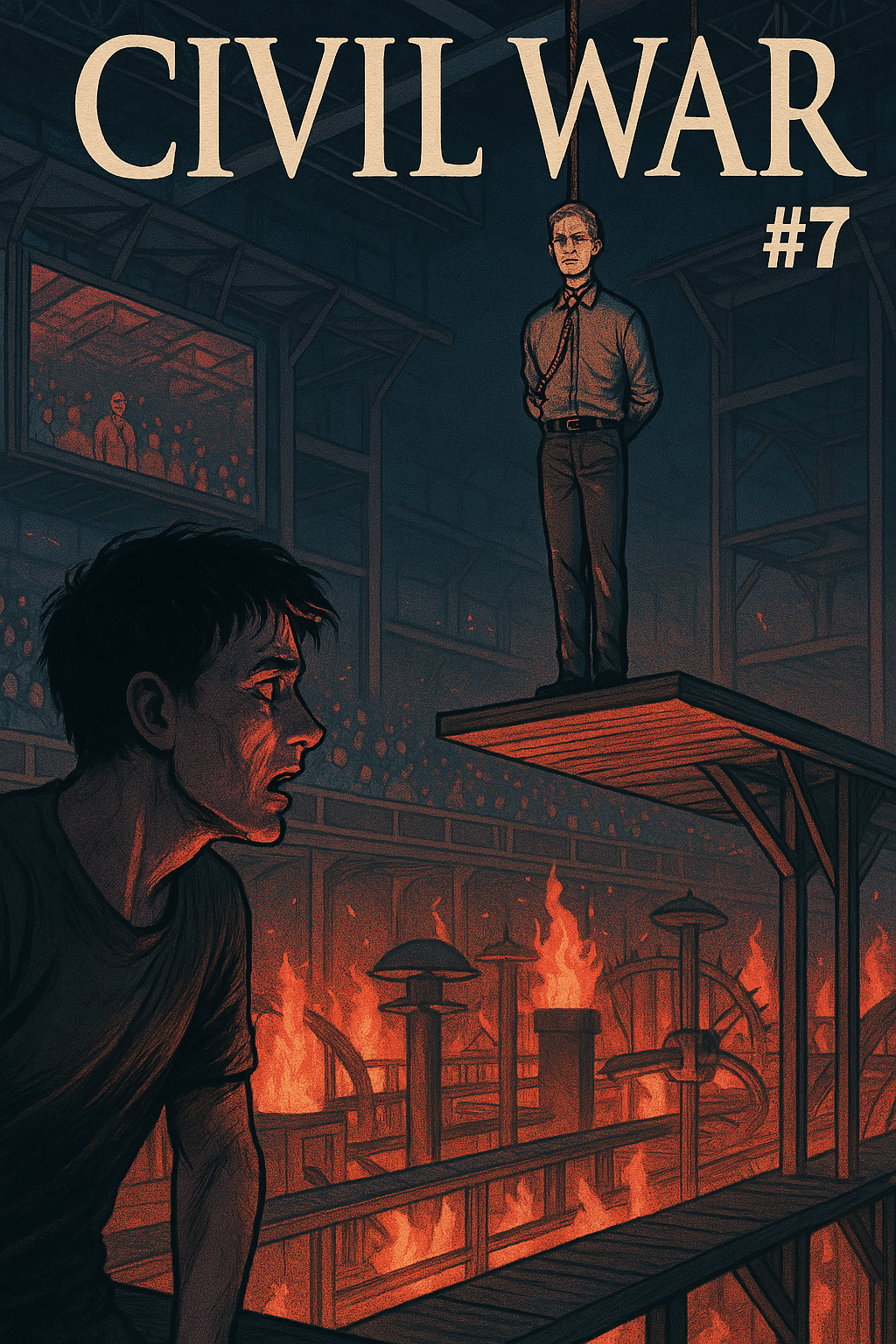
The arena unfolded like a mechanical nightmare. Towering columns split open to reveal a gauntlet-style course that stretched into the shadows. Giant mechanical pistons slammed down in rhythmic patterns, their timing just off enough to cause hesitation. Rotating platforms turned over open air. Pathways burst into sudden fire. Bladed pendulums arced across narrow catwalks. Drones hovered overhead, scanning for content, ready to broadcast failure from every angle. Interspersed throughout were combat zones—small arenas built into the track, each lit with blood-colored spotlights and filled with waiting fighters in gleaming, mismatched armor.
And at the very end of it all—high above the final stretch—a figure stood bound atop a narrow plank.
A noose hung from a gleaming metal arch. The figure’s hands were tied behind his back. His head bowed.
Corwin.
The audience gasped. Even the commentator seemed taken aback, like he was unprepared for the totality of the directors plans.
Ash’s heart dropped into his stomach.
The Director raised a hand for silence, his voice cutting through the noise like a blade.
“To win, you must survive. And to survive, you must reach the end. But the end, dear Ash… is family.”
He paused, letting the horror settle.
“If you fail,” the Director said, “he dies. And if you succeed… well, we’ll see.”
The spotlight lingered on Corwin’s face. He didn’t struggle. He didn’t plead. He just looked down at Ash, eyes unreadable.
Ash’s blood ran cold.
The Director gestured again. Another package lit the screens.
It was Corwin—glossy, flawless, everything polished. He rose through the ranks, a loyal upwardly mobile. A perfect citizen. Calm. Smart. Reliable.
But then—footage shifted.
That moment in the woods. The broken drone. The pact.
Ash stared in disbelief. They had seen everything. Since the beginning.
The Director smiled faintly.
“Quite the actor, your brother. But every role must end.”
Ash stared at the gauntlet again. At the blades. The fire. The endless stretch of pain.
And the brother waiting at the end.
Bound. Helpless.
Waiting to die if Ash failed.
 Frank M. Anderson's Writing
Leave a comment