
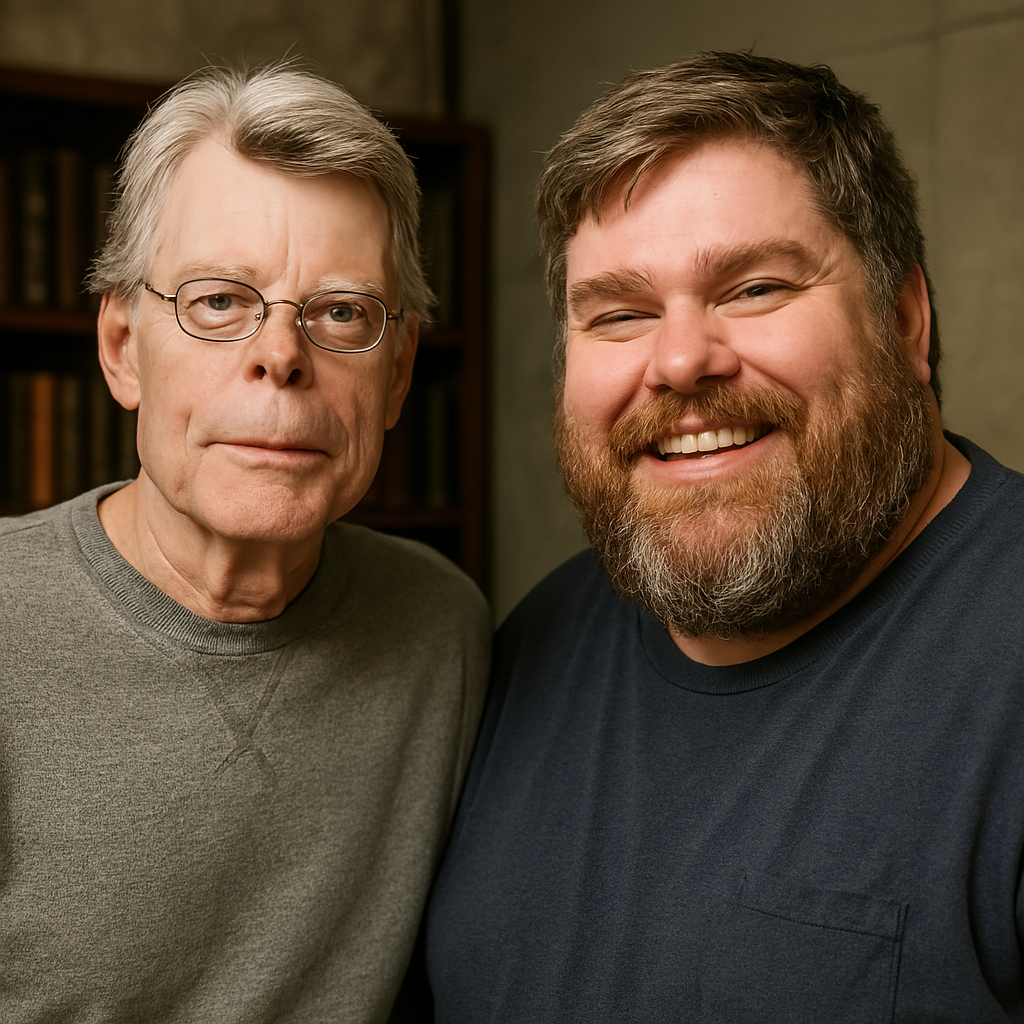
If Hugh Howey showed me that it was okay to break the rules, Stephen King was the one who first showed me what it meant to have a voice.
Long before I had any real sense of craft or structure, I had Stephen King. His books were everywhere when I was growing up—on library shelves, in gas stations, in the hands of people I trusted and people I feared.
And once I started reading, I never really stopped.
But it wasn’t just the horror, the suspense, or the twisted small towns that grabbed me—it was the honesty.
King wrote like someone who didn’t care what anyone thought, and yet somehow cared deeply about the reader. He talked to you. He told the truth, even when the truth was messy, terrifying, or stupidly human. He made writing feel like a conversation—intimate, confessional, and alive.
When I started writing—lyrics, essays, fragments of stories—King was already in my bloodstream. I copied his tone without even realizing it. I used contractions in narration. I wrote about flawed people. I let characters ramble. I didn’t clean up the mess.
Then, in what felt like the boldest move of my life at the time, I sent him a short story.
It was about a nuclear alligator that stole a baby from a house.
Inspired by the infamous “a dingo ate my baby” news story—and, in true 90s kid fashion, Jurassic Park—I poured everything I had into that bizarre little piece of horror. It was dark, absurd, and probably terrible. But I finished it.
And I mailed it off to Stephen King—because who else would get it?
What I got back was a form letter—short, polite, probably mailed by an assistant.
But at the bottom, in a different ink, was a handwritten note:
“P.S. Thanks for the story.”
That tiny gesture meant everything.
It felt like someone—maybe even him—had actually seen me, even for just a second.
I kept that letter.
And I kept writing.
That moment didn’t launch a career. It didn’t open any doors. But it gave me something just as important: the belief that I belonged.
That maybe I wasn’t crazy for wanting this.
Years later, after a heart attack and a mental collapse, I threw away most of the writing I’d done—including that story. I wish I could remember the title, but I don’t.
All I remember is how much it meant to write it, to send it, and to feel—briefly—like I was part of something larger.
King’s books stayed with me through all of it.
On Writing became a sort of gospel—clear, sharp, no-bullshit encouragement.
Like a hand reaching out from the wreckage saying:
“You’re not done yet.”
Now, I’m writing again—creating and releasing new work, much of it made with the help of AI.
Not in place of my voice, but alongside it. I still do the dreaming, the shaping, the bleeding on the page.
The AI helps keep the threads untangled.
The result is something honest, surprising, and alive in its own way.
Stephen King may never read anything I write.
But he was the first writer who made me believe I could.
And that’s enough.
 Frank M. Anderson's Writing
Leave a comment