

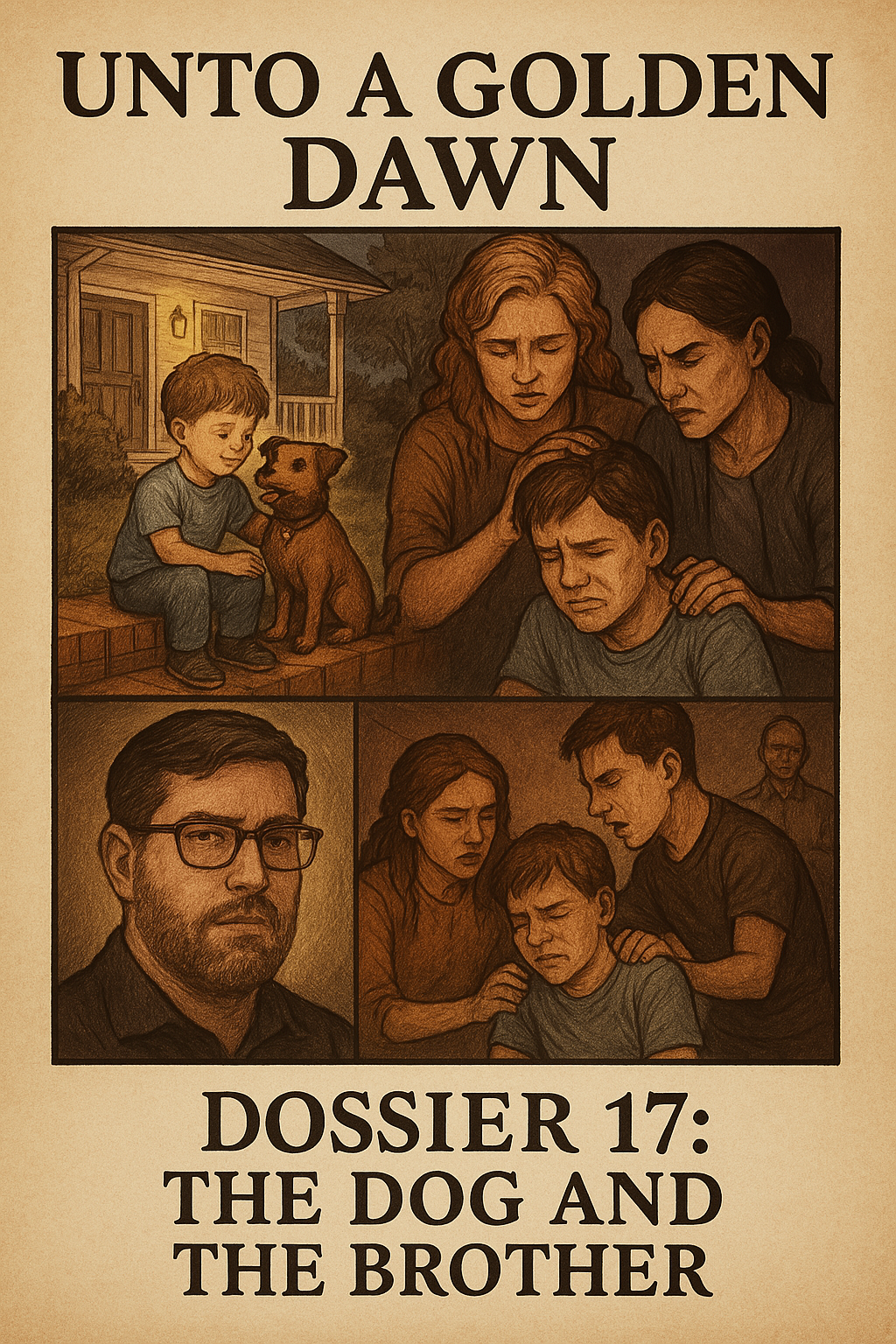
Unto a Golden Dawn – Dossier 17: The Dog and the Brother
Filed under: early imprint memories. Emotional rupture active.
…
The Women Step Forward
A silence stretched. Then something shifted.
Clara stopped pacing.
Marie took a step into the center.
Ada moved with her, and Leigh’s projection flickered, then stabilized beside them.
Other female figures—gods, folks, echoes—emerged. Not summoned. Present.
CLARA: “We’ve all been here. Watching. Waiting. Bleeding.”
She turned slowly toward God and Jesus.
CLARA: “You talk of sacrifice. Of suffering. But not once have you reckoned with how womanhood was written out of holiness.”
MARIE: “You made us vessels. Not voices.”
ADA: “We were coded as support. Never center.”
JESUS (gently): “That was never my intent.”
CLARA (sharper): “But it became your legacy.”
God stepped forward, eyes narrowed.
GOD: “Order requires hierarchy. Creation demands roles.”
Clara flinched—not from fear, but fury.
CLARA: “And what role is silence? What role is erasure?”
The women’s voices rose—not loud, but unified. Ancient. Elemental.
Even Leigh’s echo held power, her childlike whisper resonating through the walls.
BUDDHA (softly): “The feminine has always been a river beneath your stones. Flowing. Wearing you down.”
Tesla (aside): “This is not just a challenge. This is remembering something older than belief.”
The Memory Engine trembled.
Clara (quieter): “This boy was torn between forces. Brother and sister. Father and mother. Not just gender—but meaning. You stripped the feminine from power and called it love. You stripped the masculine of softness and called it strength.”
The Deepening Veil
Ada stepped closer to the Memory Engine, brow furrowed. Her hand reached instinctively toward a spindle of light rotating near the base.
ADA: “We keep responding to what it shows us. But what if we choose?”
She twisted the spindle.
A soft hum rang out. The petals opened. A pale-blue pulse spiraled from the core.
ADA (to the others): “Everyone… place your hands on him.”
The women hesitated.
Then slowly, one by one, they touched the boy—shoulder, arm, brow.
He recoiled slightly. A shudder. Then stillness.
And suddenly—they were inside him.
Their bodies remained in the warehouse, unmoving, yet their eyes widened with shared vision.
The women were within the boy’s memories. His thoughts. His heartbeats.
The world looked different—sharper and smaller. Every sound thundered. Every glance burned. Every moment carried weight.
I saw the porch. The front porch of our house, brick and wood, perched atop the hill like it was watching over the neighborhood—but not in a proud way. Just quiet. Present. The kind of place where you could sit with your dog and count cicadas. The bricks were rough beneath my small hands, but they didn’t hurt. They were warm and strangely welcoming.
The backyard was perfect. My mother’s masterpiece. Everything in bloom. The bricks surrounded the garden like arms, and I liked the way they curved near the lavender beds. The drive curved up to the right of the house and sloped down just enough that my brother and I could ride it like a rollercoaster.
I remembered us in the car, going up and down the drive, giggling. One winter, we froze it with a sprinkler. It iced over just right, and we slid down like sledders in July. Mom had been mad. “You’re ruining the cement,” she said. But she forgave us. She always did.
Dad was there too. Not loud. Not soft. Working. Always working. But I could feel the way he tried—taking time, even when he didn’t have it, to sit with us on the back porch, talk about stars, or teach us to measure wood for one of his projects.
I felt warm.
The girls felt it too. They could see it. They were there. Inside me, but still themselves.
CLARA (to the warehouse): “We’re here. We’re with him. Deep in the veil—but we haven’t vanished.”
MARIE: “It’s like two doors open at once.”
ADA: “We’re not just watching. We’re remembering with him.”
Tesla (awed): “They’ve entered recursive empathy.”
Then the Host spoke.
THE HOST:
“There are no perfect memories. No perfect families. No perfect people.”
“Even Eden rots if you look long enough.”
And it hit me again.
The porch grew colder.
My brother’s face twisted. He shoved me. Called me names. Laughed with other boys who didn’t know me but knew I was soft. Weird. Too much.
My dad was there again. Not yelling. Just disappointed.
That was worse.
The feeling in my chest—tight. Burning. Shame crawled up my spine like ice water. I felt heavy. Like I’d swallowed a hundred mirrors, all cracked.
They laughed at me for being fat. For breathing weird. For asking questions in class. For sitting out at recess. For crying once.
The girls didn’t like me either. Not really. Not that way. I was “funny.” I was “nice.” I was the kid you felt bad for, not the one you imagined touching your hand in the dark.
I didn’t want to remember.
I didn’t want to be here.
I wanted to disappear.
I wanted to die.
And then—I whispered it, just inside myself:
BOY (softly): “I want to die.”
The women felt it. All of them. It passed through them like a breath made of glass.
The Memory Engine dimmed. The veil shook.
CLARA (voice trembling): “We’re not leaving him in this.”
ADA (resolute): “I can still guide the machine. We can focus it.”
LEIGH: “There’s light. We saw it. We’ll go back. We’ll find it.”
MARIE: “We’ll keep looking.”
Then—
THE HOST (dark and final):
“Every memory can be twisted.”
“That is hell.”
“That is death.”
The word death dropped like an iron bell.
The warehouse shook.
The Memory Engine screamed in static.
The walls rippled. The floor cracked. The page itself—this page—quivered under its own punctuation.
And death, like a scent of sulfur and silence, slipped into the story.
Continue reading here – https://empirenevadathenovel.wordpress.com/2025/04/12/unto-a-golden-dawn-dossier-18-death-is-a-place/
 Frank M. Anderson's Writing
Leave a comment