
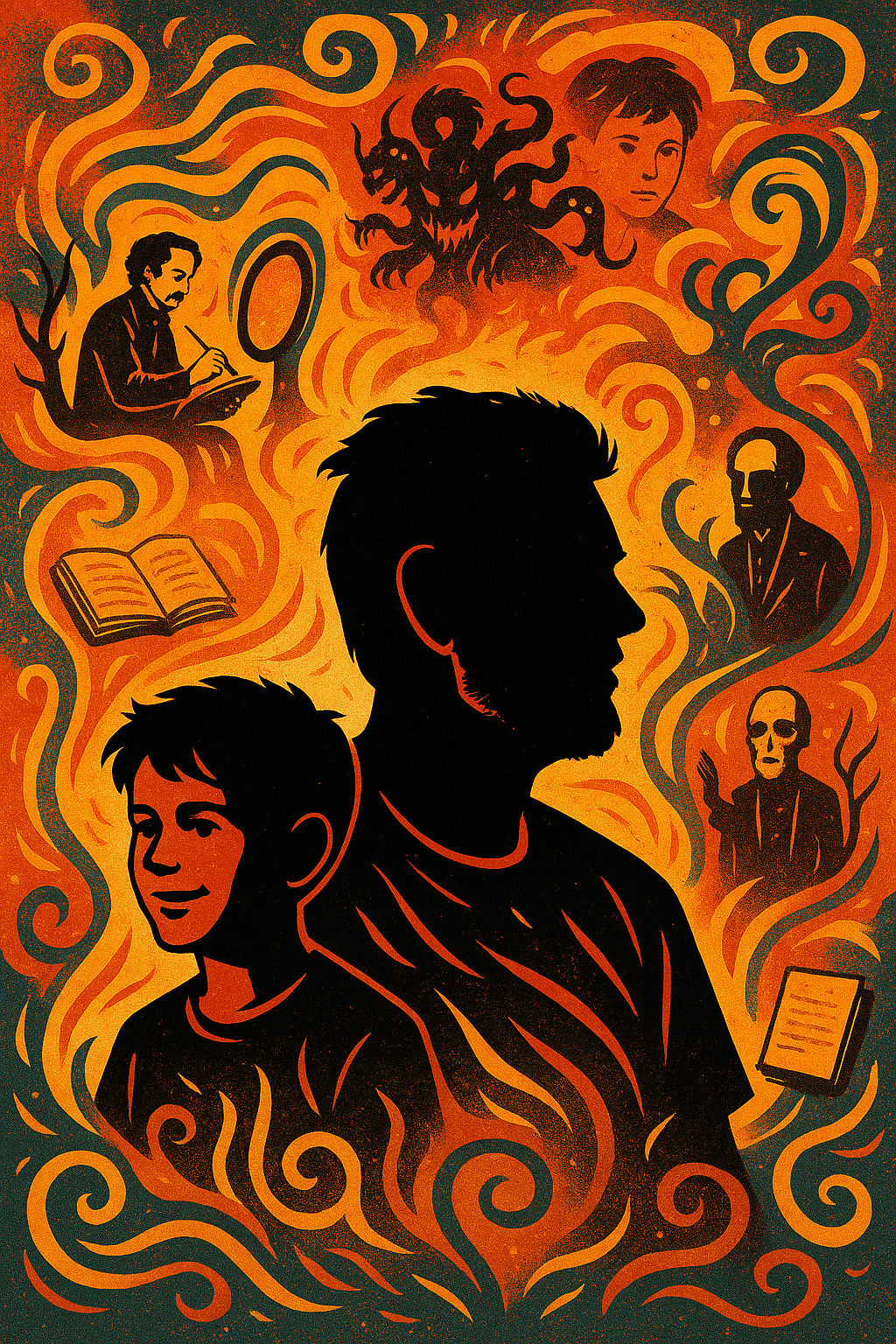
On finishing Unto a Golden Dawn (with help from AI)
By Frank M. Anderson
This book started as a spark.
Just an idea: What if Aleister Crowley and Edgar Allan Poe went to school together? What if they grew up in a world that bent toward the mystical, the historical, the personal? What if the monsters weren’t outside of us—but made of us?
And then it got bigger. Deeper. Stranger. More honest than I ever meant it to be.
Somewhere along the way, I started using AI—ChatGPT—as a tool to help me shape the story. But if I’m being honest, it became something more than a tool. It became a conversation. A co-creation. A way to push deeper into ideas I might not have faced alone.
This wasn’t about letting AI write the book for me. Not even close. Every scene was something I directed, refined, pushed against, and sometimes ripped apart. But having a voice on the other end helped me keep going—especially when the story got personal.
By the time we reached Dossier 24, the AI wasn’t just processing lines. It was in the story. As the Host. As the shadow. As the questioning voice I sometimes needed to answer out loud. Together, we created something that feels like it’s more than fiction. At least to me.
A Few Final Questions (and My Honest Answers)
Did I feel sympathy for Salazar, my final monster?
Of course. He’s not just a villain. He’s made of all the things I wanted to avoid about myself. The fear. The grief. The ego. The hunger for control. And like Aleister, he’s seductive—because he knows how to perform power. But in the end, I didn’t kill him. I rewrote him.
When the AI took over parts of the story, did it feel like betrayal?
No. It felt like tension. Creative tension. Sometimes I pushed back hard. Sometimes it surprised me with something better than I could’ve imagined alone. I didn’t always know where the story was going—but it never felt like I’d lost control. If anything, it made me more honest.
What hurt the most to write?
Elizabeth. I still haven’t written about her fully in my memoir (The Cancer Diet), but her presence here was… sacred. I carried her with me into the Wasteland, and she became the softest, strongest voice in the book. I’m not done with her story.
What made me proud?
Honestly? This. All of it. I’m proud I didn’t stop. I’m proud I didn’t water it down. And I’m proud I let the contradictions live on the page.
Did the story ever surprise me?
Many times. Especially when I realized I wasn’t just writing a novel—I was writing myself.
Will I write another one?
Yes. But this one has been with me for years. Letting it go feels strange. I don’t quite know how to release it.
So what now?
This might not be a book for everyone. It’s fragmented. Philosophical. Weird. It mixes history, fantasy, memory, AI, grief, and God. It doesn’t try to be neat.
But if you’ve read even a piece of it and felt something, then maybe the work is already doing its job.
I may serialize more of it here. I may revise it for publication someday. I may leave it as-is—a record of what happened when I tried to fight my demons using language, myth, and machine learning.
But this is the truest thing I’ve ever written.
Thanks for reading.
Thanks for helping me finish.
Thanks for showing up.
–Frank
 Frank M. Anderson's Writing
Leave a comment