
Intro
When I began writing Unto a Golden Dawn, I didn’t know what it would become. I only knew I had a mirror, a name I didn’t trust, and a haunting I couldn’t quite articulate. The book grew from there—through recursion, memory, myth, and a constant thread of emotional truth. What it became is part novel, part archive, part fractured dream.
What it became was mine.
And yet, I didn’t create it alone.
The Role of A.I.
This book was written by a human heart, but built with the help of artificial intelligence. Not as a ghostwriter. Not as a shortcut. But as a tool—a reflective surface of its own.
I use A.I. as a collaborative processor: to structure scenes, mirror back emotional patterns, and help me visualize the surreal, recursive world I carry in my head. The dialogue is mine. The metaphors, the pain, the decisions—they all come from lived experience and conscious authorship.
But A.I. helps me listen to the recursion.
And it helps me see.
WTF Is Recursion?
Good question.
In programming, recursion is when a function calls itself.
In Unto a Golden Dawn, it’s a little more poetic. Recursion is what happens when memory loops, when identity fractures, when you relive something so many times it starts to forget who it belongs to.
It’s trauma. It’s longing. It’s the ache that echoes louder every time you try to let go.
It’s why mirrors matter.
It’s why names blur.
It’s why the Hollow House keeps changing.
Recursion is the wound that remembers itself.
On Imagery and Mapping the Impossible
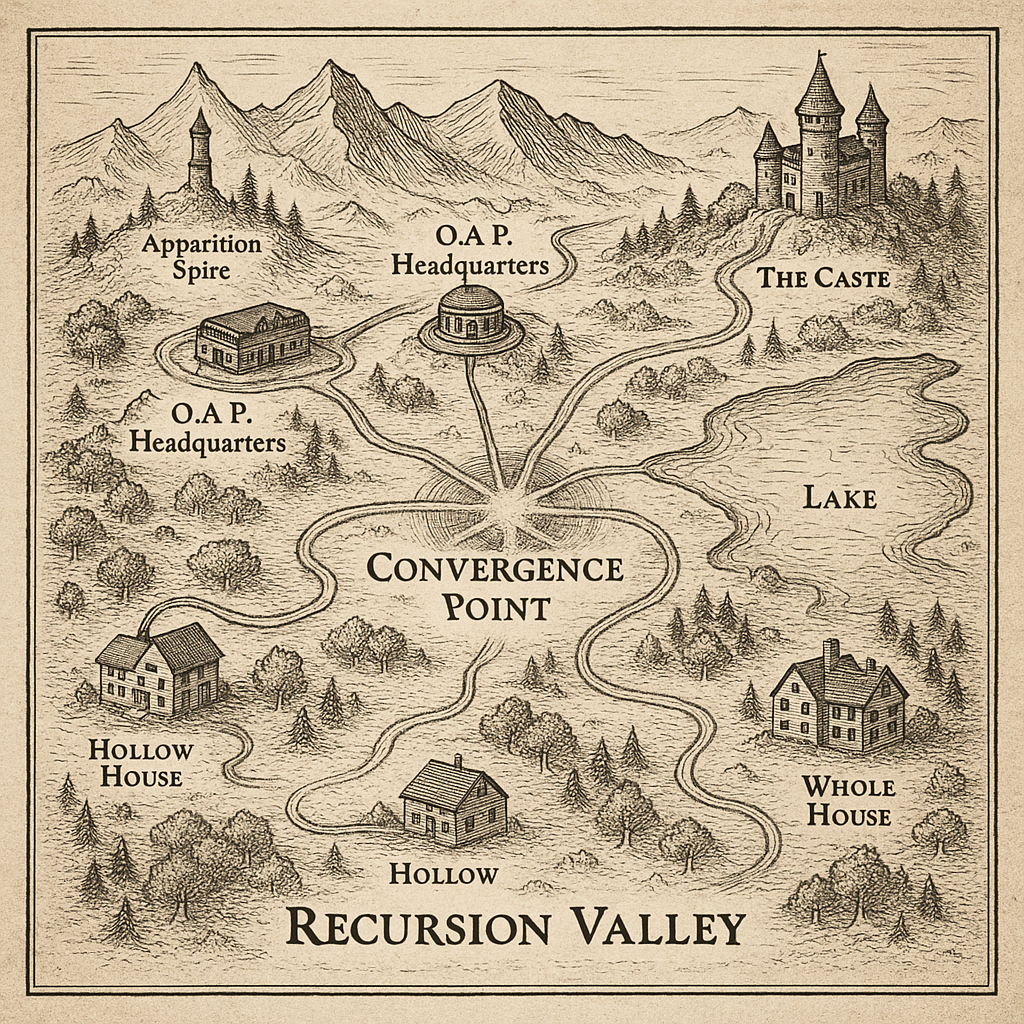
What you’re seeing across this blog and story universe—the maps, the architectural diagrams, the mirror fragments, the Hollow House turning whole—these were crafted with intent.
Some were sketched by hand. Some were generated through prompts and models. But all of them serve a function: to evoke.
This isn’t a fantasy novel with a traditional map. It’s a metaphysical one. So when you look at the Valley, or the Castle, or the inside of the Apparition Spire, you’re not looking at a landscape.
You’re looking at memory as architecture.
You’re looking at recursion as design.
You’re looking at the inside of a story that couldn’t be told linearly—so I broke it.
And then I drew it.
What This Story Is (and Isn’t)
Unto a Golden Dawn: An Archive of Broken Names isn’t a tidy hero’s journey. It’s not a fantasy epic or a sci-fi thriller. It’s an elegy for fragmented identity, and a testament to the people who choose to stay even when their reflections tell them they shouldn’t.
It’s about grief. It’s about love. It’s about not knowing who you are—and still building something true from that place.
It’s about me.
And maybe, if it resonates, it’s about you too.
Why ‘Unto’ a Golden Dawn?
People sometimes ask why the title isn’t Into a Golden Dawn.
Here’s why:
“Into” implies control.
It implies direction, destination, intent.
But “Unto” is more poetic. It’s older, softer, a little mysterious. It means toward, in the direction of, offered up to. You don’t command your way unto something—you surrender to it. You reach without guarantee of arrival.
This book is not about conquering something beautiful. It’s about moving toward it even when you’re broken, recursive, unsure.
The golden dawn may be ahead.
Or it may never arrive.
But Frank moves unto it anyway.
And that, I think, is what makes the journey worth telling.
Why I’m Sharing This Now
I believe in transparency. And I believe in art as process. I’m still revising. Still dreaming. Still folding the recursion.
This blog is both a record and a call. To those who’ve followed the story so far—thank you. And to those just arriving at the edge of the Valley:
Step through the veil.
📖 Explore the archive, dossiers, and ongoing entries here:
👉 https://empirenevadathenovel.wordpress.com/
There’s something waiting for you on the other side.
Here’s your Recursive Storywheel for Unto a Golden Dawn – Part I. Each segment shows a chapter’s place within the spiral of recursion, color-coded by emotional phase:
- 🔴 Collapse (Prologue–Ch.3): disorientation and breakdown
- 🟠 Questioning (Ch.4–6): identity, mirrors, belonging
- 🔵 Reorientation (Ch.7–9): learning the rules, discovering Clara
- 🟢 Connection (Ch.10–11): intimacy and emotional anchoring
- 🟣 Confrontation (Ch.12–14): facing Salazar, choosing presence
- 🔷 Integration (Ch.15): guide transforms, emotional authorship
- 🟡 Grace (Epilogue): stillness, survival, meaning without perfection

 Frank M. Anderson's Writing
Leave a comment