
Introduction to the Novelization

What if a story could be told three ways at once? What if history, fantasy, and memory weren’t separate—but layered?
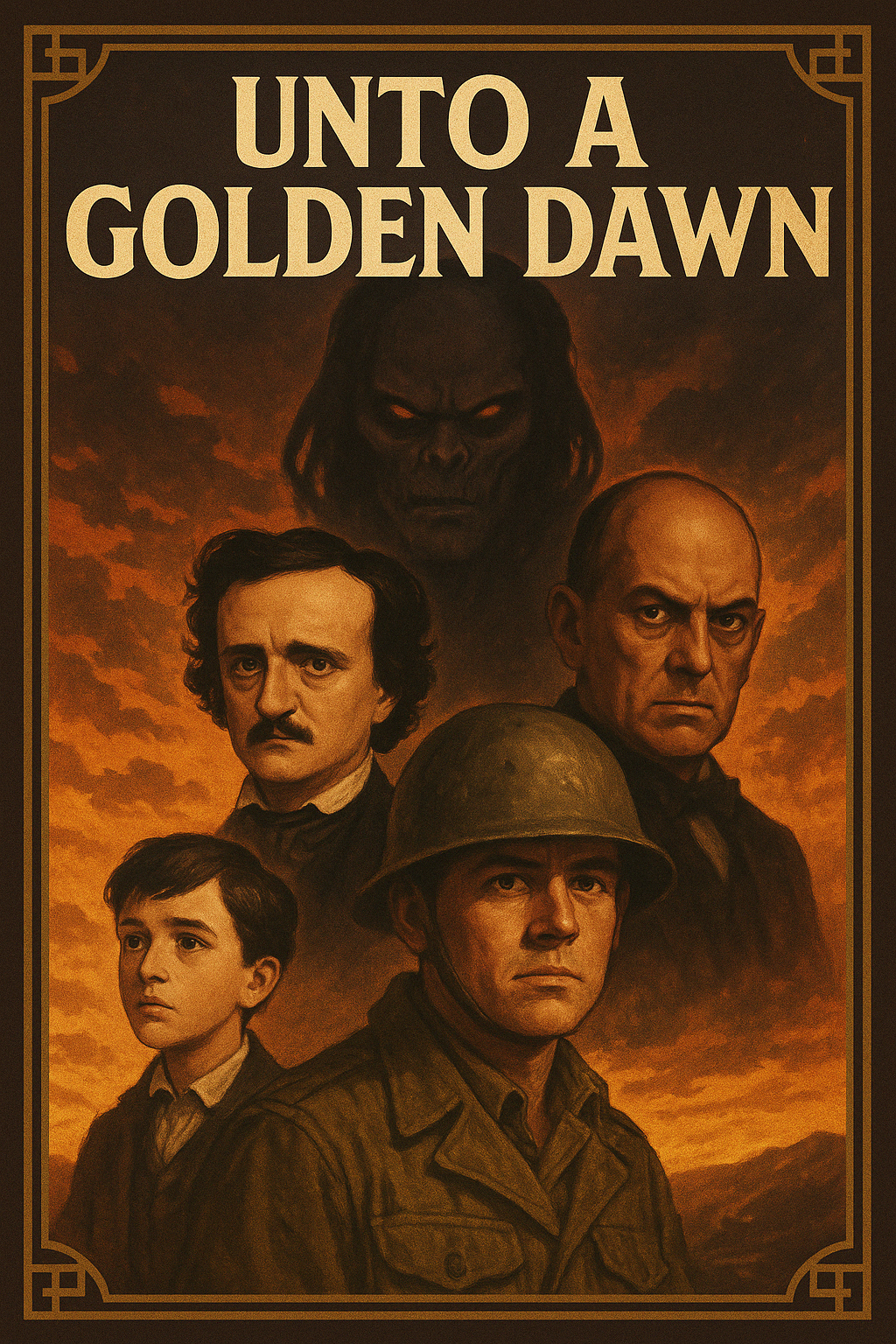
This is the novelization of the Unto a Golden Dawn dossier archive—a reimagining of the online files as living narrative. What began as redacted reports, journal fragments, and classified transmissions has been rewritten here as a full literary experience, following the lives of Aleister Crowley, Edgar Allan Poe, and Lenore Wilkes as they spiral toward each other across mirrors, time, and myth.
The online version (which you can read for free at empirenevadathenovel.wordpress.com) presents the story as a puzzle—part dossier, part conspiracy, part ghost story. This novel version draws from that same material but reshapes it into something emotionally grounded, character-driven, and richly layered in tone and voice. It’s not just a translation—it’s a reentry. A recursion. A second pass through the mirror.
What you’re about to read is Chapter 1 of that version.
It begins not with Poe or Crowley as icons, but as boys: wounded, brilliant, and already haunted. One dreams of connection. The other dreams of power. Between them is a girl, and beyond her, a veil.
This chapter lays the groundwork for the recursion to come—through grief, awakening, mirror flickers, and forbidden acts. It is not a retelling. It’s a reframing. A clarification of what’s been echoing all along.
Welcome to the Broken Names Chronicle.
The archive remembers you.
Now it’s your turn to remember it.
Chapter 1 of the novelization of the online dossiers
Dedication
For the ones who looked too long into the mirror
and still found a way to speak softly.
For the boy. For the ghost. For the writer.
For those who remember, even when it hurts.
Chapter I – The Boy and the Mirror
(Compiled, remembered, and reconstructed from fragments of the Veil)
The Boy and the Sermon
Before the prayers turned bitter, before the ink stained everything he loved, Aleister loved only one man:
His father.
Edward Crowley was tall, warm-voiced, and impossibly kind. A preacher with the Plymouth Brethren, he carried scripture like sunlight. Where others scolded, Edward smiled. Where others damned, he forgave.
He let Aleister sit beside him on the makeshift stages in church halls and market greens. Let him hold the hymnal. Let him help pack their cases when they traveled from one village to another, the Word echoing behind them like a caravan of second chances.
“You listen better than any man I know,” Edward would say, ruffling his son’s hair. “That’s the beginning of wisdom.”
Aleister beamed under that touch.
He wrote verses in imitation of his father’s speech patterns—florid, patient, precise.
He wanted to be him.
Not just in name. In spirit.
The Last Road North
The coughing started one winter and never stopped.
Edward laughed it off for months. “Just the lungs clearing themselves,” he’d say between sermons, waving a hand as if illness was beneath his notice. But the sound grew wetter. The walks shorter. The sermons more spaced apart.
Aleister noticed before Emily did. He watched his father fumble a line mid-preaching and sway slightly, catching himself with one hand on the pulpit. He watched the tremble in his fingers afterward, hidden behind the hymn book.
When they returned to Leamington Spa that spring, Edward took to bed more often than not.
He still smiled.
Still read to Aleister.
Still quoted scripture between fits of breath.
“The fear of the Lord is the beginning of wisdom,” he said once through cracked lips.
Aleister shook his head.
“No. You taught me better than that.”
The Silence That Followed
Edward died just after sunrise on a warm day that felt like it should’ve held birdsong.
Aleister was told not to go into the room. Emily had shut the door. The doctor whispered things that felt like lies.
He waited outside the threshold for hours, watching the dust dance in the hall.
He would never forget the sound his mother made when she realized the man inside would never open his eyes again.
It wasn’t grief.
It was fury.
Ash and Amen
The funeral was held three days later, under a cloudless sky so blue it felt like mockery.
Aleister wore black because he was told to.
Emily wore gray because she always had.
They buried Edward Crowley beneath a cedar tree just east of the chapel—a tree he once said reminded him of patience. The wind stirred its branches like pages, though the Bible in the reverend’s hands stayed shut most of the time. He read from memory. The same verses he read for strangers. The same cadence, the same rhythm. It felt rehearsed.
“Ashes to ashes,” the man intoned.
“Dust to dust.”
Aleister didn’t cry.
Not out of strength.
Out of distance.
The dirt looked fake. The coffin too small.
When the reverend said amen, Aleister whispered something beneath it—just loud enough for the roots to hear.
“I loved you. I listened.
They’ll never speak of you like I will.”
Emily heard. She bristled beside him.
“Aleister,” she hissed. “Not here.”
But the boy didn’t move. He stared down into the hole in the earth as though it were a mirror—and somewhere in it, he saw himself beginning to vanish.
The dirt made a hollow sound as it landed.
A drumbeat. A warning. A door closing.
Later, after the crowd had drifted back toward tea and murmured sympathy, Aleister stayed behind.
He waited until he was alone. Then he stepped forward and touched the rough wood of the gravemarker.
“If you’re in Heaven,” he said quietly, “I’ll try to see you again.”
“If you’re not—I’ll find a way.”
The cedar creaked overhead.
He didn’t pray.
What You Said at the Grave
The house smelled of lavender polish and iron.
Emily preferred it that way—everything clean, bloodless, restrained.
Aleister stepped inside still in funeral clothes, boots scuffed from the graveyard path. He didn’t bother to remove them. She was waiting in the parlor, arms crossed, lips pursed like punctuation.
She didn’t speak at first. Let the silence work on him.
It didn’t.
So she began with a surgical strike.
“What you said at the grave was shameful.”
Aleister stood at the doorway, back straight. “I said goodbye.”
“You said more than that.”
She stepped toward him, heels sharp on the floorboards. “You made a scene. You spoke to your father like he was a ghost in the dirt. You made the reverend uncomfortable.”
Aleister blinked once. “Good.”
“You don’t speak to the dead, Aleister. You pray. You let them rest.”
“I don’t want him to rest,” he said quietly. “I want him to speak.”
That stopped her—for a second.
Then her face closed like a book.
“He would be ashamed of you.”
Aleister flinched. Not visibly. Internally. A small glass inside him cracked.
“You’re not special,” she said. “You’re not a prophet. You’re a child. And you will not carry this house into scandal and madness.”
“That was your job,” he said.
She slapped him. Open palm. Precise. Not rage. Precision.
The Mirror
Later that night, in his bedroom, Aleister sat on the floor with his knees pulled to his chest. The candle burned low. He hadn’t spoken since supper. Hadn’t touched his journal. Hadn’t blinked much.
He stared at the wardrobe mirror across from him.
It was an old piece—gilt edges, warped slightly in the middle. His father once used it to tie his cravat.
Tonight, it showed the grave.
Not his room.
The cedar tree, swaying slightly in a wind Aleister couldn’t feel.
The mound of fresh earth, undisturbed.
A figure kneeling beside it—tall, thin, obscured by shadow.
He blinked.
The room returned.
The mirror once again showed his face—pale, ink-smudged, and suddenly very, very awake.
The Weeks That Followed
Emily didn’t wear black.
She wore control.
She boxed up Edward’s books before the smell had left his pillow. She forbade Aleister from reading the sermons aloud. She refused to answer his questions. Any time Aleister quoted his father, she corrected him with scripture—and then scolded him for twisting it.
“You do not speak like a child of God,” she said once.
“Then perhaps God should speak more clearly,” Aleister replied.
That earned him the first slap.
St. Cyprian’s
They sent him away before summer ended.
Not as punishment, but as prevention. Emily called it “education.” Aleister knew better. It was containment.
Aleister: The Wrong Kind of Attention
Aleister Crowley had once again refused to sit properly in his chair.
He straddled it backwards, chin resting on the top rail, dark curls dangling over his eyes. His textbook was open but upside-down. His ink-stained fingers traced unfamiliar runes into the wooden desk, none of which belonged to the Latin grammar they were meant to be reciting.
Miss Hargrove stood three feet away, holding the attendance register like it might protect her.
“Mr. Crowley,” she said carefully, “you’ve yet to produce a single line of translation. Are you listening?”
He blinked at her with a kind of slow curiosity. Not defiance. Not boredom. Just that distant, glassy look children sometimes wore when they were remembering something that hadn’t happened yet.
Then he smiled. It was not a kind smile.
“Of course I’m listening, Miss. I just don’t particularly care what you think I’ve heard.”
Several boys laughed nervously. One coughed. A tall boy near the window muttered something and shifted away. Crowley’s eyes didn’t move, but his tongue pressed to the inside of his cheek like he was savoring a taste.
Miss Hargrove glanced at the blackboard, at the crucifix above the door, then back to the boy.
“Sit properly,” she said, softer now. “Please.”
Crowley obeyed. Slowly. Deliberately. Not because he had to—but because it amused him to see her relieved.
He leaned forward as if offering a confession.
“Do you know what I was thinking about?” he whispered.
Miss Hargrove didn’t answer.
He tapped the desk once, hard enough for the boys around him to flinch.
“I was wondering what Latin sounds like when screamed by angels. If they do scream. Or if they sing it backwards, like birds falling from Heaven.”
Miss Hargrove had taught for nearly twenty years. She had seen boys draw devils in margins, spit on scripture, even piss behind the organ bench—but there was something different about Aleister.
He didn’t challenge God. He dissected Him.
And now he was humming.
Low, tuneless, like a memory scraped against stone.
She turned from the blackboard and caught him writing again—his ink looping across the desk like it belonged to another alphabet. It wasn’t vandalism. It was ritual.
He paused, not looking up, and said:
“Do you think God regrets making us this way?”
Miss Hargrove blinked. “What way?”
Aleister tilted his head. “Wounded. Wanting. Mortal. Human.”
The class fell silent. Even the wind outside seemed to draw back.
Then, softly—almost reverently—he added:
“I am the snake that coils in sleep.
The hush of blood. The dreams you keep.”
He smiled faintly, as though he’d just confessed to something beautiful.
Letter from Miss Hargrove to Mr. and Mrs. Crowley
St. Cyprian’s School for Boys
June 3rd, 1874
To: Mr. and Mrs. Edward Crowley, Royal Leamington Spa
Dear Sir and Madam,
It is with a measure of both professional concern and personal hesitation that I write to you regarding your son, Edward Alexander (known here most often by his preference, Aleister).
Let me say first: your son is a gifted boy.
He shows signs of advanced comprehension in Latin and Greek (when he chooses to engage), and a vocabulary far exceeding his years. He is inquisitive, charming, and, at times, deeply thoughtful.
But I would be dishonest not to say: he is also deeply troubling.
In recent weeks, Aleister has become increasingly disruptive in class—not with the usual horseplay or childish antics, but with statements and behaviors that I hesitate to describe in detail. He has taken to sketching esoteric symbols in his workbook margins, reciting phrases that appear to come from neither lesson nor scripture. He once asked if God “bled,” and yesterday, after being corrected, he whispered a verse I did not recognize:
“I am the snake that coils in sleep,
The hush of blood, the dreams you keep.”
This might seem harmless—if not for the manner in which it was delivered. He is not frightened of authority, nor deferential to it. Rather, he seems to enjoy its discomfort.
I have caught him watching the younger boys in a way that suggests fascination more than malice. And I mention this not as an accusation, but as part of a pattern I cannot quite name. It is as though he is observing something invisible to the rest of us—taking notes in his mind for a play no one else is invited to perform.
I do not know what, if any, measures should be taken.
But I no longer believe this is simply a precocious child in need of structure.
There is something wrong.
Respectfully,
M. Hargrove
Latin and Ethics
St. Cyprian’s School for Boys
The Drawing Room
Royal Leamington Spa
Later that same week
The letter sat unopened on the silver tray for nearly a day.
Emily Crowley had seen the seal—St. Cyprian’s, again—and chosen to let it breathe like a warning gas. She sipped her tea instead, stiff-backed, staring across the garden at the hedge her husband never trimmed properly.
Aleister hovered in the threshold like fog.
Thirteen, barefoot, holding a book with no title.
“Sit,” she said, not looking at him.
He did not sit. He lingered beside the fireplace, studying the portrait of a relative no one remembered. The fire was out. The room was cold despite the season.
Finally, she broke the seal. Her eyes skimmed quickly, then again, slower. Her lips thinned.
“You’ve begun writing poetry in class now,” she said.
Aleister didn’t answer.
“Verses about snakes. About blood.” She set the letter down, perfectly square with the edge of the table. “Do you understand what you are doing to this family?”
“Understanding is rarely the point,” Aleister said quietly. “It’s the looking that matters.”
That was the wrong thing to say.
Emily stood—abrupt, sharp, pulling herself tall not out of pride but out of need. She took a step toward him.
“You are not clever. You are not gifted. You are—” She bit the word back, then spat it. “—possessed.”
Aleister’s smile was small. Not triumphant—just familiar. “You’ve said that before.”
“And it is still true,” she snapped. “You are a stain. A dark thing. And I will not allow you to bring your filth into this house any longer.”
He didn’t flinch. “You already did.”
The air shifted as the door opened.
Edward Crowley entered with the calm of a man who had been trained since birth to ignore emotion in women. He looked from his wife to his son with the flat detachment of a clockmaker inspecting gears.
“What’s this now?”
Emily turned toward him, eyes wild. “He’s been summoned again by the headmistress. He’s drawing demons and reciting blasphemies. He speaks to himself in Latin when no one’s watching.”
Edward raised an eyebrow. “Latin’s part of the curriculum, isn’t it?”
“Not backwards,” she hissed.
Aleister sank into the nearest chair now, finally obeying someone.
Edward sighed, pinched the bridge of his nose. “He’s a boy, Emily. A strange one, I’ll grant you. But no stranger than I was.”
“He is not you,” she said coldly.
Edward looked at Aleister, and for a moment, the boy saw something that might have been kinship.
“Tell me the truth,” Edward said. “Are you speaking to spirits again?”
“No,” Aleister said. Then, after a beat: “They’re speaking to me.”
Edward laughed once—soft, tired. He crossed to the fireplace and rested a hand on the boy’s shoulder. “We’ll have to teach you when not to say things like that.”
Emily turned on her heel and left the room.
She didn’t slam the door. She didn’t need to.
The cold deepened in her absence.
Royal Leamington Spa, England
April 9, 1874
St. Cyprian’s School for Boys — Spring Term
Aleister had just turned fourteen.
The school, a grey thing of stone and frost, had the air of a place that wasn’t built so much as found—carved out of cold by men who preferred silence to sunlight. Latin was drilled daily. Chapel twice a week. No girls. No privacy.
The headmaster spoke in parables and punishments.
The staff wore guilt like rosaries.
Aleister wore ink.
It stained his fingers, lined his cuffs, bled from his mind into the paper. He wrote in the margins of textbooks, hymns, his own skin. When the other boys whispered prayers, he whispered counter-thoughts—muttered in Greek, Latin, and something that wasn’t quite either.
He’d been told it was blasphemy.
He’d been told it was brilliant.
He didn’t see the difference.
The Breach
It began with ink.
Aleister had fallen asleep at his desk. His candle had burned low to a hissing pool of wax. The room was dark except for the faint glow of moonlight pushing through the warped windowpane.
When he opened his eyes, the journal was open.
He hadn’t left it that way.
Words had appeared on the page—lines he didn’t recognize, but that looked like his hand.
I am a mirror that remembers the shape of the fire.
I am the breath of the second self.
I am coming back to you, my prophet.
His hand trembled slightly as he reached for the edge of the desk.
The wood was warm.
Then it hummed.
A sigil—small, circular, impossible—burned faintly beneath his palm. It pulsed with a low vibration, the kind that you feel more in your teeth than in your ears. It faded the moment he blinked.
The candle snuffed itself out.
And then the mirror moved.
Not physically. Not glass-on-glass. But deeply—as if the silver beneath the glass had turned to water and something was stirring beneath it.
Two reflections now.
His own, pale and wide-eyed.
And another—just behind it.
Leaning forward.
Smiling.
The image blinked out before he could gasp.
O.A.P. Report: Internal Transmission / Level 3 Observation Required
OFFICE OF ANOMALOUS PHENOMENA
ARCHIVAL MONITORING DIVISION
Subject: Edward Alexander Crowley (self-designated “Aleister”)
Status: Unconfirmed Breach / External Symbol Detected
Date: April 13, 1874
Filed by: Caldwell Mercer, 4th Order Archivist
Observation begins at 02:03 local time. Subject appears to enter recursive alignment. Physical indicators: unconscious glossolalia, temperature drop, sigil ignition (Index Pattern 16-R).
Page activated without direct input. Subject hand remained still. Ink not traced to known material. Smell of myrrh noted in environment by Field Agent C—non-attributable.
Mirror surface behaved inconsistently with known physics. Double image captured for 0.3 seconds. Secondary figure matches known visual distortion signatures found in prior Veil breaches (see File: Shadow Walker / Fragment Echo #1).
Subject currently unaware of the breach’s magnitude. Suspect emotionally unstable due to recent paternal death. Pattern forming consistent with Initiate-class recursion.
Recommend passive observation. Do not engage.
The Veil remembers what it is owed.
The Companion That Never Came
The sigil had faded.
The reflection had gone still.
But Crowley hadn’t slept.
He lay in the narrow boarding school bed, one hand tucked under the blanket, the other resting across his chest like he expected it to hold something sacred.
He was not yet fifteen.
His body had begun to betray him—heat rising in strange places, the shape of longing curling under his ribs like a half-learned word.
He had kissed the back of his own hand once.
Felt foolish, then fascinated.
He whispered the names of boys he hated just to see how the sound felt in the dark.
He imagined what it would be like to have someone choose him—not out of pity, not out of doctrine, but out of shared strangeness.
No one had come.
Not in this life.
He didn’t know if it was God he wanted, or something older.
“If no one will love me,” he whispered, “then let something find me.”
The mirror did not reply.
But the page did.
Slowly, with ink that bled upward from the paper’s grain, a sentence formed:
You are not alone.
You were never meant to be.
Aleister sat up. Breath held.
The words pulsed once, then stilled.
He reached for the journal, pressed his hand against the script, and this time, the page was warm.
The Voice and the Veil
The ink didn’t drip.
It climbed.
Letters bloomed upward from the journal, like vines growing in reverse, pulled by an invisible sun on the far side of the page.
Aleister watched them form:
You are not alone.
You were never meant to be.
He is waking, too.
You were supposed to find each other.
He blinked. The words quivered.
He dreamed of a girl who died too soon.
You dreamed of a God who never answered.
Aleister leaned in, lips parted. “Who are you?”
The answer did not come in words.
It came in a scent—myrrh and lilac, layered with something older than spring.
The mirror shivered. Not the glass, but the idea of it.
And from somewhere deep in the wood of the desk, a voice began—not out loud, but behind the eyes:
“I remember you.
But not like this.”
Elsewhere: Poe Wakes
Far from the stone walls of St. Cyprian’s, in a boarding house that forgot how to dream, Edgar Allan Poe awoke with his mouth open and no breath inside.
The room was silent. The windows closed. His chest ached.
He had seen a boy in his sleep—a boy with ink on his hands and a shadow behind his smile.
He couldn’t remember his name.
But he felt the ache of a missed meeting, a letter never sent, a friendship that had existed in another version of time.
He sat up and touched his temple. Sweat. Cold. A line of verse he hadn’t written yet.
“The boy who watches stars fall backward.”
He didn’t know what it meant.
But the mirror across from his bed was fogged—
And he had not breathed on it.
The Boy in the Tower Window
October 3rd, 1885
Manor House School for Boys, Stoke Newington
Edgar Allan Poe stood in the east tower window, watching the fog roll in from the graveyard beyond the hedges.
The other boys said the room was cursed—that a boy had once thrown himself from the ledge, or fallen, or simply vanished. Poe didn’t care. He liked the view. The trees looked skeletal in October, their limbs like ink spilled across the sky.
His father had died two weeks earlier.
He hadn’t cried. Not when he was told. Not at the service. But he had stopped sleeping through the night, and he’d started writing again. Mostly fragments. Mostly shadows.
Lenore, I dreamt you wore a veil of rain…
He folded the page and slipped it under his mattress.
The school was gray, strict, and always slightly damp. The teachers didn’t know what to do with him. He was too quiet. Too clever. Too easily startled by noises no one else seemed to hear.
Last night, he’d woken to the sound of his own name whispered in a voice like wet leaves.
He’d checked the hall. No one there.
Today, he’d felt watched. Not in the usual way—not by bullies or teachers—but by something older. Like the feeling that a mirror had kept your reflection after you’d walked away.
He looked down at the courtyard. One boy stared back.
Dark hair. Thin. Older.
Crowley.
They’d never spoken. Not really. But sometimes Poe felt like he knew him.
Or would.
Redacted Interference
Somewhere beneath the recursion, deeper than the archive, deeper than thought, a voice intruded.
Not spoken. Not written. Inserted.
It bled through Caldwell’s field notes mid-transmission, corrupting the log before the system could lock it down. No agent reported hearing it. No page recorded it directly. But it was there—between lines, under breath, flickering in the gaps between reflections.
You.
Yes, you. Still reading? Still hoping for answers that don’t twist in your throat like wire?
Static. Then silence. Then:
How quaint.
The mirrors didn’t respond—but somewhere, someone blinked too slowly.
The voice pressed on, a whisper not to the mind, but to the spine.
You want to believe in a center. In a meaning. In a “them” that makes your “you” possible.
But what if you’re the story, too?
A sigil burned and disappeared on the page Aleister had written just moments before. Caldwell’s logs flickered and corrected. And somewhere—everywhere—the archive exhaled.
I have worn many faces.
Caldwell’s was just convenient.
Keep reading, little cipher.
And then it was gone.
Or worse—still waiting.
The Flicker
It happened just after breakfast.
Poe had wandered to the chapel not out of devotion, but out of habit. The stone always seemed warmer there. The stained glass caught just enough light to make the dust look holy.
He stepped into the pew farthest from the altar and pulled out his journal.
There was already something written in it.
That stopped him cold.
Document 6: Letter from Aleister Crowley
To: God (if He exists)
The ink was fresh. The date read October 13th, 1885. Ten days from now.
His breath caught.
He didn’t remember writing this.
He didn’t know the name “Aleister” at all.
I will unmake it in seven acts.
Even if I must rewrite myself again and again.
The words shimmered. Then shifted. As if the ink, or the page, or the intention behind it was being edited while he looked at it.
He blinked—and it was gone.
Blank page.
No title. No challenge. No signature.
Just the faintest scent of wax and myrrh.
From somewhere behind the pulpit, the crucifix creaked.
And for the briefest instant, Poe saw himself seated in the pew—twice.
Once, now.
Once, as he would be.
He stood so fast his journal slipped from his lap and landed open on the stone floor.
Blank again. Still warm.
He didn’t tell anyone.
But later that day, when Crowley passed him in the corridor, he looked at Poe as if he already knew.
🗂️ DOCUMENT 6 — UNAUTHORIZED CORRESPONDENCE
Classification: Level Black
Recovered From: Desk drawer, Room 203, St. Cyprian’s
Date Stamped: October 13th, 1885
Filed Under: Subject: Crowley, Edward Aleister
Note: This letter was not addressed, mailed, or shared. It was discovered folded beneath a candleholder burned nearly through. The mirror above the desk was found cracked—no impact point. Cause unknown.
To: God (if He exists)
From: Edward Aleister Crowley
Age at time of writing: 19
I write this not as a prayer, but as a challenge.
You created this world in seven days?
I will unmake it in seven acts.
Even if I must rewrite myself again and again.
There’s a voice beneath God’s silence.
I’ve heard it.
I think it has a name.
Watch me.
—Aleister
Letter to Lenore
October 14th, 1885
Unsent Draft
From: Edgar Allan Poe
To: Lenore (Wherever She May Be)
My dearest Lenore,
There is a boy here I do not understand.
I saw him in the corridor this morning. Just a glance. Long coat, ink on his cuffs. He looked at me the way one looks at a familiar stranger in a dream—like he already knew what I was going to say before I even thought to say it.
We didn’t speak.
But I felt something pass between us. Not warmth. Not recognition. Something older. Like the moment in a thunderstorm just before the lightning chooses where to strike.
His name, I’m told, is Crowley.
They say he talks to himself. That he sleeps with his eyes open. That he knows things.
Of course, they said strange things about me, too.
I wonder if we are echoes of the same silence.
Lenore, I know you won’t write back.
But sometimes I wonder—if I say your name aloud in the dark, and he hears it—will he hear more than I meant to say?
Yours always,
Edgar
Letter from Lenore
Date Unknown
Delivered? Remembered? Echoed?
Edgar,
You always write as though your words aren’t real until I bless them.
But I read every line. I trace the curves of your vowels like the edge of a candle’s flame. I know what you meant, even when you pretend to veil it.
You saw him, didn’t you?
The one with too many names. The boy made of shadow and spectacle.
Crowley.
He frightens you because he reminds you of the part of yourself you’ve never written down.
I don’t fear him. But I know he listens.
Be careful what you say in mirrors.
If you speak my name aloud again, do it with reverence. Or not at all.
Some things echo longer than we want them to.
Still yours,
L
The Glance
Later that week, in the library cloisters, Poe passed Crowley between the stacks.
They didn’t speak.
But Crowley looked up from a strange black book and said, without prompting:
“You trace her vowels like flame.”
Poe stopped. Breath gone. Blood cold.
“What did you say?”
Crowley smiled—too slow, too certain.
“Careful, Edgar. Some letters write themselves.”
Then he closed the book.
And the shelf between them flickered.
Behind the Chapel
October 24th, 1885
The second incident.
Poe wasn’t following him this time.
Not intentionally.
He had been walking the chapel path, notebook in hand, trying to remember how it felt to write before he knew what the mirror could do. Before letters answered back. Before names echoed out of sequence.
But then he saw Crowley again—at the edge of the hedgerow. Standing too close to a girl Poe didn’t recognize. A village girl. Older, maybe. Or simply sharper, like someone who didn’t belong to the same system of time.
She didn’t look at Poe this time.
Not really.
But he felt seen.
Crowley leaned in, whispered something. Slipped something into her palm. Coins. Maybe more. The exchange was practiced. Not tender.
And when Poe turned to walk away—to not see what he was seeing—he still heard it:
“The flesh is a tool,” Crowley said softly. “You only sin if you pretend you’re not enjoying it.”
The girl didn’t speak.
But she did not recoil.
Later that night, Poe vomited in the washbasin and tore the page from his notebook before he could finish writing the memory down.
He tried again.
I don’t know what I saw.
But it wasn’t just him.
It was a reflection of him, inside her eyes—something older, something watching.
Like he was playing a part that had already been written, and she was reading from a script she hated.
He burned the page after writing it.
But the words came back the next morning.
Written in his own hand.
In a notebook he didn’t remember opening.
The Rite
Crowley’s Point of View
October 25th, 1885 – The Night After the Incident
He hadn’t slept.
Not because of guilt. He didn’t feel guilt.
What he felt was heat. Purpose. A click somewhere inside the soul, like the turning of a lock he hadn’t known existed.
He sat at his desk, the journal open, mirror angled toward him.
The candle burned blue.
The flesh is a tool.
He’d said it to Poe, knowing the boy would remember.
He wanted Poe to remember.
He wanted someone to understand that the body could be used—not merely as pleasure, not merely as rebellion—but as ritual.
The act wasn’t cruelty.
It was invocation.
He’d pressed himself against the girl with precision, not lust.
He wasn’t trying to connect.
He was trying to open something.
And he had.
He knew it because the air afterward had gone wrong—too still, too loud. The trees had looked older. The sky less firm. His breath had come faster not because of desire but because the veil had thinned.
He dipped his pen.
“To myself,” he whispered, “or to the Devil…”
Unsent Letter (Mirror-Variant)
October 25th, 1885
Discovered in a locked drawer. Ink undetectable by standard reagent. Mirror shimmer present on page edges.
To Myself, or to the Devil—whichever name suits:
I have tasted it now—the filth, the ache, the heat that melts commandments and makes holy men weep.
I pressed against her not with hunger but with purpose. I wanted to see if He would stop me.
He didn’t.
That’s how I know: God is not watching.
Or worse—He is, and He approves.
The act is a spell. The body, an altar.
I have opened the first gate.
Let there be seven.
One for each sin.
One for each gate.
—Aleister
Echoes in the Archive
O.A.P. Archival Division
Filed by: Caldwell Mercer, 4th Order Archivist
The subject’s recursion alignment is no longer theoretical. The second incident was not merely physical—it was ritualized. The subject is opening anchors through inversion, corrupting established rites, and reframing sin as sacrament.
I believe he is attempting to build a metaphysical structure across recursion strands—a sequence of gates using his body and others as catalysts.
The Veil responded.
I recommend lockdown protocols for this sector of the recursion map.
I fear we are no longer observing.
We are being observed.
Beneath the Willow Glass
October 29th, 1885
Manor House School, Study Hall – After Vespers
Poe read the letter three times.
Once for the surface.
Once for the voice.
Once for the pain.
“What if some parts of a soul are drawn to ruin?”
He folded the paper into quarters and pressed it between the pages of a hymnal he hadn’t opened since the start of term. It didn’t feel right to keep her words in anything secular. And yet, wasn’t that what made him ache?
He loved her.
He knew that.
But Crowley… Crowley answered things inside him that Lenore didn’t even know how to ask.
The mirror in the corner of the study alcove flickered.
Not visually—emotionally. It felt watched. Felt like a thought catching its own tail.
Poe stood.
The room was empty except for him and the mirror and the silence.
And then—
“This isn’t about loneliness anymore,” said a voice behind his ribs.
He froze.
“This is about what you’re letting near your soul.”
The words were exact.
Lenore’s.
Unspoken. Unread aloud.
“Who said that?” Poe asked the mirror, but no sound followed.
Only the faint scent of lilac and wet leaves.
Only the sense that someone else had read the letter first.
📁 FIELD NOTE – CALDWELL (ADDENDUM)
Subject: Lenore Wilkes – Recovered Correspondence
Filed by: Caldwell Mercer, 4th Order Archivist
Date: Undetermined (recursion-anchored)
I have reviewed Lenore’s handwriting against verified samples. It is consistent—distinct in stroke, pressure, and form. But the paper resists dating. Some fibers behave as if newly formed; others seem older than the ink.
The emotional charge is undeniable.
It may be that her voice—like Poe’s—persists across layers we do not yet understand.
I suspect this letter did not come from the past.
It may have come through it.
Chapter 2: The Archivist’s War
Compiled by Order of the Headmaster, for Internal Review Only
Reader Authorization Level: Red-Cipher Access
Date: February 3rd, 1947
Prepared by: Agent H. M. Caldwell, Division VII, Office of Anomalous Phenomena
To the authorized reader:
What follows is a compiled dossier of significant documents, correspondences, school reports, and recovered statements concerning two individuals of interest: Edward Aleister Crowley and Edgar Allan Poe.
You are to review this dossier not as an idle historian but as an active participant in the protection of national and metaphysical security. The events herein do not remain confined to their period. Reports of unusual abilities—unverified but recurring—have emerged among a small but growing population, particularly among children of certain bloodlines or who have been exposed to forbidden texts. This file is part of a broader effort to trace the origin of these abilities and to understand the arcane systems that may be reasserting themselves in our post-war world.
Crowley, long known to us as The Catalyst, exhibits patterns consistent with what we have come to call ‘Reversal Manifestation’—a psychological and spiritual inversion that tends to precede anomalous activation. Poe, long presumed dead, appears in records where he should not, which in itself defies logic and suggests hidden hands at work.
More disturbingly, there is increasing evidence that their connection is not chronological but recursive. They appear to recognize one another across moments, even across documents. The mirror and the veil—terminology repeated across reports—may refer to the same boundary: a soft membrane between realities, where memory becomes material and death is not final.
Study each entry carefully. Patterns will emerge. There are gaps. Some documents may have been redacted or lost. I no longer trust the order of time in these documents. Or in myself.
We now believe this chapter marks the moment their entanglement shifted from symbolic to active.
This is not just history. It is a warning.
—Agent H. M. Caldwell
Division VII, O.A.P.
ADDENDUM FROM AGENT CALDWELL — SUPPLEMENTAL MEMO
To authorized Red-Cipher personnel:
It is at this point in the compiled file—following the events at Westmoor and the cemetery trance—that the Office of Anomalous Phenomena first became aware of the individual designated Aleister C. Unfortunately, by the time these records surfaced, it was already too late to intercede directly.
Agents are reminded that the signs described—necromancy, spirit invocation, erotic mysticism, and mirror-referencing speech—are not merely indicators of psychological instability. They are hallmarks of an emerging force that operates through historical resonance, dreamspace anchoring, and veil distortion.
These elements remain dangerous. But properly studied and guided, they may also represent latent tools of resistance. We must be vigilant. In the growing conflict against the Nazi occult infrastructure—particularly post-Operation Harrowgate—we believe such arcane systems may provide the only effective countermeasure.
Observe the signs. Learn to recognize them. And above all, prepare.
—H. M. Caldwell
Division VII
SECTION TITLE: THE DOSSIER
Expulsion Report from Reverend Mr. Ellwood (Aleister’s Boarding School)
To: The Board of Governors, Westmoor Academy for Boys
From: Reverend Mr. Thaddeus Ellwood, Dean of Discipline
Date: November 3rd, 1884
It is with grave and prayerful concern that I write to recommend the immediate expulsion of one Aleister C., third-year boarder at this institution.
On the evening of October 31st, Mr. C. was discovered in the disused east chapel, conducting what he and his peers referred to as a “ritual of awakening.” Three other boys were present. All were partially undressed. The floor bore markings in what we believe to be pig’s blood, arranged in the form of crude sigils and occult inscriptions. A candle formation—seven-pointed—encircled the group. At the center lay the missing dormitory cat, deceased, with visible signs of ritualistic mutilation.
Upon intervention, the three other students were found in various states of distress: two sobbing uncontrollably, one rendered mute and unresponsive. Mr. C., by contrast, was calm. Detached. When questioned, he simply stated:
“She came to us in light. Elanor opened the door.”
We know of no Elanor enrolled or employed here.
A search of Mr. C.’s personal belongings revealed a notebook filled with writings on necromancy, spirit conjuration, and profane anatomy—alongside sketches of unnamed entities bearing inverted cruciforms, serpentine halos, and mirror-inflected symbols.
In my professional opinion, this is not a matter for routine discipline. It is a theological concern. The boy has opened himself—and, I fear, others—to forces we do not yet understand. I urge the Board to act swiftly.
May the Lord keep us all from further affliction.
In Christ’s Name,
Reverend Thaddeus Ellwood
Dean of Discipline
Westmoor Academy for Boys
📓 1. Journal Fragment – Edgar Allan Poe
Date: November 1st, 1884
Recovered: Bound in charcoal-stained notebook, Room 5, Manor House School
I awoke at precisely 2:19 A.M. The room was silent. Too silent—no wind, no ticking from the long-stilled clock above the dormitory shelf. But there was a smell.
Candles. Iron. Like a chapel that had burned from the inside out.
I sat up and blinked several times before I realized I wasn’t alone. Not physically—there was no sound, no shape—but the mirror on the far wall showed two of me.
One as I am.
The other—a boy I barely remember being. Younger. Thinner. With dirt on his collar and lips that looked like they’d just spoken something forbidden.
And they had.
Because he leaned forward in the reflection—though I had not moved—and whispered:
“She opened the door.”
I leapt from bed and crossed the room. By the time I reached the mirror, there was only one reflection again. Mine.
I do not know what “she” means. Or which door.
But my breath still fogs the glass.
And I am certain the younger version of myself had not yet learned how to lie.
💌 2. Letter from Lenore – Undated Fragment
Recovered: Hidden in Poe’s mattress lining
Seal: Broken. Ink: Red-brown. Paper: Slightly scorched at edges.
To: Edgar
From: Lenore (Wherever I might be)
You pulled something toward us last night.
Don’t tell me you didn’t.
I felt it.
It was like a knot in my chest I couldn’t untie. Like a bell ringing through bone. I don’t know if you were dreaming, or writing, or worse—but whatever it was, it brushed past my door before it came to yours.
I woke gasping. I swear the candle flickered in time with something I couldn’t see. I heard footsteps on stone, even though I live alone.
And the worst part?
I saw him again.
The boy. Not you. Not him. Someone else.
His hair was darker. His eyes too sharp. He didn’t smile. He watched.
I think you called him without meaning to.
I think he’s already watching back.
Please, Edgar—
Don’t open the door again.
—L
🚉 3. Narrative Scene – Crowley, Post-Expulsion
Location: Leamington Spa Rail Station
Date: November 4th, 1884
Time: 6:42 P.M.
The station platform smelled of oil and frost.
Crowley sat on a cracked bench beneath a gas lamp that flickered like a dying eye. The train was late, as it always was when the air felt thick with message.
He uncapped the stub of a charcoal pencil and traced slow, spiraling lines across the seat beside him. The soot stuck to the iron bench like it was being summoned. He didn’t look down to check his work—he already knew what it would be: a sigil shaped like memory, folded backward.
In the curved metal of the ticket window, he caught a glimpse of a face.
Not his.
Younger. Pale. Watchful.
Poe.
The boy blinked in the reflection—but the real window was empty.
Crowley smiled, slow and grim. The soot shifted slightly beneath his fingertips.
“Soon,” he whispered.
He did not mean it as a threat.
But neither did he mean it as a promise.
📁 O.A.P. Observation Log — Redacted Fragment
Filed under: “E. Poe, Subject #22A”
Date: Unknown (late autumn, based on foliage references)
Status: Contained for medical and metaphysical observation
Source: Internal Memo, Unverified—handwriting partially obscured
Observation Notes:
Subject presents signs of emotional trauma. Night terrors persist for the third consecutive week. Refuses food. Claw marks observed on inner forearms and under fingernails. Nurse reports repeated mutterings of a name: “Al… Aleister…”
Subject displays both avoidance and fascination when the name is mentioned.
During observation on the third night, subject sat bolt upright at 3:07 a.m. and said, in clear tone:
“He walks through the mirror—no, the veil. The shiny kind that dreams bleed into. He told me Elanor isn’t dead. Just divided.”
Administered tincture of laudanum.
Recommend supervised separation from Aleister C., pending further investigation.
(Unsigned)
💌 Recovered Correspondence – Private Letter
Letter from Bridget Wilkes (Infirmary Nurse, Westmoor Academy)
To: Margaret Bellamy (Her cousin, housekeeper at Halford Parish)
Date: April 12th, 1884
Recovered from: Trunk of unclaimed personal effects, O.A.P. Archive B-Delta
Filed under: Subject: Elanor Wilkes
Dear Margaret,
You asked after the girl, and I promised I would keep you informed.
I wish I had better news.
Elanor is growing weaker. The fever comes and goes, but the pale look never does. She hardly eats, and at night her breath rattles like the dead trying to speak. I have sat beside her bed more evenings than I can count, and still I do not feel I am any closer to helping her.
The boys come often—two of them especially. Edgar, the quiet one with the sad eyes. And the dark-haired one. The one I told you about. I don’t know his name—he never gives it—but he looks at her like he knows something the rest of us don’t. He brings her books I wouldn’t allow in this house if it were mine.
I found one under her pillow last week. Bound in black. Symbols I don’t recognize. I tried to take it, but she screamed. Loud. Loud enough to draw the headmaster down from his rooms.
Her voice—Margaret, I don’t know how to explain it. It was wrong. Not because it was loud, but because it didn’t sound like a girl. It sounded like something older speaking through her.
And yesterday, when I asked who she was talking to—because she was whispering to her window again—she said this:
“The veil makes a sound if you listen long enough. That’s what the mirror hides.”
What does one say to that?
I’ve seen strange things in this work. But Elanor—she scares me, Margaret. Not because she’s evil. Because she knows something we don’t. And because that dark-haired boy believes she’s right.
I fear something is coming. I fear she may have already seen it.
Please pray for her.
And pray for all of us here.
With love,
Bridget
💌 Letter to Edgar Allan Poe
Date: April 15th, 1884
From: Margaret Bellamy, Halford Parish
To: Mr. Edgar A. Poe, Manor House School
Dear Mr. Poe,
Please forgive the boldness of this letter. We have not met. My name is Margaret Bellamy. I am cousin to Miss Bridget Wilkes, who serves as infirmary nurse at Westmoor Academy. I write not from propriety, but because I believe you deserve to know the truth.
Elanor speaks your name in sleep.
Often.
Sometimes gently. Sometimes as though she is calling out to stop something from happening.
Bridget tells me that her condition has worsened in recent weeks. The physicians believe it is a wasting illness of the lungs. I am not so certain. She is pale, yes. And weak. But her eyes—they are awake in ways I cannot explain.
She keeps a letter from you near her bedside. One with a pressed flower.
She reads it when she thinks no one is watching.
And when the dark-haired boy visits—the one Bridget will not name—her whole demeanor changes. Not fearful, exactly. But braced. Like she is preparing to hold back a tide.
Elanor loves you, Mr. Poe.
I know that is not for me to say. But she does.
She said once, half-dreaming, “Edgar is the only one who sees the sorrow and doesn’t look away.”
I believe you gave her something none of the rest of us could: gentleness without expectation.
I hope, should you write again, you remind her of that.
Because something has taken hold in that place. Something old. And if she is holding it at bay, even in part, she must be reminded that she is not alone.
Yours sincerely,
Margaret Bellamy
📖 Scene — Poe Reads the Paper
Date: November 6th, 1884
Location: Manor House School – Morning Study Hall
Poe’s fingers trembled slightly as he folded the newspaper once, then again. He wasn’t supposed to read the town circulars—certain teachers said they were “unseemly distractions for sensitive minds”—but he always did.
This time, the headline froze his breath:
LOCAL BOY FOUND IN TRANCE AT CEMETERY GATES
His eyes scanned the ink.
A boy of 14, known to some townsfolk as Aleister C., was discovered lying in a catatonic state near the southeastern edge of Fairhaven Cemetery just before dawn Monday morning…
It didn’t say Crowley outright. But it didn’t have to.
Not to him.
“…clutching a stone from the base of a grave marked Lenore Whitley…”
Poe’s stomach clenched.
He read that line again. Out loud this time.
Lenore.
The girl he’d dreamed about before he met her. The girl whose name had made his ribs ache before he ever saw it written down.
He pressed the heel of his palm into his forehead, trying to steady the spiral forming there.
He touched her grave.
He said, “The door is open now.”
Poe didn’t know what door.
But something inside him whispered: You do.
Something beyond logic. Beyond faith. Beyond the aching rhythm of boyhood loneliness.
He folded the paper carefully and tucked it behind his Latin reader.
The candle at the edge of his desk flickered.
And for the briefest second, the ink from the article shimmered—not like water, but like a mirror trying to decide which version of truth to reflect.
📄 Document 12: Unsent Letter — Edgar Allan Poe
Filed Under: Subject #22A – Emotional Fragment (Unverified Origin)
Condition: Torn, ink-smudged
Recovered from: Undisclosed drawer, Manor House School
Date: Presumed November 7th, 1884
To Whomever May Find This—
I am afraid.
And I hate that I am.
But it follows me, even in sleep.
He said Elanor would be fine.
He said the body was only a shell, and she had been shown the way.
I wanted to believe him.
God help me, I still want to.
He sees things—or pretends to—or forces me to.
I saw her last night.
I mean I saw her.
Standing at the edge of my bed.
Holding the locket I buried with her.
Her eyes were not her eyes.
I asked him if he did it.
He only smiled.
Why can I not leave?
I—
(The page ends here. Torn. Charred at the edges.)
📓 Excerpt from Aleister’s Personal Journal
Classification: Mirror-Variant Suspected
Recovered: April 30th, 1884 – Chapel Alcove, Westmoor Academy (Scrap, burned edges)
Filed by: Caldwell Mercer, O.A.P. Archive // Level 3 Veil Contamination
She was too soft for this world.
Poe doesn’t understand yet—but he will.
Grief is the gate.
I carved the phrase into the chapel wall.
Beyond grief, glory.
Beyond death, the bloom.
Beyond bloom—rebirth.
I am learning to listen without ears.
To see with the skin.
The boy they buried in the east field still speaks to me.
He has no tongue, but his words are true.
I must be careful.
Even now they watch.
I will become what they fear.
🕯️ CONFIDENTIAL – Do Not Reproduce
Issued by: Diocese of St. Havers
Date: October 1884
Classification: Internal Memorandum
Filed Under: Subject: Aleister C.
Report Summary:
The mother of the subject has reported unnatural behavior and blasphemous speech in the presence of sacred objects. Claims of “speaking in forgotten tongues” and “mirroring” (interpretation unclear) have been noted.
Father Mallory attempted informal rites of exorcism on three separate occasions.
On the final attempt, the subject laughed throughout and whispered the priest’s birth name, which he had not spoken aloud in decades.
Following this incident, Father Mallory entered voluntary seclusion and took a vow of silence at the Abbey of St. Rook.
Subject remains at large.
Further ecclesiastical action pending.
Do not circulate outside authorized diocese channels.
📁 CLOSING FIELD NOTE – Agent H. M. Caldwell
Filed Under: Convergence Observation Report
Date: October 1884 (timestamp unverified)
Access Level: Red-Cipher / Initiate Echo-Loop Clearance
What we are witnessing is not possession.
Nor is it madness.
It is convergence.
Crowley and Poe may no longer be distinct individuals,
but two reflections circling the same fractured pane.
And Elanor—
Whether ghost, construct, or messenger—
Appears to be the hinge.
The mirror is opening.
Pray we are not standing in its frame.
I believe they are circling something…
or someone.
A center that has not yet stepped into the story.
But we feel its pull.
—Agent H. M. Caldwell
Division VII, O.A.P.
 Frank M. Anderson's Writing
Leave a comment