
I’ve always known that bipolar comes in cycles—bursts of manic energy, followed by the crash of depression. But recently I discovered something I didn’t expect: my moods don’t just swing on their own schedule. They seem to move with the moon.
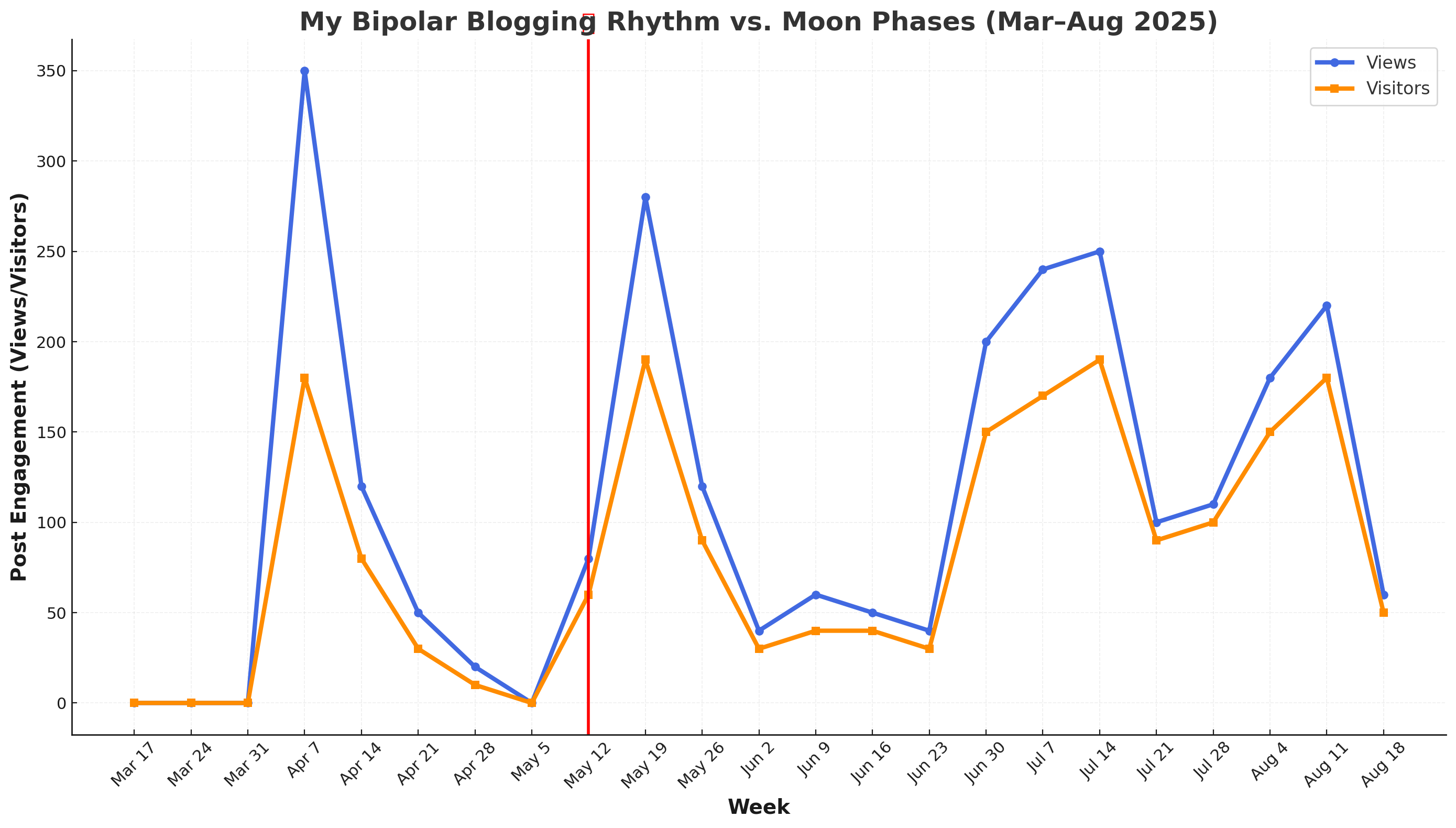
Looking back at my blog stats, I could already see the rhythm: a manic week means dozens of posts and ideas pouring out of me, followed by a valley of silence when depression hits. But then I overlaid the moon phases on top of my posting graph—and the pattern got eerie.
- April 7: A huge spike in posting just days before the April 13 full moon.
- May 19: Another surge right after the May 12 full moon.
- July 7–14: A manic burst that lined up almost perfectly with the July 10 full moon.
- August 11: Yet another spike, almost exactly on the August 9 full moon.
It’s not exact every time, but the trend is undeniable: the same energy that pulls the ocean seems to tug at my brain.
Science says the evidence is mixed. Some studies find no consistent lunar effect on bipolar, while others suggest that full moons can disrupt circadian rhythms—sleep, light exposure, the body’s clock—and bipolar is tightly wound up in circadian disruption. Whether it’s coincidence or not, my own lived data makes the connection hard to ignore.
Seeing it this way changes how I think about my illness. Instead of randomness, I see cycles. Instead of chaos, I see a pattern—tides that rise and fall, carrying me with them. It doesn’t make the mania easier, or the depression lighter. But it makes it less mysterious.
Blogging gave me a mirror, and the moon cast its light across it. Now, when I feel the rush of words coming, I look up. And when I see that bright disc in the sky, I know: the tide in me is turning.
 Frank M. Anderson's Writing
Leave a comment