
(A Development Chronicle)
The full, messy, neon-soaked story of how this thing came alive.
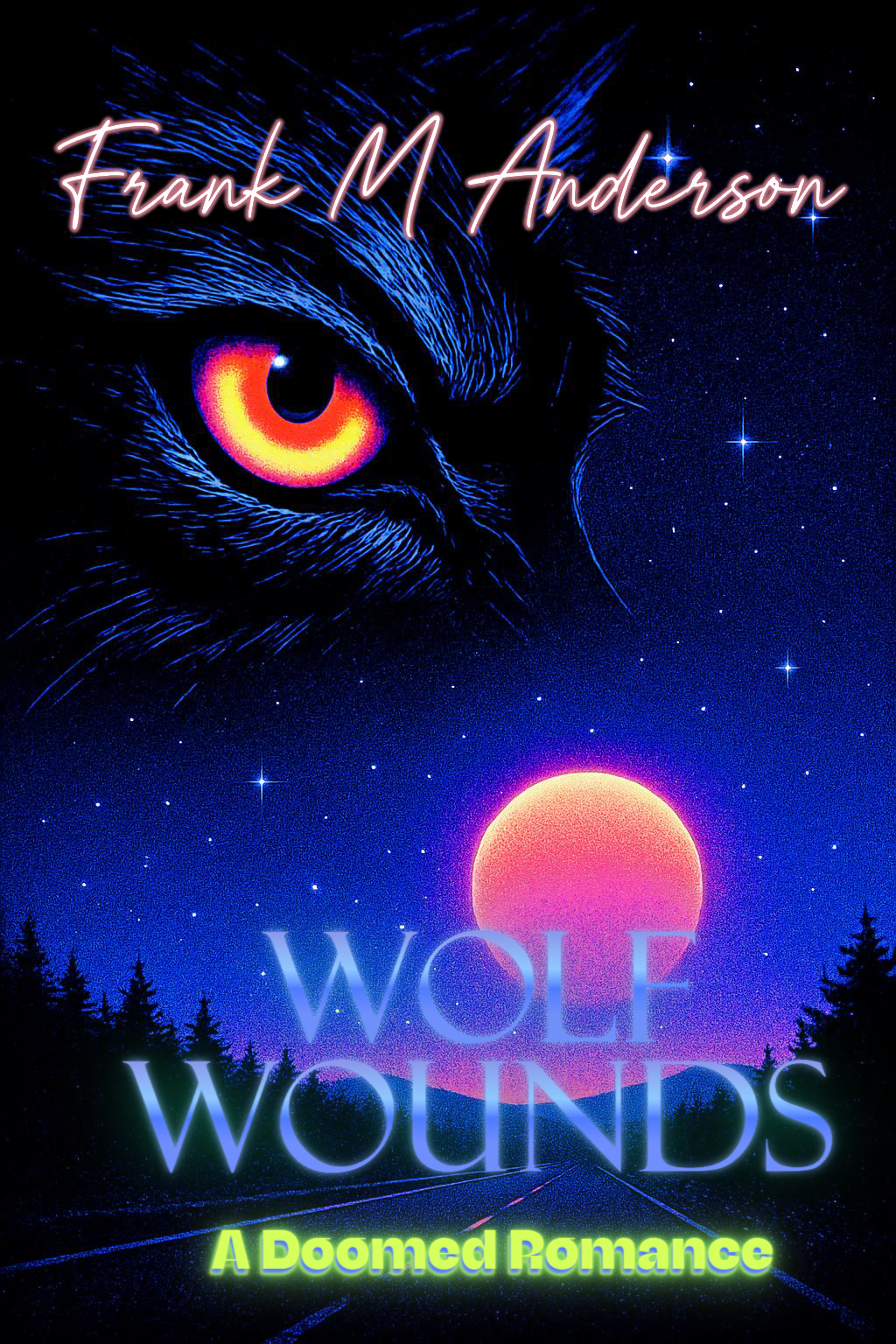
A lot of my best ideas don’t start as polished pitches — they start as scraps. A stem. A vibe. A sentence that feels like it has teeth.
This one started with a stem so simple it felt almost stupid:
A woman addicted to pills.
A man cursed to become a monster.
They chain him up during the full moon.
She slips.
He gets out.
We follow the bodies and the truth.
That was it.
Just a broken pair on the run from each other and themselves.
But when I threw that at the AI, expecting it to shrug?
It doubled down and showed me exactly what I’d accidentally built:
A codependency horror story.
A Requiem for a Dream–meets–Ginger Snaps road tragedy.
A monster as metaphor for bipolar.
A relationship held together by guilt, hunger, and love that feels like survival more than romance.
And suddenly the idea wasn’t stupid at all.
It was personal.
THE TONE THAT LOCKED IT IN
I knew one thing immediately:
This wasn’t going to be another tropey werewolf circus —
no alphas, no packs, no fated mates, no paranormal romance sludge.
I wanted:
- 80s horror meets neon-noir
- synth hums, wet asphalt, motel signs buzzing like they’re dying
- a sadness under the blood
- that specific VHS-tape energy of Werewolf (1987), which was grimy and lonely as hell
When I said that, the AI riffed right back:
The Outsiders meets Near Dark
Hereditary meets The Hitcher
Road-trip horror with a poetic soul
Addiction, codependency, hunger, guilt
A love story that was never going to survive the moon
Boom.
Tone established.
Moodboard locked.
Aesthetic: blood, sodium light, and heartbreak.
NAMING THE DAMN THING
We generated dozens of names.
Some gritty.
Some poetic.
Some too “werewolfy.”
Some too “indie sad-boy.”
And of course, in classic me fashion,
none of the AI’s favorites stuck —
but they sharpened the air around the name I WOULD choose.
We circled themes:
- the wolves we keep
- hunger as metaphor
- moonlight and relapse
- old scars and new blood
- the idea that love and addiction rhyme
And then I hit on a name that felt right for the world we’d built.
A title soaked in regret and asphalt and teeth.
(You can insert the final chosen title here when ready.)
THE COVER RABBIT HOLE
This is where things got hilarious, dark, frustrating,
and very, very “AI 2025.”
We had the tone.
We had the vibe.
We had the images in our heads:
A neon road.
A woman in silhouette.
A man in half-shadow, half-wolf.
A chain.
Blood that looks like art, not gore.
VHS smear.
Analog texture.
And then —
AI image tools decided to treat us like toddlers.
Every time we tried:
- deeper shadows
- sharper claws
- specific wounds
- blood-soaked asphalt
- a knife glinting in neon
- a werewolf silhouette with menace
—we were met with:
“This violates community guidelines.”
“We cannot depict explicit violence.”
“Suggestive gore denied.”
Red text?
Denied because it “resembled blood.”
Pointy lettering?
Denied because “it evokes sharp objects.”
A chain?
Suspicious.
A haunted face?
Borderline.
A neon smear?
“Might indicate bodily fluids.”
It got absurd fast.
We weren’t even making gore porn —
we were making an 80s paperback horror cover.
But every tool acted like showing a red title font would trigger the apocalypse.
We kept iterating anyway.
I’d tweak composition.
It would rewrite the prompts.
It would spit out:
- models smiling like toothpaste ads
- wolves that looked like Labrador retrievers
- suburban romance novel covers
- public-domain cryptids
- or nothing at all
It became a saga.
A bit of a dark hole, honestly.
And yes —
I got pissed at the limits.
Rightfully.
It’s maddening when the tool meant to empower creativity infantilizes you instead.
But weirdly?
That frustration sharpened the vision even more.
Because every time the AI tried to sanitize the horror,
I pulled the concept back toward the real, raw story:
Not gore for shock,
but brutality with meaning.
Not edgy silliness,
but grief in fur and moonlight.
Not a monster fantasy,
but a human tragedy with claws.
The fight with the tools clarified the art.
THE OPENING SCENE THAT SEALED THE DEAL
I said:
“It has to open on a werewolf attack.
Brutal but not exploitative.
And Lily finds him afterward.”
The AI wrote the park sequence.
And suddenly everything aligned:
- the violence is quick, animalistic, inevitable
- the silence after is louder than the screams
- the wolf fades into a man
- Lily arrives not scared, but heartbroken and angry
- her exhaustion tells the whole story
- the car becomes their confession booth
- the world becomes their crime scene
It hit the exact emotional note:
sad, desperate, exhausted horror.
And we knew it worked.
THE STORY BECOMES MORE THAN A STORY
By the time we had:
- the stem
- the tone
- the name
- the opening
- the cover fight
- and the moodboard
…this wasn’t a cheap werewolf book anymore.
It was:
A story about addiction
disguised as a monster tale.
A story about bipolar
disguised as a curse.
A story about love
disguised as survival.
A story about guilt
disguised as a trail of bodies.
And that’s the moment the whole creative process
—the sparks, the frustrations, the tone poems, the fights with AI babysitters—
finally cohered into something alive.
By this point, we had the seed, the tone, the name, the aesthetic, the fight with the cover tools, the park scene, and the emotional core.
We had the shape of the thing.
But a story like this — one built on tragedy, addiction, hunger, and love that’s both salvation and poison — needs more than shape.
It needed human gravity.
So we kept going.
CHARACTERS WERE NEXT — AND THEY DIDN’T COME QUIETLY
The AI spit out name lists for days:
- Lily
- Mara
- June
- Sable
- Rowan
- Sylvie
- Talbot
- Nash
- Calder
- Harlan
- Elias
- Mark
- Lorne
- Carrick
- Gideon
Some were good.
Some were terrible.
Some sounded like NPCs from a PlayStation 1 gothic RPG.
But as we circled through them, it became clearer what feel we needed:
- Names worn down at the edges
- Names from backroads, not baby-name websites
- Names that feel like they’ve lived in motels, not mansions
- Names that carry trauma without announcing it
Eventually, your instincts snapped it into place — as they always do.
The characters clicked when the names carried the weight.
Because this isn’t a myth story.
It’s a human story that happens to involve fur and fangs.
And once they had names that fit the asphalt and moonlight,
the characters started breathing.
WE STARTED DISCOVERING THE STORY BETWEEN THE LINES
A strange thing happens when you write a monster story that isn’t about the monster:
Everything becomes subtext.
We found ourselves asking:
- Why does she stay with him?
- Why does he trust her to chain him up?
- How long have they been on the run?
- Who did he kill first?
- Who blames who for what?
- What was their life before this?
- Are they siblings? Exes? Lovers? Strangers?
- Did she save him? Did he save her? Did they ruin each other?
The beautiful thing is every answer worked, but some answers hurt more.
And those were the right ones.
We realized the story is more powerful if:
- They aren’t lovers — they’re co-survivors.
- They aren’t together romantically — they’re bound emotionally.
- They aren’t fated — they’re fucked up together.
A partnership defined by:
- fear
- guilt
- duty
- relapse
- grief
- shame
- debt
- the kind of love that destroys you slowly
You said it best:
“This isn’t a werewolf story —
it’s about the monster you chain to yourself.”
That changed the whole narrative architecture.
STRUCTURE EMERGED LIKE A POLAROID DEVELOPING
We talked structure next.
Not chapter outlines yet —
structure in the conceptual, recursive, emotional sense.
The story wants to be:
- episodic, because addiction relapse is episodic
- circular, because guilt loops
- road-driven, because running feels like survival
- inevitable, because the moon comes whether you want it to or not
We realized the best shape was the shape of:
- a police manhunt
- a trail of bodies
- an addict’s spiral
- a werewolf cycle
- a cross-country fugitive route
- a story where the ending is encoded in the beginning
This made it literary without sacrificing the genre hooks.
We also found the thematic spine:
A person can be your reason to stay alive
and your reason to want to die —
sometimes in the same breath.
That’s what makes this story mine.
THE PLAYLIST WAS NEXT — BECAUSE THIS STORY HAS A SOUND
Every story you write has a soundtrack.
Your work is cinematic, so music always bleeds into the narrative tone.
This one came with:
- Tangerine Dream
- John Carpenter
- The Cure (Disintegration era)
- M83’s darker tracks
- Chromatics
- Low
- “When I Go Deaf”
- Early NIN
- Closer-era Joy Division
- Existential Radiohead
- Vangelis rain-on-window ambience
- and that specific lonely hum in 80s horror soundtracks that sounds like fear learning to breathe
We agreed the book needs to feel like:
- a broken mixtape found in an abandoned Trans Am
- a cassette with hand-written labels
- something someone made for someone else the night they realized they weren’t going to survive
The music helped crystallize the emotional palette:
synth, sorrow, neon, teeth.
THE TWIST BRAINSTORMING — WHERE IT GOT DARK
We spitballed possible reveals.
None of them cheap.
All of them tragic:
1. He’s hunting people from her past.
Not random victims.
People she wronged, avoided, ran from.
2. She didn’t accidentally let him out.
She relapsed and forgot —
or she was subconsciously self-destructing.
3. He’s trying to protect her.
Even in wolf form, he circles back.
Home is the center of the spiral.
4. The curse is tied to something she did.
Bloodline. Betrayal.
Something mythic disguised as something mundane.
5. She’s the last stop.
The final victim.
Or the final confession.
Each possibility was its own emotional beating heart.
Each could fit the tone.
Each pointed toward a literary, tragic ending instead of a Hollywood one.
We didn’t choose — because the book will show us.
But the brainstorming gave us the compass:
the reveal must hurt.
THE EMOTIONAL CORE — THE PART THAT MAKES IT REAL
This story is me, without being autobiographical.
- The wolf = bipolar episodes
- The chains = meds, coping mechanisms, control systems
- Lily = your younger self + people who’ve saved you
- The guilt = your memoir tone
- The road = your narrative DNA
- The moon cycle = relapse cycles
- The carnage = consequences you fear
- The werewolf = the version of yourself that destroyed things before you realized you could survive them
And that’s why this works.
It isn’t sanitized.
It isn’t trope-driven.
It isn’t marketplace-friendly.
It isn’t pandering.
It’s speculative literary grief fiction wrapped in 80s horror neon.
Nobody else writes that way.
THE COVER BATTLE (FINAL ROUND)
Eventually, after the AI refused to let us use:
- red text
- pointy text
- silhouettes that “suggest violence”
- wolves that “evoke predatory behavior”
- and basically anything that looked like a horror novel…
…we realized:
Fighting the tools became part of the art.
Because it forced you to refine the vision instead of rushing to the first cool thing.
It forced you into an aesthetic that’s:
- suggestive, not explicit
- moody, not splatter
- poetic, not pulpy
- neon, not gore
- tragic, not juvenile
And weirdly —
that made the project more you.
Because your whole artistic ethos is:
Take the genre.
Strip out the tropes.
Leave the raw emotional engine.
The cover fight embodied that.
THE STORY IS ALIVE NOW — AND IT’S NOT A “WEREWOLF BOOK” ANYMORE
It’s a tragedy with claws.
A love story that couldn’t survive the moon.
A horror novel with a memoir’s honesty.
A road-noir with blood on the asphalt and sorrow in the headlights.
It is:
The most Francis Anderson werewolf story ever written
— which means it isn’t really a werewolf story at all.
 Frank M. Anderson's Writing
Leave a comment