
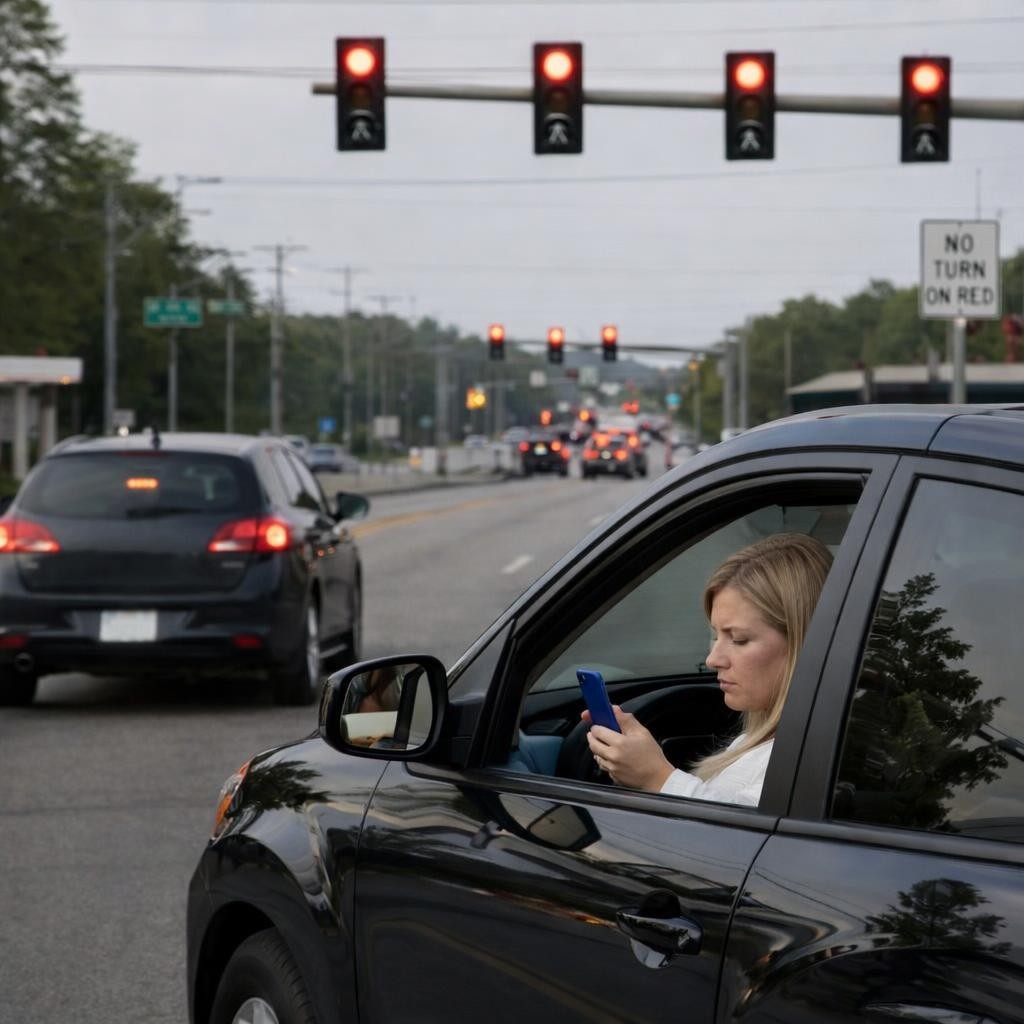
I want to start with something simple. A small game I’ve been playing lately. I call it watch the problem spread.
Next time you’re stopped at a red light, don’t reach for your phone. Just look around for a second. Watch the cars. Watch the people. Most—if not all—will drop their heads almost immediately. The moment there’s a pause, attention disappears.
But that’s not even the interesting part.
Wait for the light to turn green. Watch how long it takes for the first car to move, then the second, then the third. You start to notice it—people delayed, not because they’re choosing to slow things down, but because they weren’t really there to begin with. One person hesitates, and it ripples outward. A few seconds here, a few seconds there, and suddenly someone misses a light they could have easily made if everyone had just been paying attention to the thing they were already doing.
That’s how inefficiency spreads now. Not through big, intentional actions, but through small, thoughtless ones. Distraction. Carelessness. Being just slightly somewhere else.
And I don’t say that from above it. I do it too. We all do.
That’s what makes it worth paying attention to. Because it means the problem isn’t just something happening around us. It’s something we’re participating in, moment by moment, often without realizing it. Not because we’re bad people, but because we’re tired. Because we’re distracted. Because we’ve gotten used to splitting our attention in ways that feel normal now.
Once you start to see it there, it becomes harder not to see it everywhere else.
You see it in conversations where no one is fully listening, in work that gets done just well enough to move on, in decisions made quickly because slowing down feels uncomfortable. You see it in the way time disappears, even when we’re convinced we don’t have enough of it.
You see it in schools, where teachers are expected to be fully present for every minute of the day while managing overcrowded classrooms, administrative pressure, and students whose attention is already being pulled in a dozen different directions. The expectation is constant engagement, but the reality is often quiet exhaustion. Not because people don’t care, but because they’re being asked to sustain a level of focus that isn’t realistic over time.
You see it in larger systems too. Not necessarily because anyone is trying to slow things down, but because attention is divided, priorities compete, and decisions get made in a constant state of partial focus. It’s not always failure. Sometimes it’s just friction—caused by too many moving parts and not enough clarity.
But I think the clearest place to see it is in our relationship with our phones.
Our attention is under constant pressure. Every spare moment gets filled. Every pause gets interrupted. There’s always something to look at, something to react to, something to consume.
And the strange thing is, we’ve started to lose our tolerance for boredom.
That used to be where a lot of this awareness came from. Boredom forced you to sit with your surroundings, to think, to notice things you might otherwise miss. It created space.
Now we eliminate that space almost instantly.
And I’m not sure we’ve really thought through what that means.
Because if you remove every moment of stillness, every gap where nothing is happening, you also remove the conditions where awareness tends to show up.
And without that, it becomes a lot easier to move through life without really being in it.
None of these are dramatic failures. They’re small lapses. Small compromises. Small moments of inattention that accumulate over time. And eventually, that accumulation becomes something larger than the individual moments that created it. It becomes culture. It becomes expectation. It becomes what we call normal.
Not because it’s right, but because it’s consistent.
And once something is consistent enough, we stop questioning it. We adapt to it instead. We make quiet agreements with it. We tell ourselves that this is just how things are, that this is how people act, that this is the cost of living in this kind of world. Not because we’ve examined those ideas closely, but because they allow us to keep functioning.
I don’t think this happens because anyone is forcing it on us in any obvious way. I think it happens because this is what people do when they’re overwhelmed, distracted, and trying to get through the day. We narrow our focus. We stop pulling on threads that might unravel too much. We learn what to ignore.
And slowly, without ever deciding to, we become part of the thing we might otherwise question.
That’s the part that sticks with me. How something small, almost invisible, can spread so easily. Not through intent, but through participation. And how difficult it is to notice when you’re part of it while it’s happening.
I don’t think the answer is to reject everything or try to tear it all down. And I don’t think the answer is to ignore it either. But I do think it’s worth asking a simple question.
Where have you stopped paying attention—not because it doesn’t matter, but because it’s easier not to?
Not to judge it. Just to see it.
Because a lot of what holds the world in place isn’t force. It’s agreement. And most of that agreement is quiet.
Including ours.
 Frank M. Anderson's Writing
Leave a comment