
By Francis Anderson
When I think about how I became a writer, I don’t picture the usual origin scenes. I don’t picture myself reading The Chronicle of Narnia on my bedroom floor, or staying up late with Stephen King novels I was far too young to understand. I don’t even picture the first time a teacher told me I had talent, or the first time a stranger bought something I’d written.
Instead, I picture myself in a college creative writing class, turning in comics I drew with a cheap pen and absolutely no sense of shame.
They were weird, ridiculous things: upside-down pages, scribbled panels, earnest disasters dressed as superheroes, a wandering Eskimo who kept losing track of himself, and short strips literally labeled “FILLER.” Looking back, I’m amazed I turned them in at all. I must have believed my professor would “get it,” though I didn’t fully get it myself. I thought I was being clever. Maybe subversive. Maybe just lazy.
What I didn’t realize then was that those comics contained the earliest versions of the writer I am now. The themes I would later explore in memoir, satire, speculative fiction, and metaphysical narrative were all sitting there in black-and-white panels, waiting for me to grow into them.
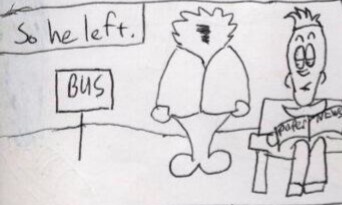
The first story was Oombier. He was an Eskimo, though there was nothing culturally Eskimo about him—I just liked the word. He wandered from place to place, confused, hopeful, asking questions he didn’t know how to phrase. He got caught up in situations he didn’t understand. He fell in love too quickly. He returned home too late. The only constant in his life was bewilderment.
At the time I thought I was writing something lighthearted and surreal. Now I see it for what it was: my first attempt to describe the way I moved through the world. I didn’t know I was writing a stand-in for myself. But of course I was. We’re always working on our autobiography long before we realize we’re writing it.
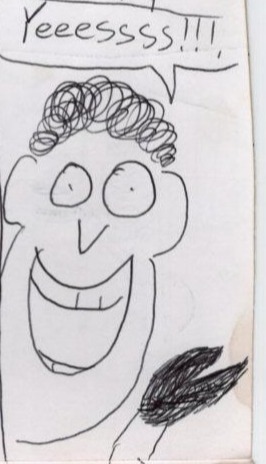
Then there was the Clawed Crusader. If Oombier was the wandering inner child, the Crusader was the performance mask I wore when I didn’t know who I was supposed to be. He was a superhero who shouldn’t have been anywhere near danger, responsibility, or even a locked closet. He was overeager, oblivious, convinced of his destiny in a way that was both touching and deeply unsafe.
When terrorists took hostages and demanded him of all people, he puffed out his chest and proudly marched to the scene—only to immediately detonate the bomb he had been told not to touch. The comic ends with the kind of abrupt, exhausted finality that only a young writer can deliver: “THE END (Thank God!).”
I laugh at it now, but it’s a knowing laugh. Because the Crusader wasn’t far from who I was becoming—someone who cared too much, tried too hard, and believed he could fix things he didn’t fully understand. Someone who mistook enthusiasm for ability. Someone who wanted desperately to be a hero, even if he couldn’t articulate what he hoped to save.
Somewhere between those two characters—Oombier with his lost innocence and the Crusader with his overgrown confidence—I started to recognize parts of myself I wouldn’t learn to name until much later.
But the comic that truly surprises me in hindsight is No Justice! At the time, it felt like just another assignment. A dimensional experiment gone wrong, a strange entity called “the Phantom,” a room full of exhausted scientists arguing over data that didn’t make sense. The humor was still there, but it sat under something heavier. Something more serious. The story wasn’t just strange—it was skeptical. It was afraid.
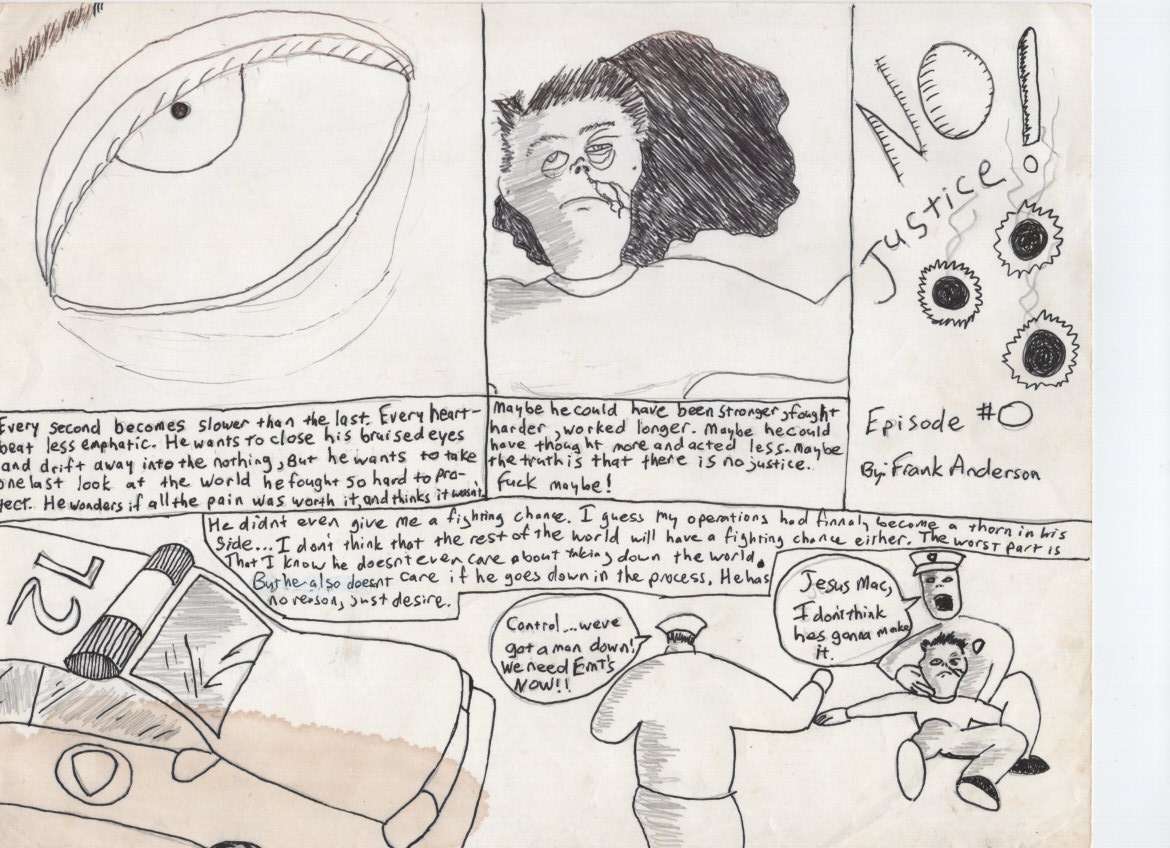
That comic was the first time my writing stepped into the territory that would later define books like The Cancer Diet and Grammar for the Dead: the intersection where human error meets cosmic mystery, where the systems we trust crumble under pressure, where the truth is both bigger and darker than we want to believe. It was my first time saying, even in miniature, that the world is frightening not because of monsters, but because of the people in charge of containing them.
And then, of course, there were the “SHORTS,” the supposedly throwaway pages. Tiny comics about identity, confusion, drunken bravado, shifting body shapes, and philosophical questions asked purely for the sake of spiraling into nonsense. One strip asked, “What came first: Oom Beer or Oombier?” and then immediately dismissed the question with “Who cares?” At the time it was a joke. Later, it would become the foundation of my recursive writing style—the idea that the question matters more than the answer, and sometimes the question is its own punchline.
Those small, self-aware gags were my first experiments with breaking the fourth wall, with letting the narrator intrude, with acknowledging the machinery of storytelling itself. Everything I later did with metafiction, everything I built into my mirror-logic novels, began there in the margins, with a Sharpie and a shrug.
What strikes me most when I revisit these comics is not how much I’ve changed, but how much I haven’t. The voice I thought I discovered in my thirties was already present in my twenties—awkward, raw, unpolished, but unmistakably mine. The same blend of sincerity and absurdity. The same longing wrapped in humor. The same interest in systems that fail and characters who fail harder. The same instinct to let the joke carry the pain, and let the pain deepen the joke.
These weren’t doodles. They were early drafts of the writer I would become.
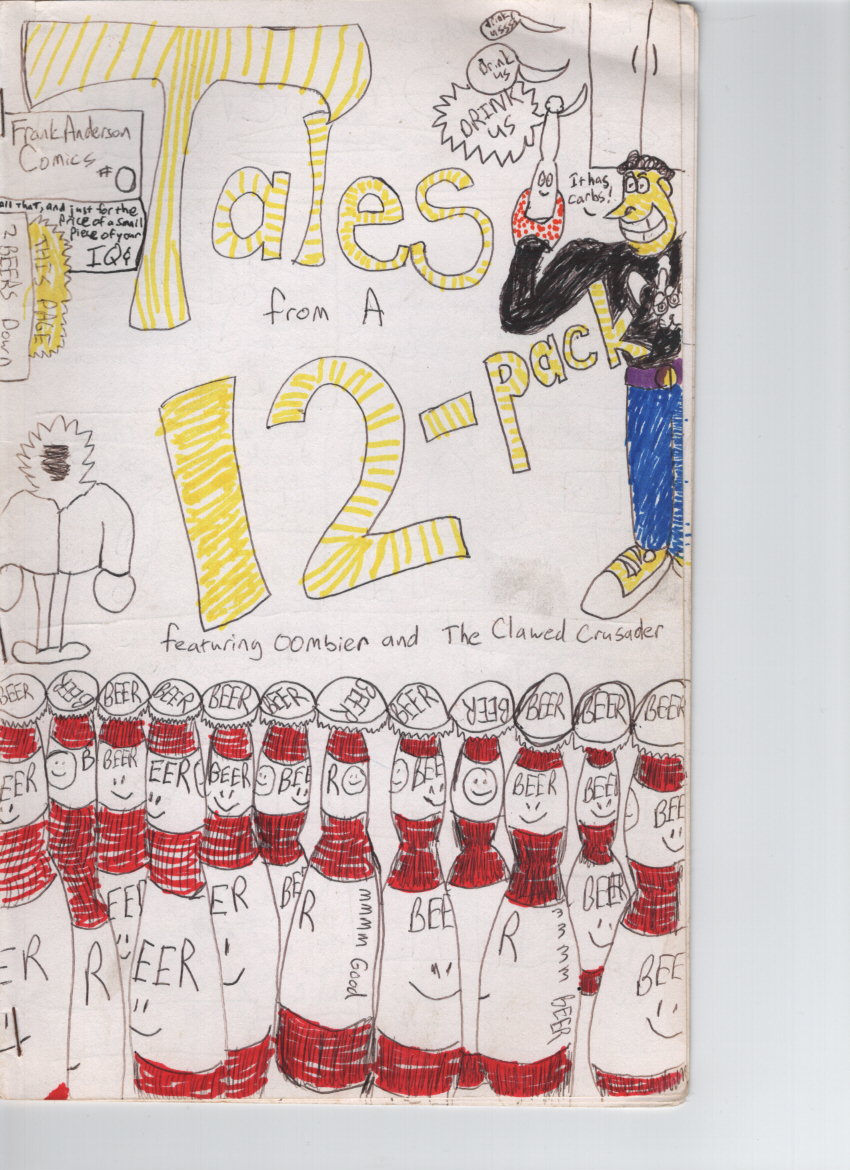
And maybe that’s the real lesson: your first stories aren’t warm-ups. They’re not disposable. They’re glimpses of your eventual self. Even the silly ones. Maybe especially the silly ones. The things we create before we know who we are often reveal more truth than the things we make once we’ve learned to be “serious.”
When I look at those pages now, I don’t see a college student phoning in assignments. I see a young man already wrestling with identity, justice, absurdity, collapse, sincerity, belonging, and the unstoppable desire to make sense of a world that refuses to sit still long enough to be understood. I see the ghosts of every book I would later write.
I see the beginning.
 Frank M. Anderson's Writing
Leave a comment