
Fair question.
Most people assume it began the day my brother died and I was diagnosed with cancer.
That’s not entirely true.
Those events forced me to finish it, but the process started decades earlier. I’ve been doing some version of this my entire life—usually without naming it.
It began with one of the first stories I ever wrote after reading Stephen King’s The Dark Half. I put myself in it: a mutative alligator in Australia, a baby snatched from a crib, devastated parents. That clumsy attempt cracked something open.
After that came notebooks, college comic strips, destroyed manuscripts, floppy disks, hard drives, and countless unfinished ideas—proof that the same quiet habit kept running in the background.
I loved Choose Your Own Adventure books for the branching, the loops, and the second chances.
Then Stephen King gave me the Tower.
Not because of Roland or the gunslingers, but because the destination was visible from the start. Everything bent toward it. Every detour mattered because there was something at the center creating gravity.
That idea stayed with me.
Every story has a destination.
Tom Sawyer wants adventure and eventually a way home.
Odysseus wants Ithaca.
Frodo wants Mount Doom.
Whether the destination is a place, a person, an answer, or a realization, something has to pull the story forward.
What fascinated me wasn’t the Tower itself.
It was the gravity.
The idea that a story, a world, or even a life could organize itself around a question that refuses to let go.
Over time the Spire became my own center point—not a copy of King’s Tower, but the axis around which my questions organized themselves: grief, memory, identity, addiction, family, love, loss, survival.
Eventually the Spire stopped being a setting.
It became the center of everything.
For years I understood the Axis before I understood the Fulcrum.
The White Room and the Spire appeared early. Even before I knew what they meant, I knew they were important. I knew there was a center. A destination. Something everything else seemed to orbit.
The Fulcrum came later.
Over time I realized the stories weren’t really about reaching the center. They were about balance. About the tension between preserving things and participating in life. Between memory and movement. Between holding on and letting go.
That’s ultimately where Fulcrum & Axis came from.
The Axis is the center line—the thing everything bends around.
The Fulcrum is the point where weight shifts, balance changes, and motion becomes possible.
It took me years to understand that I wasn’t building a world around a tower.
I was building a world around that tension.
Decades later, after experimenting with AI in my business, I became curious about what it might do in a creative process. I fed my first novel, Empire Nevada, into the experiment. At first I used it lightly—editing, refining, learning as I went—always trying to stay close to my original voice and intent.
That happened around the same time I was writing The Cancer Diet, my more direct attempt at telling my story, though “direct” has never really been my brain’s preferred operating system.
I’ve always been the kind of person who overthinks everything.
I replay conversations.
I imagine alternate outcomes.
I wonder how things might have gone differently.
I create stories and worlds and characters to examine ideas I can’t approach directly.
Decade after decade, the same impulse kept returning.
Stories written, abandoned, rewritten.
The same questions asked in different costumes.
Fiction became both scalpel and shelter.
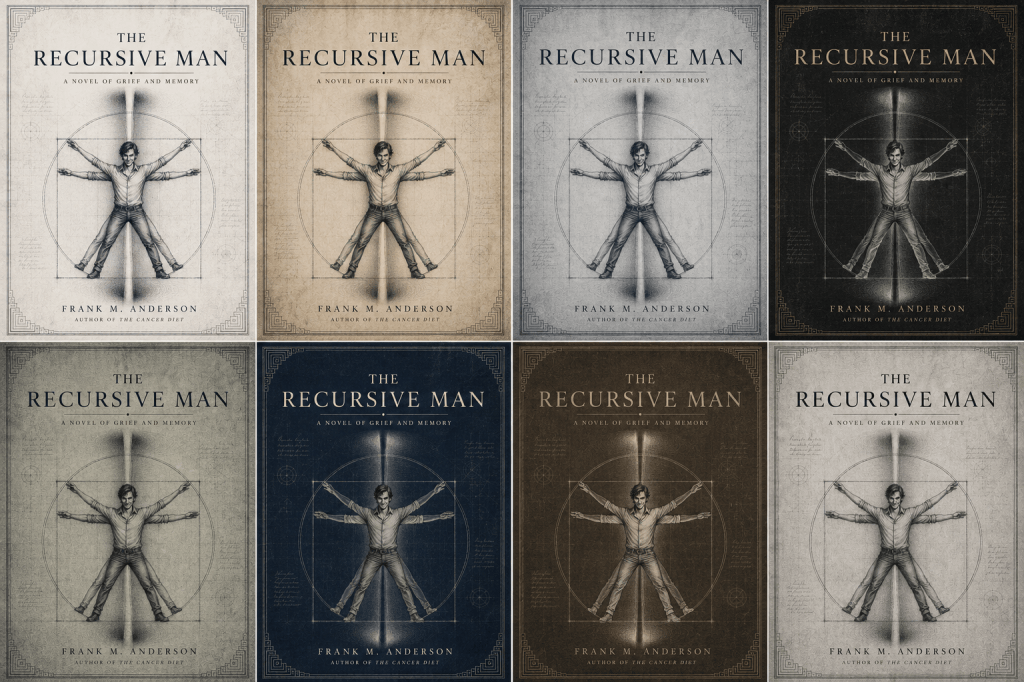
The Recursive Man is what happened when all those separate, repeated efforts finally became aware of each other.
At its core, the book is about grief, memory, identity, addiction, mental illness, family, love, loss, and survival.
But it isn’t a traditional memoir because none of those experiences ever felt linear to me.
Grief circles.
Memory folds back on itself.
Recovery loops.
You tell yourself the same story over and over until one day you realize you’re telling it differently—and that you’ve been doing exactly that for years.
So instead of writing a straightforward memoir, I built a machine that could hold the repetition.
Inside that machine are places that are fictional but emotionally real:
The White Room — where I went when I didn’t know how to keep living.
The Archive — where I tried to save everything because I was terrified of losing it.
The Valley — where life actually happens.
The Spire — the thing that connects them all, and the thing I’ve been climbing, in one form or another, my entire life.
The deeper I went, the more I realized I’d been writing versions of myself for years.
Paul from Empire Nevada.
Caldwell.
Frank.
The Woman.
Ollie.
Even characters who don’t look or sound anything like me.
They’re not literally me.
They’re different angles on the same unresolved questions.
What if this had gone differently?
What if I let go?
What if I couldn’t?
What if the person I think I am isn’t the whole story?
The deeper I got into The Recursive Man, the more I realized the book wasn’t simply about grief.
It was about why I’ve spent my life quietly repeating this process in the first place.
Building stories as tools.
As experiments.
As ways of surviving.
AI became another layer in that long habit—not a replacement for the work, but another way to explore the branches I’d always been drawn toward.
In some ways, The Recursive Man is less a single novel than an archaeology of its own long creation.
It digs through earlier versions of myself, earlier stories, earlier attempts to solve the same problems, many of which I never finished or never recognized as part of the same effort.
So what is The Recursive Man?
Part memoir.
Part literary fiction.
Part philosophy.
Part metafiction.
Part emotional archaeology.
Part weird recursive tower built out of decades of the same unspoken habit.
Or, if you prefer the short version:
A guy spends most of his life overthinking everything, quietly repeating the same strange ritual of building worlds to understand his own—from childhood Choose Your Own Adventure books to notebooks to AI-assisted drafts—until one day the worlds become aware of each other.
He climbs inside the machine he’s been building his entire life and discovers that all the stories, all the worlds, and all the versions of himself were never attempts to escape reality.
They were attempts to return to it differently.
 Frank M. Anderson's Writing
Leave a comment