
Archive Edition • Studio Edition • Gallery Edition • Museum Edition
“Listen to them—the children of the night. What music they make!”
— Count Dracula, Bram Stoker’s Dracula
A Portrait of the Man Who Gave the Vampire Immortality
Bram Stoker did not invent the vampire.
He created the vampire the world would never forget.
Count Dracula emerged from centuries of folklore, earlier Gothic fiction, historical research, theatrical experience, and Stoker’s own imagination. The result was a character who became larger than his novel, larger than his creator, and eventually one of the most recognizable figures in world culture.
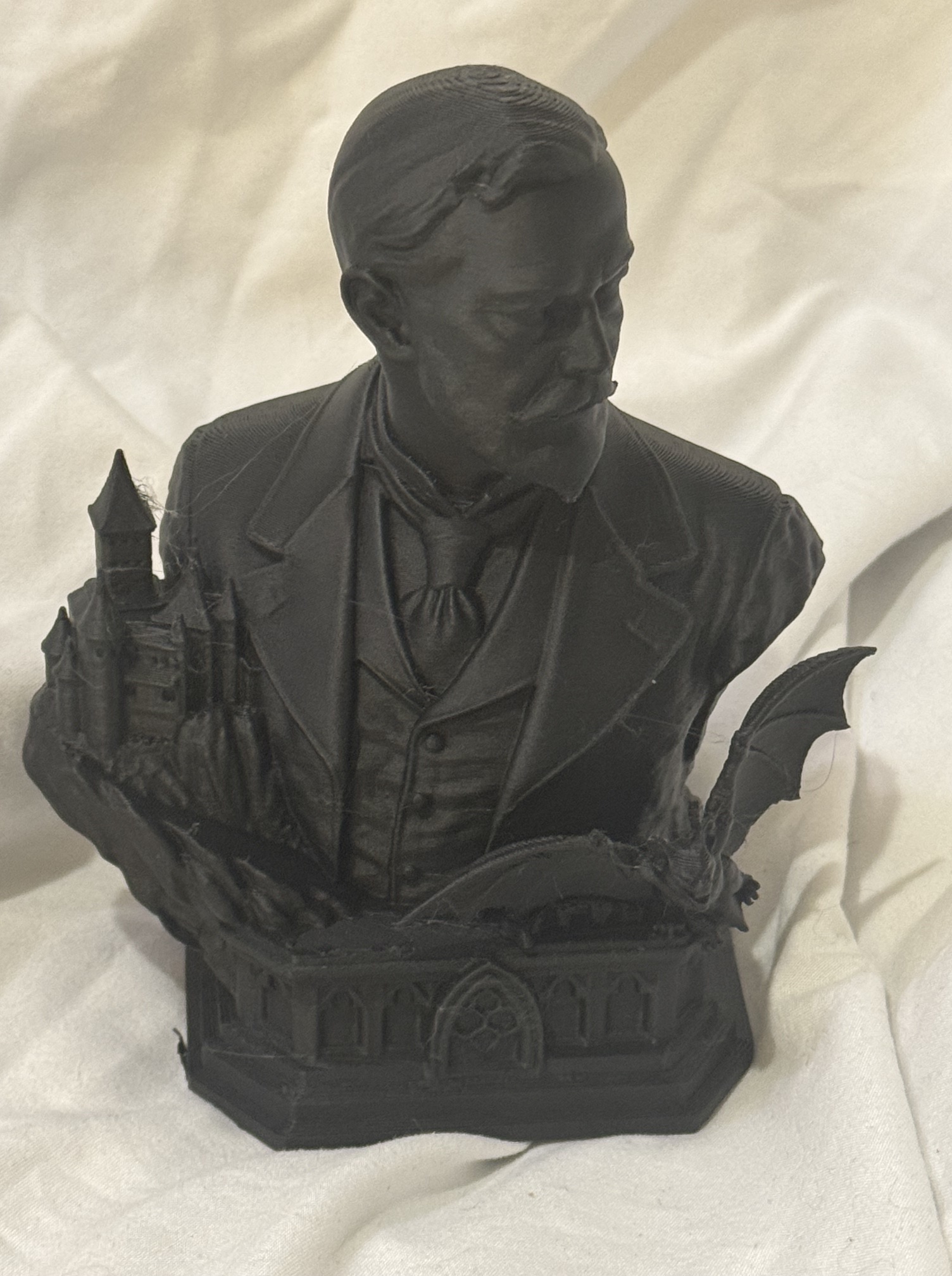
This Fulcrum & Axis Studio portrait presents Stoker as a dignified Victorian gentleman surrounded by the nightmare he released.
A dark Gothic castle rises beside his left shoulder. On the opposite side, a winged creature crouches against the base, one great membranous wing climbing toward Stoker’s right shoulder. A second sweeping wing or cape-like form stretches across the foreground. Beneath the entire composition, pointed arches, recessed openings, columns, and a central circular window create a cathedral-like architectural foundation.
Stoker remains composed at the center.
He does not recoil from the supernatural world gathering around him. His head turns slightly downward, his expression controlled and contemplative. The castle and creature appear to have emerged from the same darkness beneath him—as though the physical world of Dracula has risen around its creator.
The sculpture does not reproduce one exact scene from the novel.
The castle is not presented as a literal reconstruction of Dracula’s Transylvanian home, and the winged creature is deliberately more monstrous than an ordinary bat. Instead, the composition combines recognizable Gothic symbols connected to the novel, its immortal antagonist, and the vast cultural afterlife that followed.
The castle represents the world Stoker built.
The winged creature represents the supernatural force he released into it.
The architectural base represents the Gothic tradition from which the novel emerged.
Stoker stands between them as the disciplined human imagination capable of making the impossible feel terrifyingly real.
This portrait was developed for The Archive of the Great & Famous as a physical interpretation of the Irish writer whose work transformed the vampire into one of modern culture’s most enduring monsters.
The Story Within the Sculpture
Every element contributes to the portrait of a respectable Victorian professional surrounded by the darkness his imagination brought into the world.
The Portrait
Bram Stoker occupies the upper center of the sculpture.
His carefully arranged hair, mustache, formal coat, layered waistcoat, high collar, necktie, and broad shoulders identify him as a nineteenth-century gentleman.
Nothing about his appearance is openly monstrous.
That contrast is essential to the design.
Stoker spent most of his adult life working within the demanding practical world of theatrical management. He handled correspondence, finances, publicity, schedules, rehearsals, tours, guests, and the countless daily problems required to operate one of London’s most important theaters.
Yet this organized professional created a novel filled with blood-drinking aristocrats, undead women, wolves, living shadows, opened graves, hypnotic influence, unnatural storms, and a dead captain lashed to the wheel of a drifting ship.
The sculpture places those two identities together.
At the center stands the disciplined professional.
Around him rises the nightmare.
Stoker’s portrait is deliberately larger than the supernatural elements surrounding it. Dracula may have become more famous than his creator, but here the author returns to the center of his own story.
The castle and winged creature belong to his imagination.
He does not belong to theirs.
The Turned Head and Downward Gaze
Stoker’s head turns slightly to one side while his gaze angles downward.
This prevents the portrait from feeling like a stiff, forward-facing monument. He appears absorbed in thought, as though considering something just outside the viewer’s sight.
His restraint contrasts sharply with the dramatic imagery below.
The castle rises in narrow, irregular forms. The winged creature appears tense and capable of movement. The foreground sweeps outward in powerful curves. Stoker alone remains still.
That stillness reflects the narrative method of Dracula.
The novel presents extraordinary events through journals, letters, telegrams, newspaper reports, medical notes, ship logs, memoranda, and phonograph recordings. Impossible experiences are documented in a practical, often factual manner.
The characters may be terrified, but they understand that survival depends upon observation. They must record what they have seen, compare accounts, recognize patterns, and assemble scattered fragments into a complete picture.
Stoker’s expression suggests the intelligence organizing those fragments.
He appears less like a frightened witness than the unseen mind arranging every clue.
The Formal Victorian Clothing
Stoker wears a tailored coat over a buttoned waistcoat, shirt, high collar, and neatly tied cravat or necktie.
The layered clothing gives the portrait visual richness while grounding the supernatural composition in a recognizable historical world.
Stoker is not dressed as Dracula.
He has no cape, fangs, predatory expression, or aristocratic costume. He remains visibly human and professionally respectable.
This separation matters because popular culture has often allowed Count Dracula to eclipse the man who created him. Millions recognize the vampire immediately while knowing little about the Irish civil servant, critic, athlete, theater manager, and working writer responsible for the novel.
The sculpture restores Stoker’s identity.
Dracula’s world surrounds him, but it does not replace him.
The clothing also connects the portrait to Stoker’s theatrical life. As business manager of the Lyceum Theatre, he worked closely with the celebrated actor Henry Irving and gained an intimate understanding of how atmosphere is created.
A frightening scene does not depend upon a monster alone.
It depends upon lighting, scenery, costume, movement, timing, silence, sound, entrances, exits, and the careful control of what an audience is permitted to see.
Those lessons became part of Stoker’s fiction.
The Castle
A miniature Gothic castle rises beside Stoker’s left shoulder.
Its narrow towers, steep roofs, crowded walls, and shadowed openings immediately evoke Dracula’s isolated home in the Carpathian Mountains.
In the novel’s opening chapters, the young solicitor Jonathan Harker travels eastward to assist Count Dracula with the purchase of English property. He arrives at an ancient castle surrounded by darkness, mountains, forests, wolves, and unfamiliar customs.
At first, Dracula behaves like a courteous aristocratic host.
Gradually, Harker realizes that there are no servants, many doors are locked, his host casts no reflection, and the castle is not a place of hospitality but a prison.
The building therefore represents one of the novel’s central tensions: the contrast between outward refinement and concealed danger.
Dracula possesses education, wealth, authority, and formal manners. Beneath those civilized surfaces is something ancient, predatory, and inhuman.
The sculpture’s castle should not be interpreted as a literal reconstruction of Stoker’s description. Its architecture is an artistic concentration of Gothic ideas rather than a diagram of one fictional building.
It represents isolation, imprisonment, hidden history, inherited power, and the terrible realization that a place of apparent shelter may actually belong to the thing hunting you.
The Towers
The castle’s towers rise in sharp, irregular forms.
Their vertical silhouette contrasts with the broad, controlled structure of Stoker’s shoulders and clothing. The portrait belongs to the respectable nineteenth-century world, while the towers introduce something older and less stable.
Towers can represent power, protection, surveillance, and separation.
From such a structure, Dracula remains elevated above the surrounding landscape and removed from ordinary human society. His castle protects his secrets while trapping anyone unfortunate enough to enter.
The pointed forms may also suggest fangs rising beside the author.
This visual resemblance connects Dracula to his home. The castle is not merely a location occupied by the Count. It becomes a physical expression of him—ancient, aristocratic, isolated, decaying, and filled with hidden chambers.
Placed beside Stoker, it also represents the act of creating a fictional world.
Stoker constructed his Transylvania through research, folklore, maps, histories, travel writing, and imagination. He never needed to imprison himself inside an actual Carpathian fortress to make generations of readers feel that they had entered one.
The Winged Creature
A large winged creature occupies the opposite side of the sculpture.
It crouches low beside the base while one pointed, membranous wing rises toward Stoker’s shoulder. Another broad wing or cape-like form sweeps across the foreground, creating a curved boundary between the portrait and its architectural foundation.
The creature clearly belongs to the visual language of bats, gargoyles, dragons, and Gothic monsters without becoming an exact representation of any one of them.
That ambiguity is intentional.
Within Dracula, the Count can cross boundaries that ordinary human beings cannot. He moves between aristocrat and predator, life and death, human and animal, physical body and supernatural force.
A large bat repeatedly appears near Lucy Westenra’s window, and the Count is associated with the ability to take batlike form. The bat became even more closely connected to Dracula through later theatrical, cinematic, and artistic adaptations.
The sculpture expands that familiar symbol into something more imposing.
This is not merely a natural animal flying through the night. It is vampirism made physical—the lurking predator, the supernatural presence, and the enormous cultural creature that grew from Stoker’s original novel.
The Raised Wing
The creature’s raised wing forms one of the sculpture’s strongest silhouettes.
Its membrane stretches between pointed supports, creating a shape immediately associated with nocturnal flight. The wing rises behind the creature as though it may open farther at any moment.
That suggestion of movement represents the extraordinary life of Dracula after publication.
Stoker contained the Count within one novel, but the character could not remain there.
Dracula moved into theater, silent film, Hollywood cinema, television, radio, comics, games, advertising, music, comedy, Halloween traditions, and thousands of later stories.
Each generation changed him.
He became a decaying corpse, a seductive aristocrat, a tragic lover, a supernatural warlord, a comic figure, an action villain, and the model from which countless later vampires descended.
The raised wing captures that movement away from the original text.
Stoker remains beside his creation, but the creature is already preparing to fly beyond him.
The Sweeping Foreground Form
A second winglike or cape-like form crosses the front of the sculpture.
Rather than rising vertically, it sweeps outward in a broad curve. This lower form helps connect the creature to the castle and draws both supernatural elements into a single landscape.
Its exact identity remains open to interpretation.
It may be read as the creature’s extended wing, the edge of a vast cape, or darkness itself unfolding across the base.
That uncertainty suits Dracula.
The Count repeatedly resists fixed form. He can appear old or young, aristocratic or animalistic, solid or insubstantial. He belongs to the physical world while violating its rules.
The sweeping form therefore represents transformation.
It also creates the impression that the supernatural world is spreading outward from the center of the sculpture. The darkness has not remained confined to the castle. It has begun to cross the boundary into the viewer’s space.
The Gothic Architectural Base
The entire composition rests upon a base of pointed arches, recessed openings, columns, and repeating stonework.
Its central circular design resembles a Gothic window surrounded by smaller architectural forms.
The base may recall a cathedral, crypt, castle, monastery, or ruined abbey. It does not reproduce one specific building. Instead, it establishes the visual world of Gothic literature beneath the portrait.
Gothic stories repeatedly return to ancient structures, hidden histories, forbidden rooms, supernatural visitations, threatened identities, inherited guilt, and the fear that modern civilization has not escaped the past.
That conflict is central to Dracula.
The novel’s characters inhabit a rapidly changing nineteenth-century world of railways, telegrams, typewriters, phonographs, medical specialists, blood transfusions, and organized recordkeeping.
They use those technologies to gather information and coordinate their pursuit.
Yet technology alone cannot explain or defeat Dracula.
The hunters must combine modern knowledge with folklore, religious objects, old traditions, and beliefs that respectable society might dismiss as superstition.
The base represents that buried past.
Modern life may rise above it, but it has not made the darkness disappear.
The Central Circular Window
A circular Gothic window occupies the front center of the base.
Its shape recalls the tracery of a cathedral’s rose window, but it can also be interpreted as an eye watching from beneath the portrait.
This double meaning is especially appropriate for Dracula.
The novel is built from acts of observation. Characters write down what they have seen, preserve letters, collect newspaper reports, transcribe recordings, compare schedules, and study the movements of people and ships.
No one character possesses the entire story.
Only by bringing their separate records together can they understand the danger confronting them.
The window therefore represents both faith and evidence.
Its cathedral-like design evokes the sacred objects and religious traditions used against Dracula. Its eye-like form evokes the careful observation required to recognize the predator hiding behind a civilized appearance.
The Author Between Castle and Creature
Stoker occupies the central space between the castle and the winged monster.
His position makes him the boundary between architecture and movement, respectability and horror, history and imagination.
On one side stands the castle: ancient, solid, isolated, and apparently permanent.
On the other is the winged creature: mobile, unstable, transformative, and capable of escape.
Stoker joins them through story.
He gave Dracula a home, a history, a voice, a destination, and a group of people determined to resist him. He transformed folklore and earlier vampire literature into a modern narrative assembled from documents, testimony, research, technology, and fear.
The sculpture does not portray Stoker holding a book.
It does not need to.
The castle, creature, wings, arches, and windows have become his book. The story has risen around him until the author, the novel, and its immortal antagonist appear inseparable.
Night and Darkness
The castle, creature, wings, arches, and recessed openings create a world that seems to belong entirely to the night.
Night in Dracula is more than the absence of daylight.
It is the period in which certainty weakens.
Familiar places become difficult to navigate. Mist conceals movement. Ordinary animals behave strangely. Dreams may be supernatural attacks. The boundary between sleeping and waking becomes unreliable.
Dracula gains freedom after sunset, while the people hunting him become increasingly uncertain of what they have witnessed.
Daylight restores visibility, but not complete safety. The characters must use those temporary hours to study evidence, protect one another, and prepare for the next night.
The dark forms surrounding Stoker honor that cycle of fear and investigation.
Every sunset feels like a closing door.
Every sunrise feels temporarily earned.
Blood and Immortality
The sculpture contains no visible wound or literal stream of blood, yet blood remains present through the imagery of Dracula.
Within the novel, blood represents life, inheritance, sexuality, illness, contamination, sacrifice, kinship, and power.
Dracula survives by taking life from others. His victims weaken while he becomes stronger and younger. Blood transfusions are used in desperate attempts to save Lucy, combining modern medicine with a threat science initially cannot recognize.
The novel repeatedly asks what it means for one being to continue existing through the stolen vitality of another.
That question connects vampirism to immortality.
Dracula fears destruction, but his endless existence is not truly life. He remains trapped within hunger, repetition, secrecy, violence, and the soil of his homeland.
Stoker achieved a different kind of immortality.
He died in 1912, but his creation continues to enter new places, assume new forms, and feed the imaginations of later generations.
The Complete Composition
The sculpture joins a formal portrait of Bram Stoker with symbols drawn from Dracula and the larger Gothic tradition.
The carefully arranged hair, facial features, formal coat, waistcoat, collar, and tie restore the writer to the center of his creation.
The turned head and restrained expression represent observation, organization, and the controlled narrative method through which Stoker made supernatural events feel believable.
The castle represents isolation, imprisonment, concealed horror, and the fictional world he constructed.
The towers suggest power, surveillance, separation, and the fangs of the vampire who inhabits them.
The winged creature represents Dracula’s supernatural transformations and the larger cultural monster that escaped the boundaries of the novel.
The raised wing suggests movement into theater, film, television, art, and popular culture.
The sweeping foreground form represents transformation and darkness spreading beyond the castle.
The Gothic base connects the portrait to a literary tradition filled with ancient buildings, hidden histories, threatened identities, and the return of a past that modern society believed it had overcome.
The circular window represents faith, evidence, observation, and the attempt to see a complete pattern within scattered fragments.
Together, these elements create a portrait of a disciplined professional surrounded by one of literature’s greatest nightmares.
Bram Stoker stands at the center.
The castle rises.
The creature opens its wings.
The invitation has already been given.
About Bram Stoker
Abraham “Bram” Stoker was born in Clontarf, near Dublin, on November 8, 1847, and died in London on April 20, 1912.
He was an Irish novelist, short-story writer, theater critic, civil servant, and theatrical manager whose Dracula became one of the most influential works of Gothic fiction ever published.
Childhood and Recovery
Stoker spent much of his early childhood seriously ill and largely confined to bed.
During those years, he listened to stories told by his mother, Charlotte Thornley Stoker. Her memories and stories drew upon Irish history, folklore, famine, disease, and the cholera epidemic she had experienced as a child in Sligo.
The precise relationship between those childhood stories and Stoker’s later fiction cannot be measured, but they placed the supernatural beside the historical and the horrifying beside the believable.
Stoker eventually recovered.
The sickly child grew into a physically imposing young man and accomplished athlete.
Trinity College Dublin
Stoker entered Trinity College Dublin in 1864.
He participated actively in university athletics and won recognition in events including weightlifting, race walking, gymnastics, and jumping. In 1867, he was named Dublin University Athletic Sports Champion.
He was also deeply involved in Trinity’s debating and intellectual societies, serving as Auditor of the College Historical Society and President of the University Philosophical Society.
These activities developed skills that would follow him throughout his life: organization, argument, public presentation, criticism, and the ability to hold an audience’s attention.
Civil Service and Theater Criticism
After completing his degree, Stoker followed his father into the Irish civil service.
He worked in the administration of the Petty Sessions courts and eventually wrote The Duties of Clerks of Petty Sessions in Ireland, a serious professional manual far removed from the supernatural fiction for which he later became famous.
At the same time, he wrote fiction and reviewed theatrical productions for the Dublin Evening Mail.
His work as an unpaid theater critic changed the direction of his life.
After reviewing the celebrated actor Henry Irving in Hamlet, Stoker met Irving and developed a close professional and personal relationship with him.
In 1878, Irving invited Stoker to become business manager of London’s Lyceum Theatre.
Shortly before moving to London, Stoker married Florence Balcombe. They later had one son, Irving Noel Thornley Stoker.
The Lyceum Theatre
Managing the Lyceum became the principal work of Stoker’s adult life.
His responsibilities extended far beyond ordinary office management. He coordinated productions, correspondence, finances, publicity, local performances, and extensive international tours.
The position brought him into contact with prominent writers, politicians, artists, and public figures.
More importantly for his fiction, the Lyceum gave Stoker an intimate understanding of theatrical atmosphere.
He observed how scenery, lighting, costume, sound, silence, movement, timing, and an actor’s physical presence could control an audience’s emotions.
Dracula repeatedly uses those lessons.
The Count appears and disappears with extraordinary timing. Doors open into unexpected spaces. Storms announce arrivals. Wolves howl beyond the walls. Mist conceals movement. Characters reach rooms moments too late to prevent disaster.
Dracula himself possesses the presence of a great performer.
He can appear courteous, commanding, furious, seductive, ancient, or unexpectedly young. He assumes whatever identity allows him to approach his prey.
The Creation of Dracula
Stoker began developing the story that became Dracula around 1890 and continued researching and refining it while managing the Lyceum.
The manuscript was originally called The Un-Dead, and the vampire was at one stage named Count Wampyr.
During a visit to Whitby, Stoker encountered the name “Dracula” in his research and recognized its dramatic power.
Whitby itself entered the novel.
Its harbor, steep streets, ruined abbey, churchyard, storms, maritime history, and view across the sea helped shape the section in which Dracula arrives in England aboard the doomed Demeter.
Stoker assembled his Transylvanian setting through maps, histories, folklore, travel writing, and library research.
That method resembles the structure of the finished novel: fragments of information gathered from different sources until they form a convincing whole.
Dracula
Dracula was published in 1897.
The novel begins with Jonathan Harker traveling to Count Dracula’s castle to assist with the purchase of English property. Harker gradually discovers that his host is an undead predator and that he has become a prisoner.
Dracula later travels to England, where he attacks Lucy Westenra and turns his attention toward Mina Harker.
A group led by Professor Abraham Van Helsing eventually recognizes what they are confronting. The hunters combine medical knowledge, technology, religious objects, folklore, careful recordkeeping, and personal courage in their attempt to destroy the Count.
The novel is written primarily through journals, letters, telegrams, newspaper reports, ship logs, memoranda, and phonograph recordings.
This structure gives the impossible events an unusual sense of reality.
Readers do not receive a single all-knowing account. They examine evidence gathered by frightened people whose knowledge remains incomplete.
The method also reflects Stoker’s professional life. A theater manager accustomed to schedules, correspondence, records, travel arrangements, and coordinating many people constructed his great supernatural novel from organized documents.
The Vampire Before Dracula
Stoker did not invent the vampire.
Vampire traditions existed in folklore long before his birth, and important vampire fiction appeared before Dracula. Earlier works included John Polidori’s “The Vampyre” and Sheridan Le Fanu’s Carmilla.
Stoker’s achievement was the creation of an extraordinarily adaptable version of the vampire.
His Count combines the ancient and the modern.
Dracula is a feudal aristocrat who inhabits a decaying castle, commands wolves, changes form, and sleeps in native earth. Yet he also studies modern England, purchases property, uses lawyers and transportation networks, reads contemporary materials, and plans his movement carefully.
He is both a remnant of the past and a predator learning how to exploit the modern world.
Dracula After Stoker
Stage adaptations helped carry Dracula beyond the novel after Stoker’s death.
Film transformed the character again, particularly through Bela Lugosi’s performance in the 1931 Universal production. Later actors, writers, directors, illustrators, and game designers continued to reinvent him.
Many features now associated with Dracula—the sweeping cape, formal evening clothes, exotic accent, romantic seduction, and aristocratic elegance—were strengthened or created by theatrical and cinematic interpretations.
Stoker’s original Count is stranger and more disturbing.
When Jonathan Harker first meets him, Dracula appears elderly and possesses a long white mustache, sharp nails, hairy palms, extraordinary strength, and the ability to grow younger through blood.
The difference between Stoker’s Count and later versions demonstrates the adaptability of the character.
Dracula can change his appearance, setting, motivation, and meaning while remaining recognizable. He has been interpreted through fears involving disease, sexuality, aristocratic exploitation, foreign invasion, addiction, aging, contagion, forbidden desire, and death.
Each generation discovers something new upon which the vampire can feed.
Stoker’s Other Work
Stoker continued writing beyond Dracula.
His other books include The Snake’s Pass, The Mystery of the Sea, The Jewel of Seven Stars, The Man, The Lady of the Shroud, and The Lair of the White Worm.
He also wrote short Gothic fiction, including “The Judge’s House,” and published the two-volume Personal Reminiscences of Henry Irving after Irving’s death.
During Stoker’s lifetime, his association with Irving and the Lyceum remained central to his public identity.
History ultimately remembered him for the vampire.
Why Bram Stoker Belongs in the Archive
Fame tells us that Bram Stoker is remembered.
Greatness asks us why.
Bram Stoker belongs in The Archive of the Great & Famous because he transformed existing traditions into one of the most adaptable and enduring characters in world culture.
He did not create the first vampire.
He created a vampire capable of surviving change.
Dracula can move between folklore and modernity, horror and romance, literature and theater, terror and comedy, the ancient castle and the contemporary city.
Stoker constructed his novel with the discipline of a theater manager and the imagination of a Gothic storyteller. He assembled journals, letters, newspaper reports, medical records, ship logs, and recordings into a narrative that asks readers to examine supernatural events as evidence.
He understood that horror becomes more powerful when the impossible is placed inside a recognizable world.
His monster endures because it can carry different fears.
Dracula represents death that refuses to remain buried, power sustained by consuming others, the past invading the present, and the terror of losing control over one’s body, identity, and will.
He is also an example of what happens when a creation grows beyond its creator.
The popular Dracula no longer belongs entirely to Bram Stoker. Theater, cinema, television, illustration, games, and generations of other writers transformed the Count into something no single novel could contain.
The winged creature within the sculpture represents that escape.
Stoker stands beside it, calm and unmistakably human, while the vast cultural monster prepares to take flight.
Bram Stoker belongs in the Archive because he gave the vampire its most enduring invitation into the modern world.
More than a century after his death, the castle doors remain open.
The wings continue to beat against the night.
Count Dracula is still searching for someone willing to invite him inside.
Crafted by Fulcrum & Axis Studio
This portrait is available in all four standard editions:
Archive • Studio • Gallery • Museum
Fulcrum & Axis Studio uses digital design tools and precision 3D-printing technology to bring each portrait into physical form. Every sculpture is produced, individually inspected, finished, labeled, and packaged in our Greenville, South Carolina studio.
Each Bram Stoker portrait includes:
- Durable PLA construction
- Individual print-quality inspection
- Protective felt bottom
- Fulcrum & Axis Studio collection label
- Informational collector’s sheet
- An explanation of the sculpture’s symbolism
- Protective packaging for storage, gifting, or shipment
Each piece is produced in small batches or printed to order rather than mass-produced.
Part of The Archive of the Great & Famous
The Archive of the Great & Famous is Fulcrum & Axis Studio’s expanding collection of sculptural portraits honoring the writers, thinkers, artists, and historical figures whose lives, work, and ideas became larger than a single lifetime.
Each portrait combines a recognizable figure with symbols connected to the subject’s history, imagination, achievements, and influence—creating something that is part portrait, part biography, and part physical storytelling.
Bram Stoker is one of the inaugural Series One figures in the collection.
Contact Fulcrum & Axis Studio for current availability, ordering information, or the complete Archive catalog.
 Frank M. Anderson's Writing
Leave a comment