
If you’re new here, a quick introduction probably helps.
I’m Francis Anderson. I’m a writer, a father, a lifelong Greenville, South Carolina native, and, at forty-seven, a graduate student studying marriage and family therapy.
That last part has done something unexpected to my writing.
I went back to school because I want to become a therapist. Instead, or maybe in addition, I have found myself sitting in classrooms learning words for patterns I have spent most of my life writing around without knowing what they were called.
Family systems. Attachment. Shame. Negative cycles. Repair. Narrative. Circular causality. Cultural context. Protective behaviors.
I keep sitting there thinking some version of:
Well, shit. I know this one.
Not because I already knew the theory.
Because I lived the story.
And that has turned into the book I’m working on now.
For a while, I called it The Swerve: Returning to Life Differently.
That may still be part of the title.
But another title has recently come crashing through the front door:
Another Day Stuck in Bullshit City
And that probably requires some explanation.
What the Book Is
This is a memoir, but I don’t think it’s going to be a conventional memoir anymore.
I’m going back through my life—childhood, adoption, family, my brother Gregg, school, college, relationships, drugs and alcohol, writing, marriage, fatherhood, teaching, mental illness, divorce, recovery, cancer, grief, and now therapy school.
But I’m doing something else at the same time.
I’m asking:
What patterns kept repeating?
What did I learn early that continued operating long after the original situation disappeared?
What behaviors helped me survive one period of my life and then became liabilities in another?
What stories did I tell myself about who I was?
Which of those stories were true?
Which were bullshit?
Which were true but incomplete?
And most importantly:
What happens when you finally recognize that you are approaching the same intersection again?
That is where The Swerve comes from.
A swerve isn’t blowing up your life because you’re uncomfortable.
It isn’t impulsivity.
It isn’t running away.
It’s noticing that the familiar path keeps taking you somewhere you don’t want to go and asking whether there is another responsible move available.
Sometimes it’s leaving.
Sometimes it’s staying.
Sometimes it’s shutting the fuck up long enough to actually hear what somebody else is saying.
Sometimes it’s asking for help.
Sometimes it’s accepting something that cannot be fixed.
Sometimes it’s just doing one small thing differently and seeing what happens next.
I’m still figuring that idea out.
That’s part of the book too.
Then I Found an Old Notebook
A few days ago, I found a journal from June 2003.
I had more or less decided that this was one of the periods in my life when I wasn’t really writing.
Then I opened the notebook.
Apparently I was completely full of shit.
I was writing everywhere.
Lyrics.
Fragments.
Drawings.
Philosophy.
Profanity.
Arguments with myself.
Arrows pointing to nowhere.
Circles drawn hard enough that I can almost feel my younger hand pressing into the paper.
And then I found this:
“People underestimate the importance of keeping record, be it in songwriting, painting, or really in any form. It is quite important to have evidence that you were.”
Twenty-three years later, I was sitting there trying to reconstruct the life of the guy who wrote that sentence.
That one got me.
Because this entire project has become an archaeological dig through myself.
I’ve found old emails.
Old books.
Old songs.
Old journals.
Photographs.
Letters.
Teaching materials I thought I had deleted.
Things other people saved that I threw away.
And I’ve realized something embarrassingly simple:
Save your shit.
Save the stupid poem.
Save the terrible story.
Save the photograph, but write down who’s in the damn photograph.
Save the email.
Save the lesson plan.
Save the notebook you’re certain nobody will ever care about.
Because someday the person who cares may be you.
Where AI Comes Into This
This is also where my writing process gets weird.
I use AI constantly while I’m working on this book.
And I know people have strong opinions about that.
So do I.
But I’m not sitting down and typing:
“Write me a memoir.”
What would be the fun in that?
Instead, I talk.
A lot.
I remember something.
Then I remember something that contradicts it.
Then I find an old email that proves both memories were slightly wrong.
Then I tell ChatGPT to go through the hundreds of pages we’ve already accumulated and figure out where this new piece belongs.
Sometimes I’ll dictate for an hour.
Sometimes I’ll upload an old document.
Sometimes I’ll say:
“Okay, don’t write this yet. Just capture everything because I don’t want to lose it.”
Sometimes the AI notices that something I just said in 2026 sounds remarkably similar to something I wrote in 2003.
And I get to have the uncomfortable experience of realizing that twenty-three-year-old me and forty-seven-year-old me are apparently still sharing office space.
AI has become less of a ghostwriter and more of a combination of:
research assistant,
archivist,
editor,
conversation partner,
index,
and occasionally the annoying bastard who reminds me that I’ve already told the same story four times.
The life is mine.
The memories are mine.
The old writing is mine.
The embarrassing shit is definitely mine.
The meaning is ultimately mine to decide.
But AI gives me a way to put enormous amounts of material beside each other and ask:
Do you see anything here that I don’t?
That is fascinating to me.
Which Brings Me to the Covers
Because apparently writing the actual book wasn’t enough to occupy me.
I started playing with covers.
The first concept was for The Swerve.
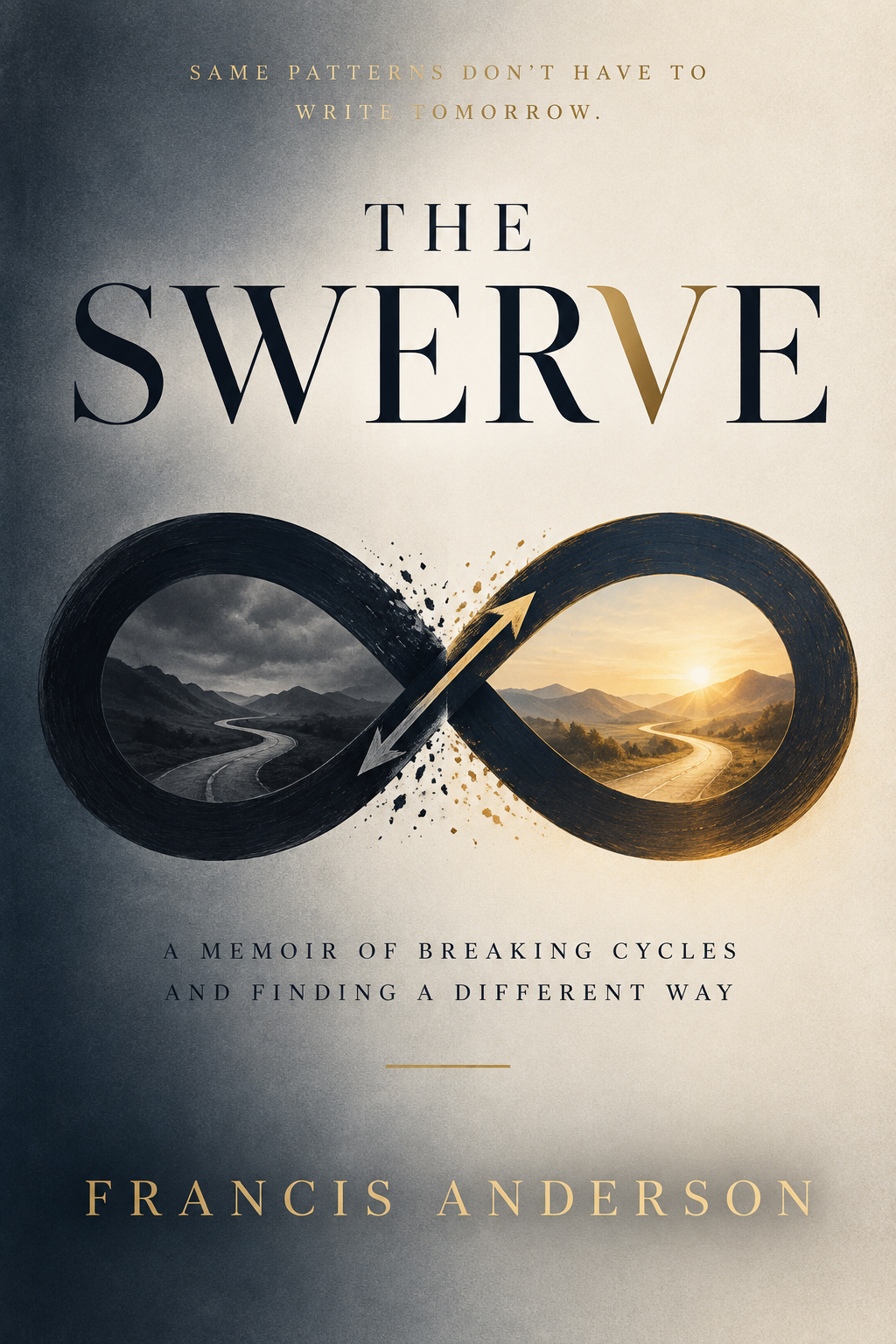
It was elegant.
An infinity-shaped road.
One side dark and stormy.
One side opening toward light.
The idea of repeating patterns with the possibility of another direction.
Very respectable.
Very therapy-adjacent.
The kind of cover that says:
This man has reflected on his life and would like to share some thoughtful observations with you.
Then came:
ANOTHER DAY STUCK IN BULLSHIT CITY
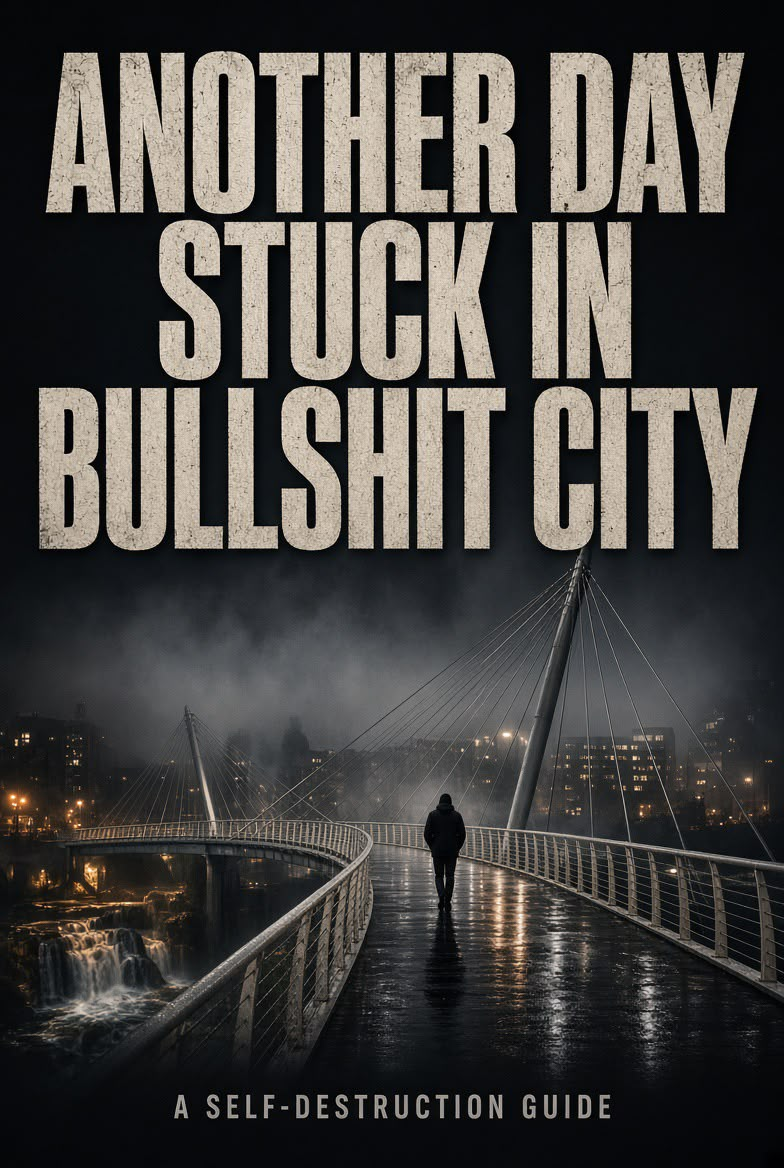
Huge distressed letters.
Dark Greenville.
Rain.
The Liberty Bridge.
A solitary figure walking through it.
And because I knew it was only a mock-up, I put this underneath:
A SELF-DESTRUCTION GUIDE
Which made me laugh way too hard.
Obviously that isn’t the actual subtitle.
Probably.
But the second cover had something the first one didn’t.
It had my voice.
The Swerve explained the idea.
Bullshit City felt like the guy telling you the story.
So then I started doing what I always do.
I iterated the hell out of it.
What if the Bullshit City cover were ripped open and The Swerve were underneath?
We tried it.
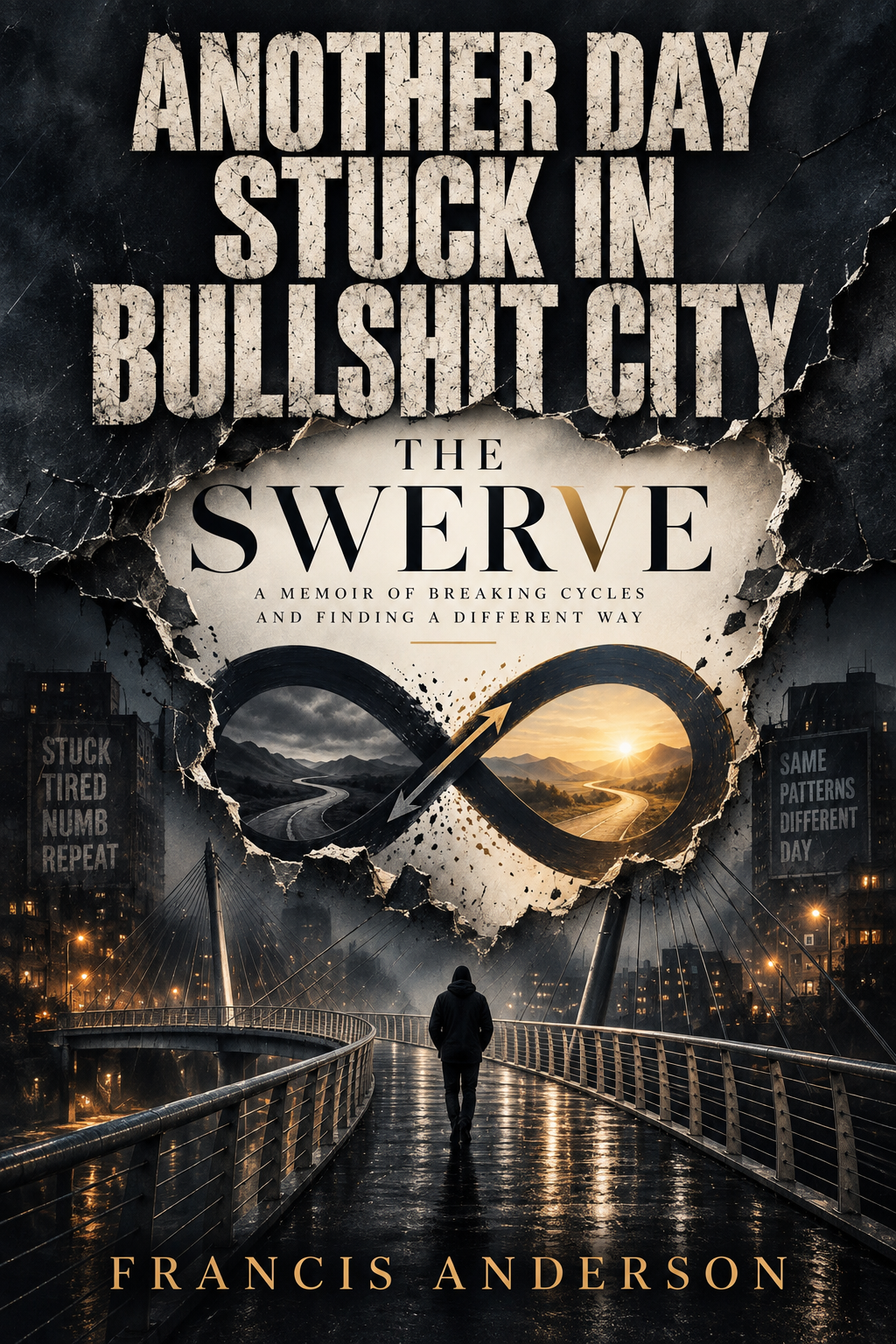
It looked fucking insane.
There were torn layers, the bridge, the city, the infinity symbol, darkness, sunlight, arrows, cracks, roads, probably the entire history of Western symbolism crammed onto one book cover.
And I kind of loved it.
It was also clearly too much.
So we tried again.
Cleaner.
Then again.
Cleaner still.
And somewhere in all of that visual messing around, I realized that the two titles may not actually be competing.
They may describe the two halves of the book.
Another Day Stuck in Bullshit City is the memoir.
The Swerve is what I am learning from it.
One is the voice.
The other is the framework.
One says:
Here we fucking are again.
The other asks:
Do we have to keep going this way?
This Is the Part I’m Loving
That’s what has been so much fun about this entire process.
It isn’t linear.
I’m not sitting alone trying to remember my life in chronological order.
I’m talking to old versions of myself.
I’m reading things I forgot I wrote.
I’m learning therapy theories that suddenly illuminate experiences from thirty years ago.
I’m discovering where those theories don’t fit too.
I’m changing my mind.
I’m correcting the record.
I’m recovering joy that got buried underneath the endings.
I’m looking at relationships I once reduced to their worst moments and remembering there were beautiful years inside them too.
I’m looking at things I once called failures and realizing some of them were adaptations.
I’m also looking at things I once defended as adaptations and admitting that eventually they became destructive.
And I’m doing all of this while bouncing ideas between notebooks, old files, my own memory, school, AI, visual design, and whatever occurs to me at 11:30 at night when I really should go to bed.
It is a profoundly hybrid process.
Human memory.
Old-fashioned journals.
Graduate school.
Therapeutic theory.
Digital archives.
Artificial intelligence.
Photography.
Graphic design.
Twenty-three-year-old Frank.
Forty-seven-year-old Frank.
And whoever Frank is going to be when this damn thing is finally finished.
I don’t know exactly what the finished book will look like yet.
That used to bother me.
It doesn’t much anymore.
Because perhaps that’s the point.
I don’t need to know exactly where the road ends.
I need to keep paying attention to where I’m going.
And right now?
I’m having a great fucking time.


Leave a comment