
Welcome to Seen / Unseen Greenville
This blog will still have all kinds of posts. Politics, family, recovery, culture, whatever life puts in front of me. That part isn’t changing.
But I wanted to mark a new direction I’m excited about.
I’ve lived in Greenville most of my life, and like a lot of people, I knew the version of the city right in front of me without always knowing how it got here. The more I look, the more I realize Greenville is layered, complicated, beautiful, ambitious, wounded, proud, and constantly reinventing itself.
So this will be the start of Seen / Unseen Greenville — recurring posts about the city’s history, culture, politics, growth, bright spots, blind spots, and the stories beneath the polished surface.
Some posts will celebrate what Greenville gets right. Some will question what it misses. Some will simply explore.
I’m not coming at this as a historian with all the answers. I’m coming at it as someone from here who wants to learn more, think more honestly, and maybe help others do the same.
Greenville is a great town.
It’s also a real town.
That’s where things get interesting.
One thing I keep learning as I dig into Greenville history is that this city has never really been one thing for very long. We talk now like Greenville simply arrived as this polished little success story with waterfalls, restaurants, and lists calling it one of the best small cities in America. But that version of Greenville is just the latest draft.
Before it was Greenville, this land was Cherokee hunting ground. Then it became frontier trading land around Richard Pearis and the Reedy River. Even in the beginning, this area was about movement, exchange, and opportunity more than some sleepy fixed identity.
After the Revolution, Greenville became more of a courthouse town. Practical, regional, still rough around the edges. A place where people came to settle business, move goods, and build something new. It was less a city than a useful center.
Then came one of the first big reinventions. In the early 1800s, Greenville started becoming a resort town. Wealthier people from hotter lowcountry areas came up here in summer for cooler air, river picnics, mountain trips, boarding houses, and social life. Greenville was once a getaway town before it was a destination city.
By the 1850s, it was shifting again. Schools and colleges gave it a more intellectual reputation. Furman University moved here. Commerce expanded. Railroads connected the town more deeply to the state. Greenville was becoming a serious Upstate center, not just a seasonal retreat.
After the Civil War and Reconstruction, Greenville entered another phase. Like much of the South, it had to rebuild, redefine labor, and navigate the enormous moral and political upheaval of emancipation. Black churches, schools, and civic life expanded even while backlash and inequality remained. The city itself was formally chartered in 1869.
Then came perhaps the most defining Greenville reinvention: the mill era.
Textiles changed everything. Population surged. Mill villages formed. Workers poured in. Wealth accumulated. Greenville became an industrial town and eventually branded itself the Textile Center of the South. Much of modern Greenville’s wealth, structure, and power traces back to that era, even if we don’t always talk about it directly.
The early 1900s and World War I pushed Greenville further into modern city status. Camp Sevier brought soldiers and money. Downtown grew upward and outward. Hotels, department stores, theaters, and business blocks rose. Greenville was no longer trying to be a town. It was trying to be a city.
Then Greenville faced what many American cities faced: decline, sprawl, and identity drift.
The Depression hit hard. Later, suburban shopping centers, highways, and outward growth drained energy from downtown. Buildings were torn down in the name of modernization. Older structures were covered up, removed, or neglected. There was a period where downtown Greenville was not the obvious jewel people now imagine.
Then came the modern comeback.
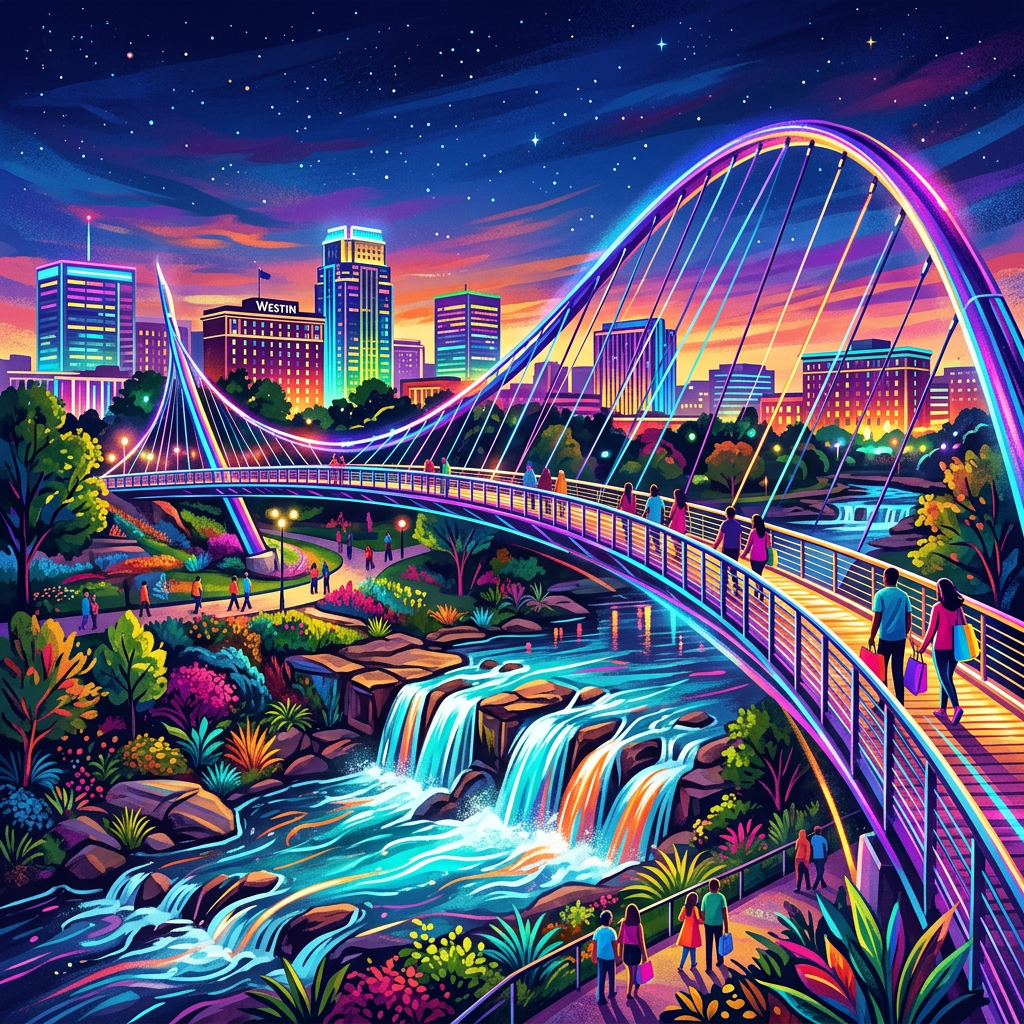
Beginning in the late twentieth century, Greenville reinvented itself yet again through streetscape improvements, private investment, public planning, hotels, parks, and eventually the version we know now: walkable downtown, Falls Park, restaurants, events, trails, tourism, and national praise. Falls Park on the Reedy is now symbolic of the city, but it sits in a place shaped by many previous Greenvilles. (Wikipedia)
That may be the real story of Greenville.
Not textiles. Not charm. Not conservative values. Not food. Not growth.
Reinvention.
Greenville has repeatedly looked at changing times and tried to become something else. Sometimes it worked beautifully. Sometimes it came with loss, exclusion, demolition, or forgetting.
That’s why current debates here matter. We are not preserving some static old Greenville. We are always choosing the next one.
Maybe the question is not whether Greenville should change.
It always has.
The real question is who benefits from the next version, what gets lost, and whether we can remember enough of the older versions to build something wiser.
Source: https://content.civicplus.com/api/assets/ce070f63-c669-4da5-ae45-d0f76cb35ec6
Want to Explore Greenville History Further?
If this piece interests you, here are a few places worth clicking through:
- Falls Park History (City of Greenville) – How the Reedy River falls became the symbolic center of modern Greenville.
- Visit Greenville History Overview – A broad intro to Greenville’s development through the centuries.
- South Carolina Encyclopedia: Greenville – A concise historical reference entry on the city.
- Vardry McBee Biography – The businessman often called the father of Greenville.
- Falls Park on the Reedy Overview – The story of Greenville’s signature park and downtown revival.
- Poinsett Hotel History – A look at one of downtown Greenville’s iconic historic buildings.
- Friends of the Reedy River: River History – The environmental story behind the river that helped shape the city.

 Frank M. Anderson's Writing
Leave a comment