
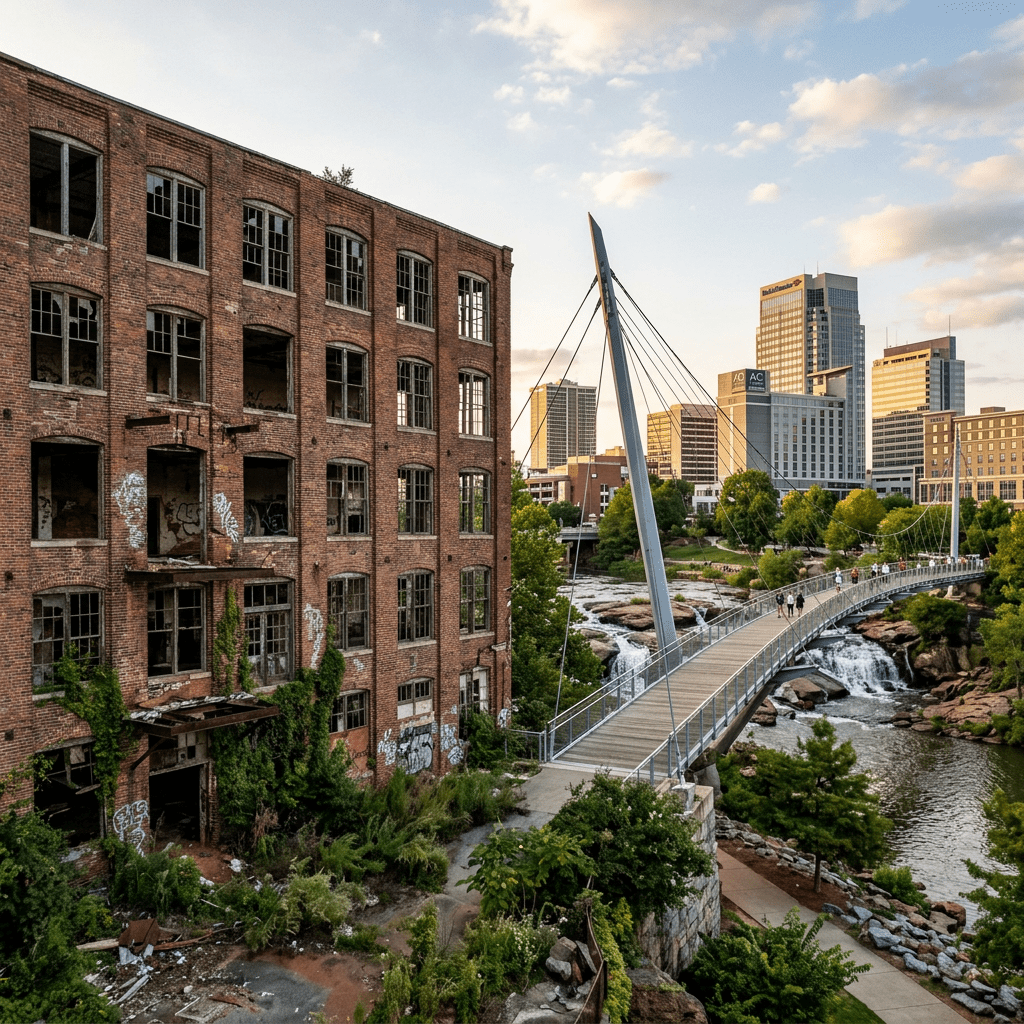
Lately, as I drive around Greenville and through other parts of South Carolina, I keep returning to a question that became much more personal after my own attempt to open a coffee shop:
What do we actually want these empty places to become?
That question sounds simple until you try to build something yourself.
From the outside, vacant lots and unused buildings often look like obvious opportunities. People drive by and think, Why doesn’t someone do something there? I used to think that too. Then I got a closer look at what it actually takes.
It takes money. Real money.
It takes investors willing to risk loss. It takes architects, permits, legal work, construction costs, changing timelines, city processes, utilities, staffing plans, equipment, insurance, and endless unknowns. It takes patience. It takes luck. It takes the ability to absorb delays without falling apart.
And after learning more about that world, I now look at empty buildings differently.
Many of them are not empty because nobody cares.
They are empty because making something work is hard.
The Pleasant Roast Lesson
When I was working to open Pleasant Roast, I learned quickly that ideas alone are not enough. Passion is not enough. Even community support is not enough.
A business has to function.
The numbers have to make sense. The site has to make sense. Access has to make sense. The city has to allow it. Investors have to stay steady. Costs have to stay within reason. The concept has to match how people actually live.
That last part matters more than many people admit.
People often say they want charming local business, unique concepts, neighborhood gathering spots, and independent coffee shops. And many do. But they also want convenience. They want speed. They want easy access. They want to get in and out on the way to work, school, or errands.
That is where the conversation around drive-thrus gets interesting.
Greenville and the Drive-Thru Problem
Greenville, especially in its more image-conscious areas, often seems deeply resistant to drive-thrus.
I understand why.
Drive-thrus can create traffic backups. They can look ugly. They can feel suburban and low-rent compared to the polished version of urbanism many leaders want to project. They can clash with walkability goals. Nearby neighborhoods may reasonably worry about noise and congestion.
Those are legitimate concerns.
But drive-thrus are also one of the clearest examples of a business model aligned with how many people actually live here.
This is still a car-heavy region. Many people commute. Many families juggle school drop-offs, jobs, appointments, and long drives. A fast coffee run or quick breakfast stop fits real life better than an idealized planning document.
When cities reject too many practical uses without offering workable alternatives, they can create a strange outcome:
They oppose the thing that would likely survive, while waiting for the thing that sounds nicer.
And sometimes the nicer thing never comes.
So the lot stays empty.
The Tyranny of “Something Better”
This is where many redevelopment debates stall.
A fast food place? Not good enough.
A drive-thru coffee concept? Wrong fit.
A chain? Too bland.
A modest local operator? Too uncertain.
A practical business? Not aspirational enough.
So everyone says no while imagining “something better.”
But what is that something?
Who is funding it?
What business model supports it?
How long will it take?
Will it survive?
Who is it for?
These questions matter because empty land has a cost too. Vacant buildings weaken corridors. Idle parcels produce less community life than occupied imperfect ones.
Sometimes a city becomes so committed to curating its image that it forgets the value of ordinary usefulness.
The Mill Question
The old mills raise a related but larger issue.
These sites matter historically. They represent labor, industry, hardship, community, and the economic story of the Upstate. They deserve thoughtful reuse.
Yet the modern script often feels predictable:
Luxury apartments. Boutique retail. Food hall. Brewery. Amenity deck. Marketed authenticity.
Maybe some of those projects are good. Some likely are.
But it is worth asking why our imagination for historic places is so often filtered through upscale consumption.
Can an old mill become workforce housing?
Can it become trade training space?
Can it host maker industries, artist studios, startup workshops, community recreation, education, or mixed-income neighborhoods?
Or does every path have to lead toward expensive aesthetics?
When history becomes branding, something gets lost.
What My Experience Changed
Trying to open a business made me less naïve and more sympathetic in two directions at once.
I have more sympathy for planners and neighborhoods than I once did. Land use decisions are real. Traffic is real. Poor design can hurt people.
But I also have much more sympathy for anyone trying to create something tangible.
It is easy to reject. It is harder to build.
It is easy to say a concept is imperfect. It is harder to make payroll, navigate regulations, raise capital, and take risk.
That tension needs to be acknowledged honestly.
Greenville’s Next Chapter
Greenville has already proven it can become prettier, more desirable, and more marketable.
The harder challenge now is becoming more flexible.
Can the city make room for polished success and practical success?
Can it allow convenience without shame?
Can it support small operators, not just major developers?
Can it tolerate imperfect businesses that serve real needs?
Can it think beyond one redevelopment template?
Because not every valuable place is elegant.
Sometimes value looks like a breakfast biscuit window at 7:15 a.m.
Sometimes it looks like a coffee line helping parents survive the morning.
Sometimes it looks like a small business that simply stays open and pays people.
Seen / Unseen
A city reveals itself not only through what it builds.
It reveals itself through what it blocks, what it delays, and what it leaves sitting empty while dreaming of something better.
After trying to build something myself, I notice those empty places differently now.
 Frank M. Anderson's Writing
Leave a comment