
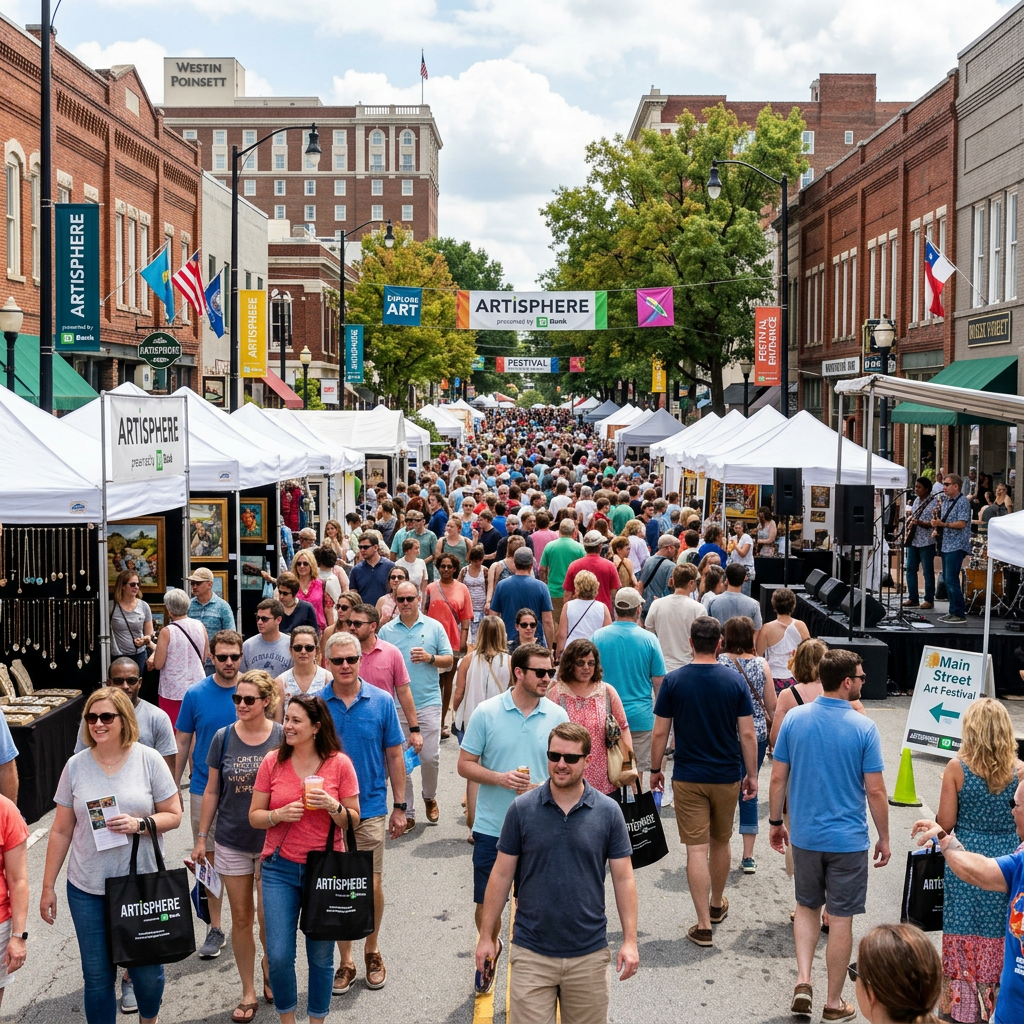
This weekend, downtown Greenville is overflowing for Artisphere.
And honestly, that is a good thing.
Twenty or thirty years ago, the idea that Greenville would host a nationally respected arts festival drawing huge crowds into downtown would have sounded almost absurd to a lot of locals. The city built something real here. People genuinely want to be in Greenville now. That did not happen by accident.
Falls Park changed the trajectory of the city. Main Street became beautiful in a way few people imagined decades ago. Fluor Field became a national model for downtown minor league baseball. Greenville escaped the fate a lot of former textile cities never recovered from.
That success deserves recognition.
And to be fair, concentrated downtown investment is not automatically a bad thing. Strong urban centers create walkability, tourism, economic density, public gathering space, and a stronger tax base. Greenville needed a healthier center. Without it, the city might have continued declining outward into endless disconnected sprawl.
But after inching through traffic this weekend, circling packed garages, and watching thousands of people funnel toward the same few downtown blocks, I found myself thinking about something strange:
Almost everything in Greenville now points toward downtown.
The festivals.
The tourism.
The branding.
The investment.
The “important” spaces.
The version of Greenville outsiders are meant to see.
And while that concentration has undeniably helped Greenville grow, I sometimes wonder if the city has become a little too centered around one version of itself.
Because Greenville did not always feel this centralized.
For a long time, the city’s identity was spread across the county in ways that were messier, less polished, and maybe harder to market—but also strangely alive.
You went near Mauldin to see the Greenville Braves play at Municipal Stadium. You drove toward Donaldson Center for Freedom Weekend Aloft and watched hot air balloons drift across the sky during July Fourth weekend. Laurens Road mattered in a completely different way than it does now. Old Greek restaurants, malls, skating rinks, flea markets, arcades, and music venues all carried their own kind of gravity.
Not everything emotionally pointed toward Main Street.
You experienced Greenville by moving through it.
That older Greenville was not objectively “better.” Some of those places were already struggling long before downtown fully revived. Some commercial corridors genuinely declined. Some malls were fading no matter what happened downtown. Reinvention was necessary in many cases.
But older Greenville did feel more distributed.
Different parts of the county held different kinds of cultural weight. There were multiple centers of gravity instead of one overwhelmingly dominant one.
The old Greenville Braves stadium is a perfect example.
Fluor Field is gorgeous. It is hard to argue otherwise. It fits neatly into the downtown vision Greenville built: walkable, picturesque, connected to restaurants, hotels, and entertainment. It works economically. It photographs beautifully. Downtown baseball became part of Greenville’s new national image.
But Municipal Stadium near Mauldin felt different.
It felt regional.
Spread out.
A little rough around the edges.
Less curated.
More accidental.
More blue collar.
Driving out there was part of the ritual. It reminded you that Greenville existed beyond downtown.
And I sometimes wonder if Greenville gained beauty while losing a little texture.
That same tension appears all over the map now.
Laurens Road once felt like one of Greenville’s defining commercial arteries. Now many stretches feel caught between eras—half thriving, half forgotten. Older gathering places disappear quietly all the time. Independent businesses close. Small weird venues vanish. Empty lots sit untouched for years because development rules, traffic concerns, or planning visions make experimentation increasingly difficult outside the approved core.
Even some conversations about Greenville’s future reveal this pattern in real time.
One of the more interesting civic discussions happening right now is the idea of building a convention center downtown.
And honestly, I understand the appeal.
From a tourism and business standpoint, it makes perfect sense. A walkable downtown convention space connected to hotels, restaurants, Falls Park, Fluor Field, and Main Street would likely attract larger conferences, bigger events, and more national attention. Cities across America are pursuing exactly that model.
But Greenville already has a convention center.
The issue is not really the absence of one.
The issue is that it is not downtown.
And that realization says something important about the direction Greenville has been moving for years now.
Increasingly, the city’s economic energy, civic identity, tourism strategy, and cultural prestige all seem to point toward the same geographic core. Downtown is no longer just part of Greenville. In many ways, it has become the version of Greenville that officially “counts.”
Again, that is not entirely bad. Downtown success absolutely benefited the wider region. It raised Greenville’s national profile, attracted investment, strengthened tourism, and helped create economic momentum across the county.
But success can still create imbalance.
Because convention centers do not just host events. They create gravity:
restaurants,
hotels,
shops,
jobs,
traffic,
public life,
economic spillover.
And when almost every new layer of gravity gets pulled inward toward the same few blocks, other parts of the county can slowly begin to feel secondary—even when they still contain enormous potential.
This is not really an argument against downtown. I love downtown Greenville. Most people here do.
It is an argument for remembering that Greenville is bigger than its polished core.
A healthy city probably needs multiple centers of gravity.
Multiple gathering spaces.
Multiple identities existing at once.
Mauldin should feel distinct.
Taylors should feel distinct.
Piedmont should feel distinct.
Berea should not feel invisible.
Laurens Road should matter for more than traffic.
Not every meaningful public experience should require funneling into the same few blocks.
Maybe the future of Greenville is not making downtown smaller.
Maybe it is making the rest of Greenville matter just as much.
Because a city becomes truly alive not when everything points toward one place, but when people across the entire map feel like they belong to the story too.

 Frank M. Anderson's Writing
Leave a comment