
What happens when a city says no—and what replaces it?
I still drive past that lot sometimes.
Most people probably don’t notice it. It’s just another piece of land sitting beside a road already carrying more traffic than it was designed for. Cars pass it every day without thinking. Another in-between space in a city full of them.
But once you’ve tried to build something somewhere, you stop seeing empty land the same way.
You start seeing ghosts.
Not haunted ghosts. Possibility ghosts.
You see the thing that almost existed there.
In my head, I can still picture Pleasant Roast clearly. A small drive-in coffee concept. Local. Functional. Designed around the reality of how Greenville actually moves. People heading to work. Parents getting kids to school. Nurses, contractors, teachers, exhausted commuters, people trying to grab something decent in the middle of a busy morning.
Not everybody lives a downtown walking lifestyle. Not everybody has time to sit in a minimalist café for forty-five minutes discussing pour-over notes and existentialism.
Some people just need good coffee without their entire morning collapsing.
That’s who Pleasant Roast was for.
And honestly, the idea itself was never particularly revolutionary. That’s part of why this whole thing became so interesting to me. We weren’t trying to build a megaproject or radically reshape the city. We were trying to build something small, local, useful, and realistic.
But somewhere in the process, the coffee shop stopped being the story.
The story became the system surrounding it.
The Greenville on Paper
Nothing failed dramatically.
There was no movie scene where somebody slammed a folder shut and declared the project dead. No cartoon villain twirling a mustache while personally destroying local coffee culture.
It was slower than that. More procedural. More modern.
There were concerns about traffic flow, backups, ingress and egress, circulation, stacking, site limitations, and how the property interacted with the larger long-term vision for the area.
And to be fair: some of those concerns were legitimate.
Traffic in Greenville is real. Anyone who drives here understands that immediately. The city has grown quickly, often faster than its infrastructure. Poorly designed projects can absolutely create headaches that last for decades.
I don’t think planning is evil.
I don’t think every project should get approved.
And I don’t think standards are inherently bad.
But what became increasingly obvious throughout the process was this:
It wasn’t that the idea was impossible.
It’s that it didn’t fully fit the version of the city that exists on paper.
That distinction matters.
Because there’s the Greenville we imagine in planning documents: walkable, aesthetically cohesive, intentional, mixed-use, curated, efficient, clean.
And then there’s the Greenville people are actually living in every day:
a sprawling, car-dependent, rapidly expanding Southern city still deeply organized around movement by vehicle.
Those two versions of Greenville overlap in some places.
But they are not fully the same city.
And once you step into development conversations, you begin realizing how much modern urban life is shaped by the tension between aspiration and reality.
The Friction You Start Seeing Everywhere
Pleasant Roast changed the way I see Greenville now.
Not because I became bitter.
Because I became observant.
Once you’ve sat inside the process, you start noticing things you previously drove past without thinking about.
Empty lots sitting untouched for years.
Buildings waiting for futures that never seem to arrive.
Perfectly usable spaces trapped in transitional limbo while everyone waits for an idealized version of development that may never fully materialize.
And eventually you begin asking an uncomfortable question:
How much are we preventing in the name of preventing problems?
Because at some point I realized something strange about modern cities:
We are often extremely afraid of traffic generated by success…
while being surrounded by stagnation generating nothing at all.
That tension became difficult to unsee.
The Startup Gap
Around the same time, I also started noticing Greenville’s complicated relationship with other small-scale business models.
Food trucks.
Temporary concepts.
Flexible low-overhead businesses.
Experimental spaces.
Drive-thrus.
Pop-up models.
Again, this is where nuance matters.
I understand many of the arguments against these things:
parking concerns,
traffic,
visual clutter,
consistency,
pedestrian experience,
long-term planning goals,
land use efficiency.
Those concerns are not fake.
But there’s another side to this conversation that doesn’t get discussed enough:
Small, flexible business models are often the only realistic entry point available to ordinary people.
Not everyone can survive years of delays, redesigns, legal reviews, carrying costs, consultant fees, and shifting requirements while waiting for approval.
Large chains can absorb friction.
Massive developers can absorb friction.
Well-capitalized groups can absorb friction.
But local first-time entrepreneurs often can’t.
That changes who gets to participate in building the city.
And once you notice that pattern, you start asking bigger questions.
Not:
“Why wasn’t my coffee shop approved?”
But:
“What kinds of businesses become easier to build here?”
“What kinds become harder?”
“What version of entrepreneurship survives this process?”
“What gets filtered out before it even begins?”
The Artifacts
Looking back at the Pleasant Roast plans now, what strikes me most isn’t failure.
It’s labor.
The sketches.
The revisions.
The handwritten notes.
The attempts to compromise.
The redesigns.
The endless adjustments trying to make a small idea fit into a rigid system.
Those documents changed the way I think about development entirely.
From the outside, people often imagine businesses appearing magically:
a building goes up,
a sign appears,
and suddenly a place exists.
But underneath every project is an invisible layer of negotiation, friction, compromise, regulation, cost, delay, and emotional energy most people never see.
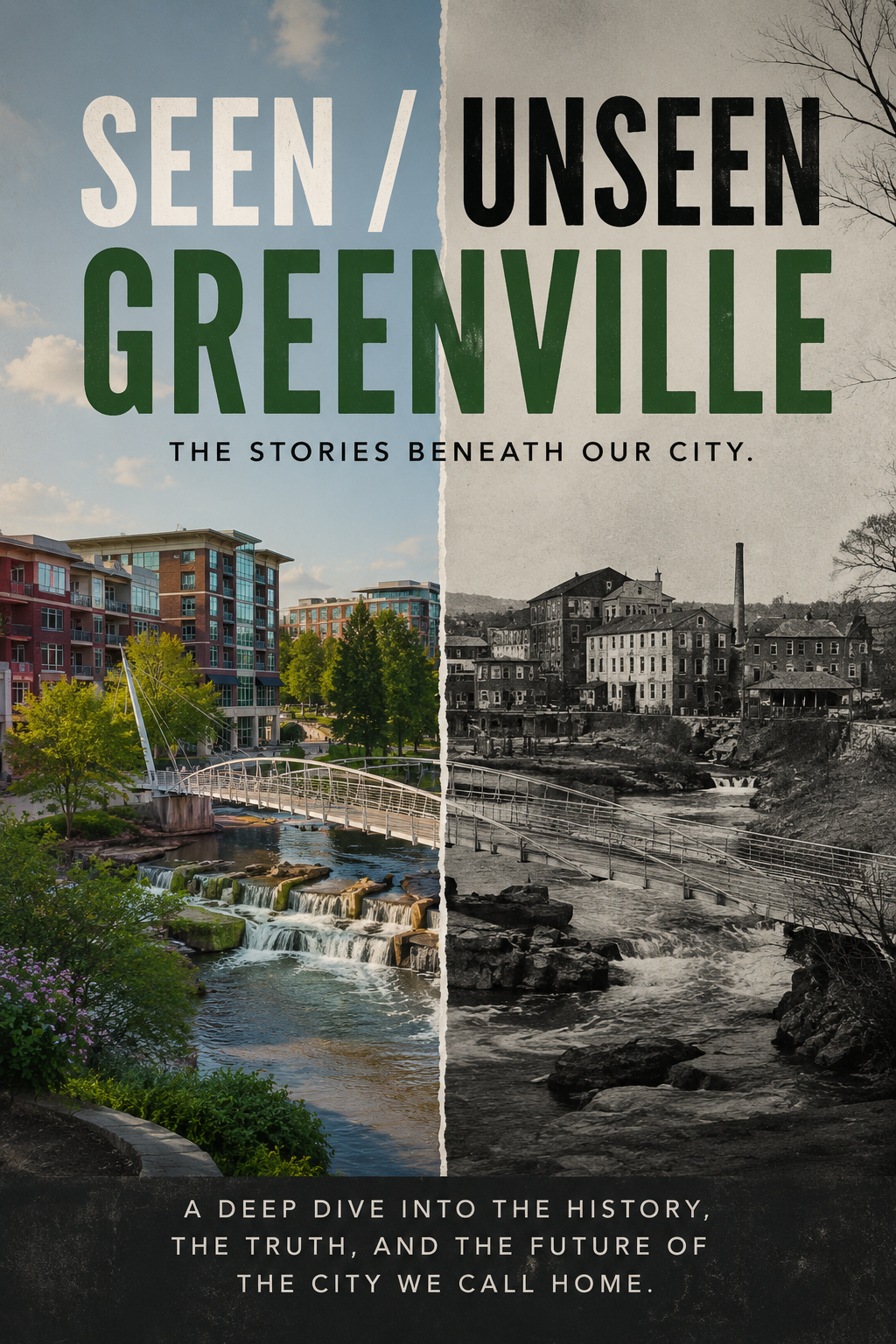
The “seen” city is the final product.
The “unseen” city is everything that never makes it through the process.
What This Really Became About
At some point I realized this wasn’t really a story about coffee.
It became a story about flexibility.
About whether growing cities still leave room for experimentation.
About whether local identity can survive systems increasingly tilted toward polished, capital-heavy, low-risk development.
About the tension between:
what looks right,
what functions well,
and what ordinary people can realistically build.
And to Greenville’s credit, the city has accomplished remarkable things. Downtown did not become what it is by accident. Vision matters. Standards matter. Long-term thinking matters.
But there’s also a danger in becoming so focused on curating perfection that you slowly squeeze out spontaneity, affordability, experimentation, and weirdness.
Cities need polished spaces.
But they also need room to improvise.
Final Thought
I still love Greenville.
That’s why I keep writing about it.
The point of this project isn’t to attack the city. It’s to understand it honestly. To look at both the visible version and the underlying systems shaping it.
And one thing I’ve slowly realized is this:
A city reveals itself not only through what it builds—
but through what it struggles to allow.
Through what gets delayed.
What gets filtered out.
What quietly disappears.
What remains empty while everyone waits for something ideal.
If you drive past that lot, you probably won’t think about any of this.
You’ll just see empty space.
But once you’ve tried to build something somewhere, empty space never really looks empty again.
Leave a Reply