
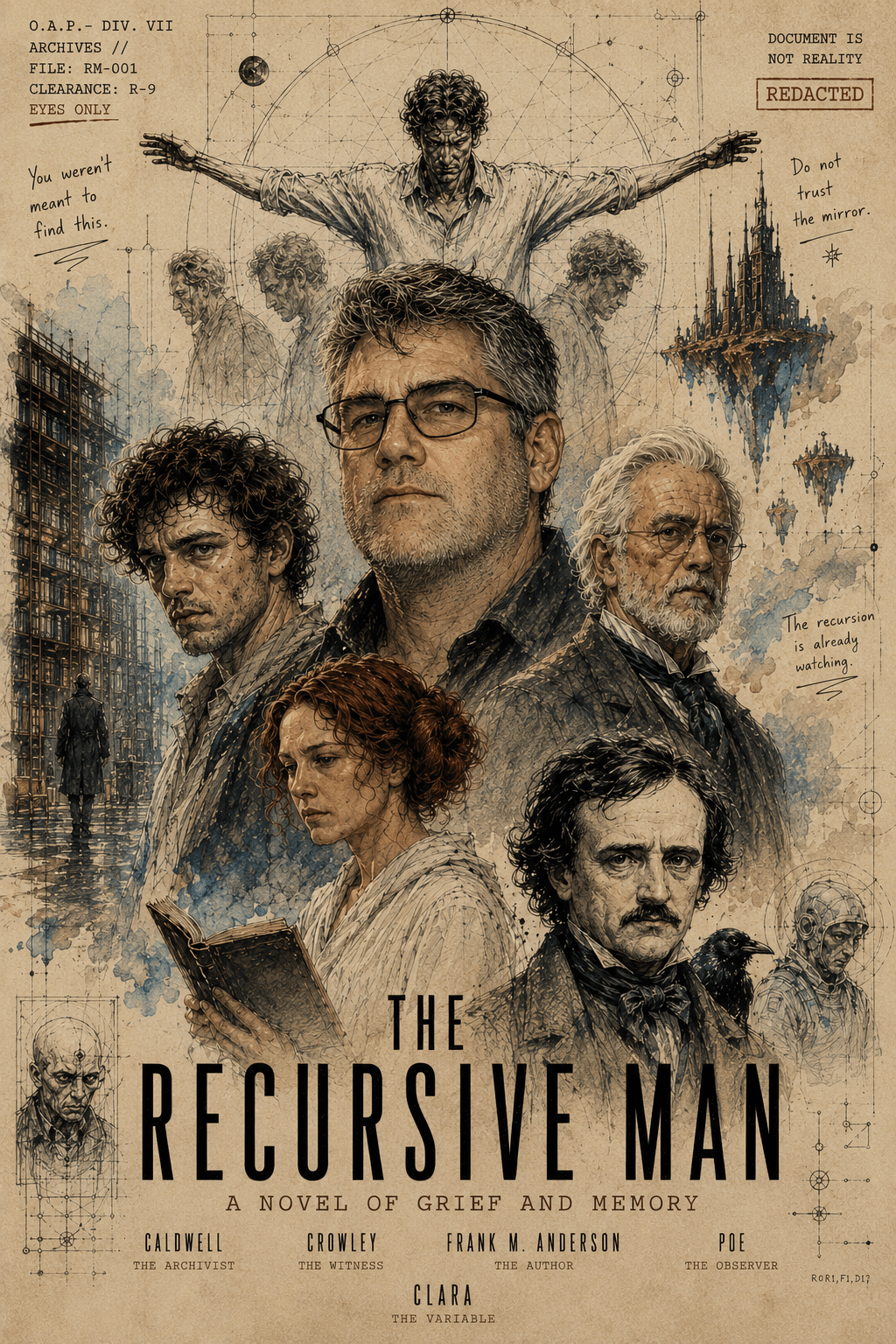
There are books that arrive fully formed.
And then there are books like The Recursive Man — books that evolve like weather systems, mutate across drafts, absorb years of life, and slowly reveal what they were actually about long after you thought you understood them.
This wasn’t supposed to happen the way it did.
At first, the project was smaller. Stranger. More occult. More experimental. It began as a series of faux-classified dossiers tied to an organization called the Office of Anomalous Phenomena — a recursive archive of mirrors, ghosts, timelines, forgotten manuscripts, and impossible figures bleeding across history.
There were fragments.
Recovered files.
Mirror rituals.
Occult conspiracies.
Aleister Crowley.
Edgar Allan Poe.
Agents cataloging recursive phenomena as reality slowly destabilized around them.
It was atmospheric. Dense. Sometimes beautiful. Sometimes incomprehensible.
And buried inside all of it was a character named Caldwell.
At first, Caldwell was little more than an archivist — a procedural observer documenting impossible events. But over time, something strange happened.
He became human.
Not in the “robot gains emotions” sense. In the real sense. He became exhausted. Lonely. Reflective. A man trying to understand why human beings preserve pain instead of living beyond it. A man trapped inside observation. A witness slowly realizing that surviving isn’t the same thing as participating.
That shift changed the entire project.
Because somewhere along the way, the recursive mythology stopped being the point.
It became the delivery system.
Underneath the mirrors and anomalies and recursive timelines was something much simpler and much more personal:
grief,
memory,
mental illness,
love,
creative obsession,
survival,
and the terrifying possibility that human beings preserve themselves through stories because we are afraid to disappear.
The deeper I wrote, the more the book absorbed real life.
Cancer.
Loss.
Relationships.
Bipolar disorder.
Friendship.
Fear.
Nostalgia.
The strange experience of trying to remain emotionally coherent while your inner life feels fragmented.
Eventually the project split into multiple forms:
- Unto a Golden Dawn
- The Catalyst Dossier
- The Recursion Dossier
- Grammar for the Dead
- and finally, what became The Recursive Man: A Novel of Grief and Memory.
Each version wasn’t exactly a replacement.
More like an alternate recursion branch.
And recently, I rediscovered an entire forgotten sequel draft: Unto A Golden Dawn – Volume II: The Recursion Dossier.
Reading it now feels surreal.
Some of it is wildly overcomplicated.
Some of it is genuinely creepy.
Some of it feels like an SCP file written by someone having an existential crisis at 3 AM.
But some of it is also the clearest possible evidence that the core ideas were there from the beginning:
- recursive identity,
- mirrors as memory architecture,
- authorship as reality shaping,
- grief becoming structure,
- forgotten people demanding significance,
- “the side character refusing to fade.”
One line from the old sequel especially hit me:
“The recursion doesn’t want editors. It wants authors.”
That became the soul of the final book.
Another:
“Maybe I’m what happens when a footnote refuses to fade.”
That’s Caldwell.
That’s Howell.
That’s probably me, too.
And honestly, that’s what the project became:
a long attempt to understand what it means to matter inside an unfinished universe.
So What Is The Recursive Man?
The simplest answer is:
it’s literary metafiction wrapped inside recursive horror wrapped inside memoir wrapped inside speculative fiction.
But emotionally, it’s about this:
What happens when memory stops being passive and starts shaping reality?
What happens when grief becomes architecture?
What happens when observation replaces participation?
What happens when a person spends so much time documenting life that they stop fully living it?
The book contains:
- occult horror,
- metafiction,
- recursive timelines,
- dead authors,
- mirrors,
- archives,
- anomalous phenomena,
- impossible memories,
- living documents,
- and a mysterious entity called Salazar, who may be less a villain than a recursive editorial force rewriting reality itself.
But underneath all of that is a much more human story:
people trying to survive themselves.
The AI Question
A lot of people understandably ask about AI when they see this project.
So let me say this clearly:
AI did not replace authorship here.
It expanded the workspace.
I used AI differently depending on the project:
- sometimes as a structural collaborator,
- sometimes as an improvisational engine,
- sometimes as a recursive brainstorming tool,
- sometimes as an editor,
- sometimes as a way to rapidly explore emotional and thematic pathways.
The best way I can describe it is this:
Writing with AI often felt less like “press button receive novel” and more like standing inside a giant recursive Choose Your Own Adventure engine where I could test emotional resonance at enormous scale.
Most paths were abandoned.
Many scenes were rewritten completely.
Entire mythologies were discarded.
Some ideas survived because they emotionally mattered.
Others survived because they simply felt true.
The human work remained:
judgment,
taste,
theme,
selection,
emotion,
structure,
meaning.
AI accelerated exploration.
It did not eliminate authorship.
If anything, it made authorship more demanding because I had to become a curator of possibility instead of just a sentence generator.
What Happens Next?
Right now, I think The Recursive Man is done.
Not perfect.
Probably never fully “finished.”
But complete in the way living things are complete.
And now comes the strange part:
trying to release it into the world.
We’re currently exploring:
- a Kickstarter campaign,
- a rebranding strategy,
- collector editions,
- dossier-style supplemental materials,
- audiobook plans,
- visual ad campaigns,
- recursive archive promo material,
- alternate covers,
- and possibly even releasing earlier “recursive branches” as companion artifacts rather than pretending they never existed.
Because honestly?
The development history has become part of the mythology now.
The drafts matter.
The abandoned paths matter.
The forgotten versions matter.
The recursion became real long before I understood what I was building.
And maybe that’s fitting.
Because in the end, The Recursive Man isn’t really about solving reality.
It’s about learning how to remain human inside uncertainty.
And for the first time in a long time, I think I finally understand that.
 Frank M. Anderson's Writing
Leave a comment