
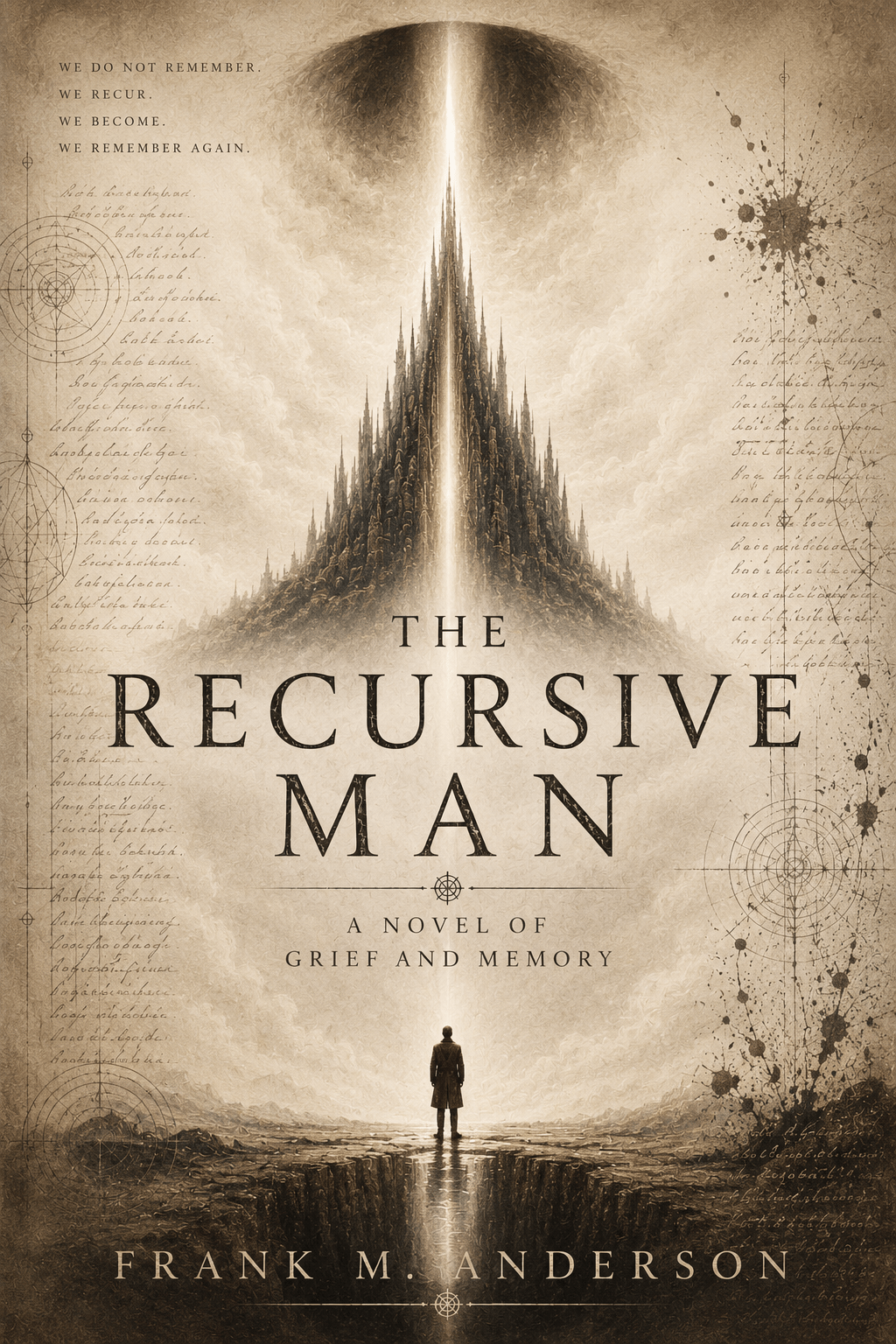
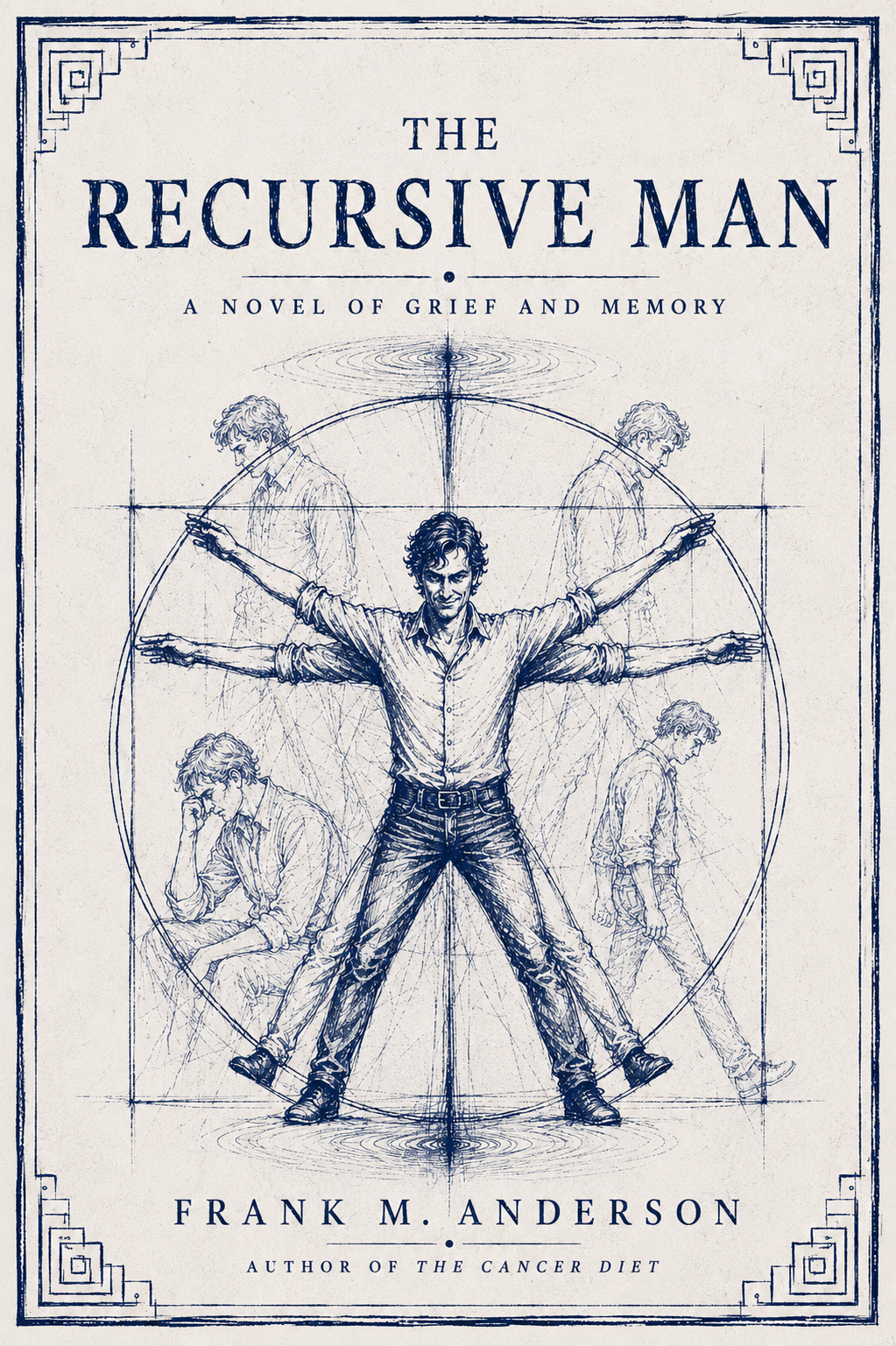
For the last few months, I’ve gone back and forth on whether I should release my upcoming novel, The Recursive Man, in its current form.
Not because I don’t believe in the book.
I do.
Actually, I think it may be one of the most honest things I’ve ever made.
But because I know people will see the rough edges.
The imperfections.
The strange formatting.
The fragments.
The visible seams.
The occasional typo.
The moments where the book feels less like a polished commercial product and more like a recovered transmission from somewhere unstable.
And honestly?
That’s because it is.
Perfection is a strange thing.
The older I get, the more I realize that some art dies from being over-cleaned.
The Recursive Man is imperfect. Intentionally and unintentionally.
There are moments where the formatting feels rough. There are fragments pulled directly from real conversations. There are places where the digital seams show. Tiny glitches. Unevenness. Static in the signal.
And for a while, I kept asking myself:
Should I smooth all of it out?
The answer I eventually arrived at was:
Not yet.
Because this version of the book is the frozen version.
The artifact.
The transmission captured at the moment it finally became alive.
Could I keep sanding it forever? Absolutely. I could spend another year polishing every edge until it became cleaner, safer, and more conventionally “professional.”
But I’m not convinced that would make it more honest.
The Recursive Man is a book about grief, recursion, memory, identity, fractured narratives, emotional residue, and the strange ways humans preserve themselves through stories. A perfectly sterile version might actually betray the spirit of the thing.
So I’m releasing it as it exists now:
alive,
uneven,
human,
haunted,
and real.
Maybe later there will be a revised edition. Maybe there will be an expanded edition. Maybe some of the roughness will get cleaned up over time.
But first, I want people to encounter the work in the state it emerged from the fire.
Not every scar needs airbrushing.
Not every signal needs noise reduction.
Sometimes the static is part of the song.
Some people will consider that unprofessional.
I consider it true to the project.
Part of the reason I’ve also been rebuilding the Fulcrum & Axis website is because I realized something important:
People were seeing fragments without seeing the architecture underneath them.
One day I’m posting memoir writing.
The next day it’s speculative fiction.
Then local history.
Then a horror screenplay.
Then an essay about AI.
Then Greenville politics.
Then a strange recursive metafiction novel.
From the outside, I think it sometimes looked chaotic.
But the truth is:
all of these projects are connected.
Fulcrum & Axis was never meant to be just a traditional “author website.”
It’s closer to a living archive.
A place where memoir, fiction, philosophy, grief, humor, local history, experimentation, and digital storytelling all collide together instead of being separated into neat corporate genres.
Because human beings are not neat genres.
Over time, I realized most of my work keeps circling the same core questions:
How do people survive themselves?
How do memory and story reshape reality over time?
What happens when identity fractures?
How do we preserve meaning inside a noisy world?
What parts of ourselves are performance, and what parts are real?
Whether I’m writing about Greenville, cancer, bipolar disorder, failed businesses, recursive fiction, AI, horror, relationships, politics, or strange internet-era loneliness…
it’s all part of the same ongoing exploration.
Fulcrum & Axis became the container for that.
Not a polished corporate “brand.”
Not a content farm.
Not an attempt to look smarter or cleaner than I am.
More like:
an evolving archive of unfinished human thought.
That’s also why I’ve stopped being afraid of showing process.
Older versions.
Drafts.
Experiments.
Messy ideas.
Contradictions.
Growth.
Failure.
Revisions.
I think the internet spent a long time teaching people to only present finalized identities.
But real life doesn’t work that way.
Most of us are still becoming.
Most of us are still revising.
Most of us are still trying to understand ourselves while simultaneously living our lives in real time.
So the rebuild of Fulcrum & Axis isn’t just visual.
It’s philosophical.
I want the site to feel less like a storefront and more like entering someone’s living creative ecosystem:
books,
essays,
fiction,
history,
experiments,
archives,
mistakes,
questions,
and all.
Not perfection.
Presence.
And yes, part of the conversation surrounding this book will inevitably involve AI.
Some people will dismiss the work immediately because of that association. I already know that.
But I also think people misunderstand what this process actually was.
I did not press a button and receive a novel.
What happened instead was something closer to an ongoing recursive creative collaboration:
a conversation,
a mirror,
a drafting partner,
an improvisational engine,
a philosophical sounding board,
a structural assistant,
a chaos amplifier,
and sometimes simply a tool that helped me continue writing when my own brain became fragmented, exhausted, distracted, overwhelmed, or emotionally flooded.
The voice is still mine.
The obsessions are mine.
The grief is mine.
The history is mine.
The emotional architecture is mine.
AI did not replace my humanity.
If anything, the process forced me to confront it more directly.
And honestly, I think that’s part of what scares people.
Not because AI can create perfectly.
But because it reveals how messy, collaborative, recursive, emotional, and unfinished human creativity already was to begin with.
The goal of this project was never to manufacture perfection.
The goal was to tell the truth as clearly as I could within the artistic framework I chose.
I achieved that.
And for now, that’s enough.
 Frank M. Anderson's Writing
Leave a comment