
Archive Edition • Studio Edition • Gallery Edition • Museum Edition
“No one is useless in this world who lightens the burden of it for any one else.”
— Charles Dickens, Our Mutual Friend
A Portrait of Victorian Literature’s Great Storyteller
Few writers have brought the overlooked people of society so vividly into public view as Charles Dickens.
Through unforgettable characters, sharp humor, emotional storytelling, and fierce social observation, Dickens exposed the poverty, hunger, exploitation, and institutional cruelty hidden beneath the prosperity of Victorian England. He transformed workhouses, debtors’ prisons, factories, courtrooms, schools, and crowded city streets into places his readers could no longer comfortably ignore.
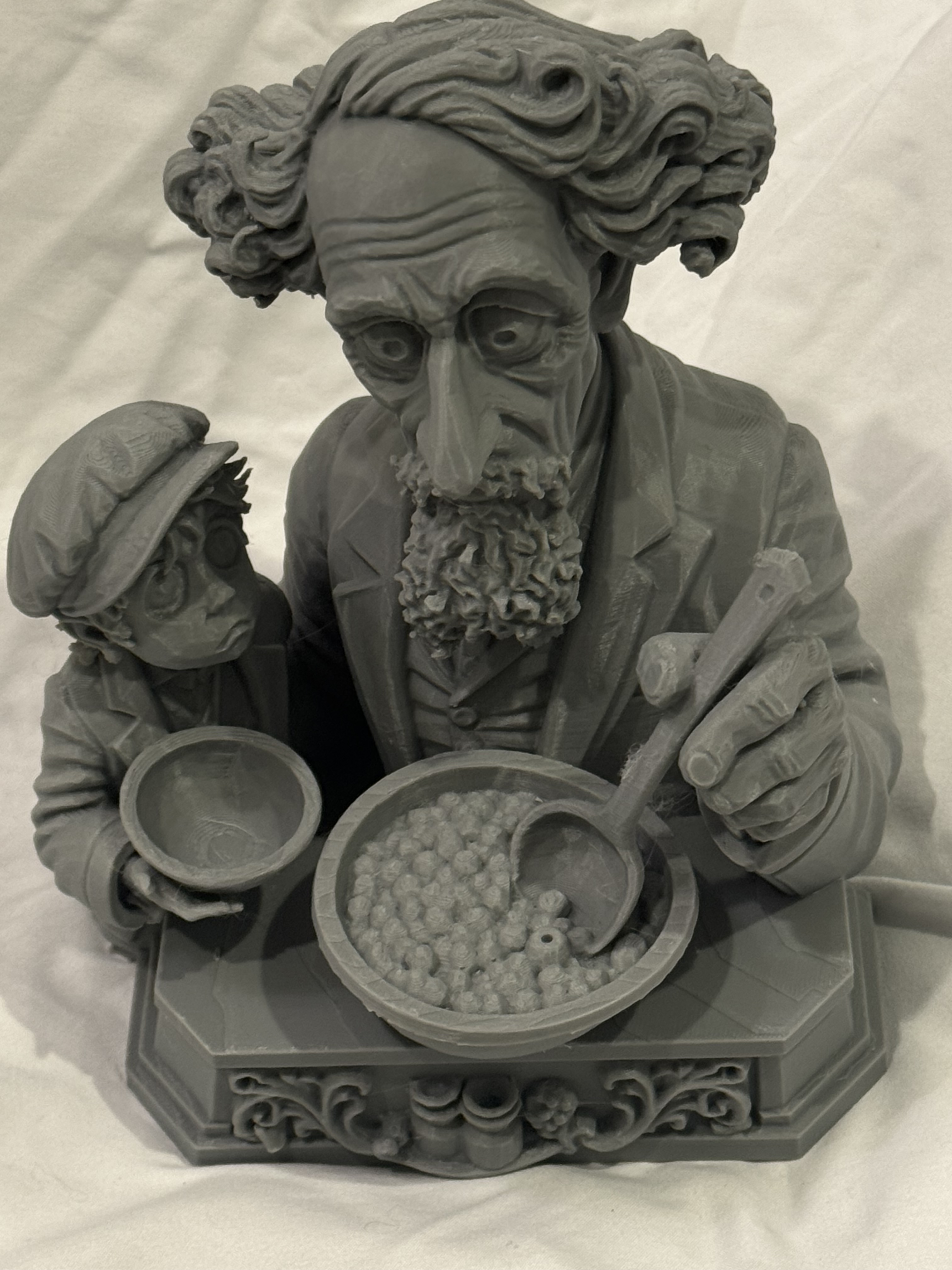
This Fulcrum & Axis Studio portrait places Dickens inside the imaginative world of one of his most famous novels.
Beside him stands the orphan Oliver Twist, dressed in worn clothing and holding forward an empty bowl. Dickens leans across a laden table with a wooden ladle in his hand, appearing ready to provide the nourishment Oliver was famously denied.
The sculpture does not reproduce a literal scene from Oliver Twist. Instead, it brings the author and his creation together in a symbolic encounter.
Dickens is no longer observing hunger from outside the story. He has entered the world he created and taken responsibility for the child standing beside him. The result is a portrait not only of a celebrated novelist, but of storytelling used as an act of attention, compassion, and social criticism.
Created for The Archive of the Great & Famous, the composition honors the writer whose stories gave memorable faces and voices to people society too often treated as statistics, inconveniences, or problems best kept out of sight.
The Story Within the Sculpture
The sculpture unites author, character, setting, and symbol in a single narrative composition.
At its center is a simple human need: a hungry child asking for food.
Around that moment develops a larger story about poverty, dignity, compassion, social responsibility, and the power of literature to change what its readers are willing to see.
The Portrait
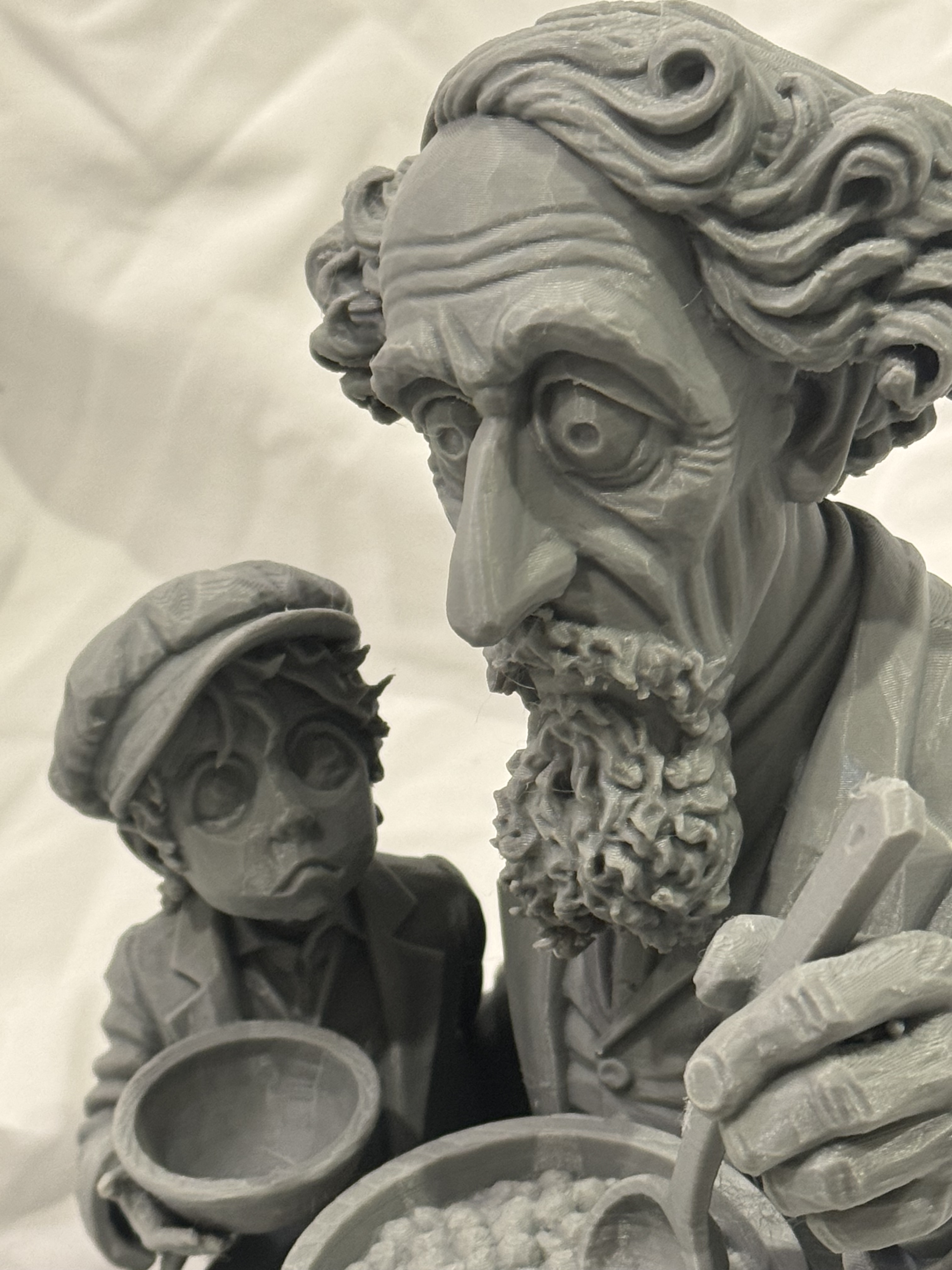
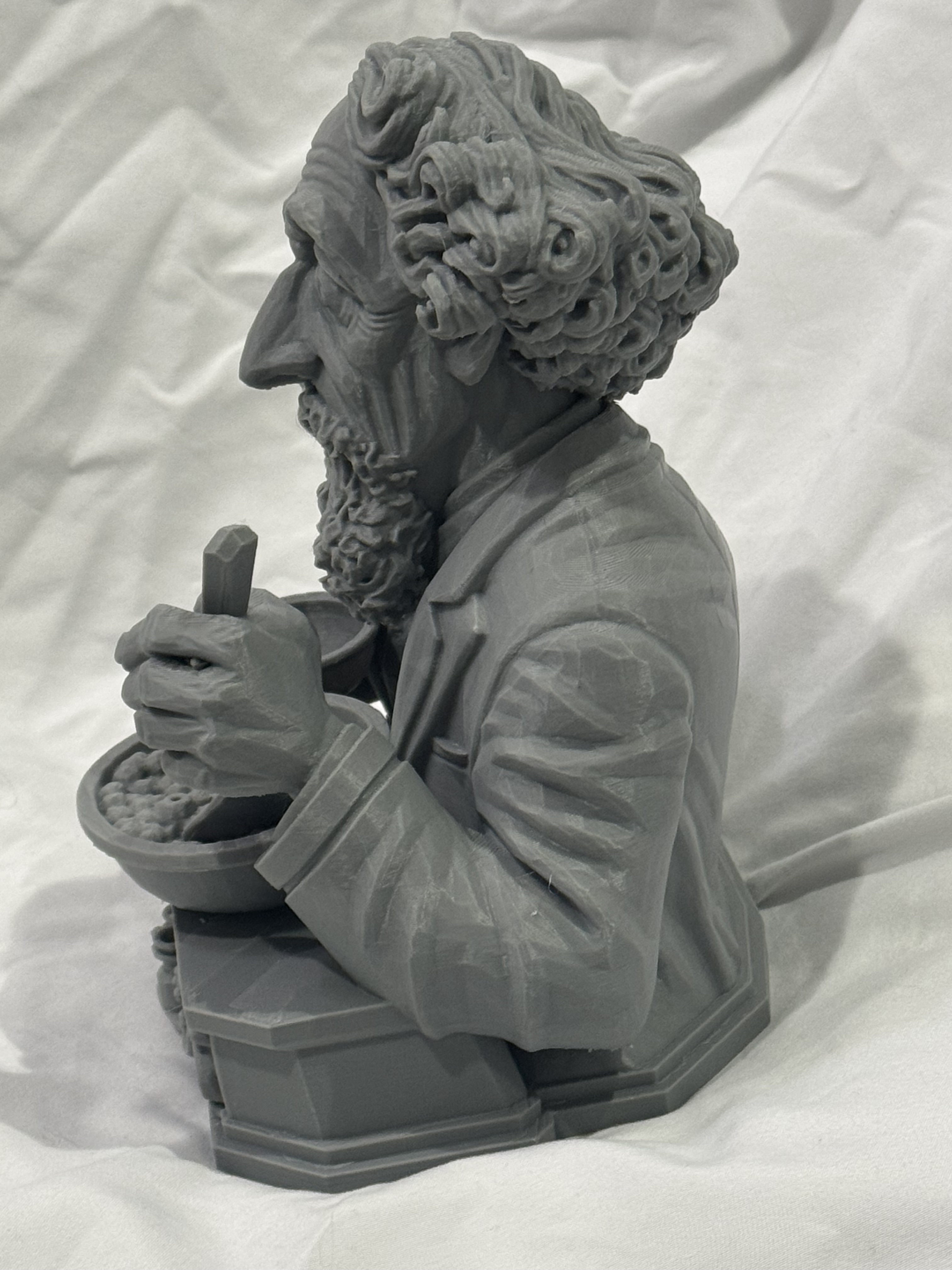
Charles Dickens appears with the sweeping hair, deeply lined face, expressive eyes, and distinctive beard familiar from surviving photographs and portraits of the author.
The sculpture does not present him as a remote Victorian gentleman posing for history. His enlarged eyes, furrowed forehead, and weary expression give the portrait an emotional immediacy. He appears troubled by what he sees.
His gaze turns downward toward the table and the waiting child. That direction matters. Dickens is not looking beyond Oliver or presenting himself proudly to the viewer. His attention remains focused on the need directly before him.
His formal coat and carefully modeled clothing identify him as an established Victorian professional, but his posture brings him into the scene rather than holding him above it. One arm reaches forward, and the hand wrapped around the ladle becomes an essential part of the story.
Dickens appears here as writer, witness, and participant.
His expression suggests someone burdened by suffering but unwilling to look away—a fitting representation of an author who repeatedly turned private hardship and public injustice into stories millions of readers could understand.
Oliver Twist
Standing close beside Dickens is the young orphan Oliver Twist.
His cap, oversized clothing, small body, and wide eyes make him appear especially vulnerable beside the much larger author. Yet he is not hidden in the background. Oliver occupies the front of the composition, where his presence and need cannot be overlooked.
Introduced in Dickens’s second novel, Oliver is born inside a workhouse and immediately enters a system that treats poverty as though it were a moral failure. He experiences hunger, neglect, exploitation, criminal manipulation, and repeated abandonment by the adults and institutions responsible for protecting him.
Despite this treatment, Oliver retains his capacity for trust, gratitude, affection, and moral judgment. His circumstances do not erase his humanity.
That distinction was central to Dickens’s appeal. His impoverished characters were not merely examples used to support an argument. He gave them names, personalities, fears, hopes, relationships, and voices. Readers were asked to recognize them as individuals.
Within the sculpture, Oliver represents both a beloved fictional character and the countless real children whose hunger and vulnerability helped inspire Dickens’s social criticism.
The Empty Bowl
Oliver holds an empty bowl prominently before him.
It recalls the defining workhouse scene in which the starving children draw lots to decide who will ask for an additional portion of gruel. Oliver approaches the master and makes one of the most famous requests in English literature:
“Please, sir, I want some more.”
The request is modest. Oliver does not demand abundance, comfort, or special treatment. He asks only for enough food to satisfy his hunger.
Within the workhouse, however, the request is treated as an act of defiance.
That reaction transforms the empty bowl into more than a symbol of physical deprivation. It represents a system so hostile to human need that a hungry child’s request for nourishment becomes an offense requiring punishment.
The bowl also represents courage. Oliver must speak when silence is safer. By extending it toward the viewer, the sculpture preserves that challenge.
What kind of society punishes a child for asking to be fed?
Who is responsible when institutions created to provide assistance instead deepen suffering?
What do people owe one another simply because they are human?
These questions reach far beyond the Victorian workhouse.
The Food and Ladle
A large serving dish rests before Dickens, filled with the plain food that defines the center of the scene. A heavy wooden ladle lies across it, held firmly in the author’s hand.
In Oliver Twist, gruel represents calculated scarcity. The workhouse provides enough food to sustain life, but never enough to satisfy hunger or preserve dignity. Deprivation is not an accident within the system. It is part of its design.
Dickens frequently used food to reveal the moral condition of his characters and communities.
A shared meal could represent warmth, companionship, security, and generosity. An empty table could reveal poverty and abandonment. Excessive feasting could expose selfishness, while the refusal to feed another person became evidence of a deeper moral failure.
Food in Dickens is rarely only food. It reveals who has power, who is welcomed, who is excluded, and whether abundance will be shared.
In this sculpture, Dickens himself holds the ladle.
The image reverses the cruelty of the workhouse scene. The author appears ready to provide the “more” that Oliver was denied. His gesture suggests that recognizing suffering should lead to action.
The ladle also becomes a metaphor for storytelling. Dickens could not personally feed every hungry child in Victorian England, but he could place their suffering before an enormous reading public. He could give abstract social problems human faces and make indifference more difficult to maintain.
The serving gesture therefore represents both physical nourishment and the moral work of the writer.
The Writer Within His Story
By placing Dickens beside Oliver, the sculpture deliberately dissolves the boundary between creator and creation.
This is not a scene that occurs within the novel. Dickens does not enter Oliver Twist as a character and personally serve the young orphan. The composition instead imagines a symbolic meeting between the author and one of the children through whom he expressed his deepest concerns.
That meeting carries particular meaning because Dickens understood childhood insecurity from personal experience.
When he was twelve years old, financial disaster struck his family. His father was imprisoned for debt, and Charles was sent to work in a blacking warehouse, where he pasted labels onto containers of boot polish.
The work itself, the separation from his family, and the sense that he had been abandoned remained among the most painful memories of his life. Even after achieving extraordinary fame and financial security, Dickens found the experience difficult to discuss.
Those memories later resurfaced in different forms throughout his fiction.
Children in Dickens’s novels are sent away, placed in dangerous institutions, exploited for labor, left without protection, or forced to survive in a world controlled by unreliable adults. David Copperfield works in a warehouse. Pip suffers humiliation because of his social position. Jo, the crossing sweeper in Bleak House, is moved from place to place because society has no meaningful place for him at all.
Oliver stands beside Dickens as one fictional child among many, but he also represents the wounded memory Dickens carried out of his own childhood.
The sculpture allows the adult author to perform an act of care for the child—something neither Oliver nor the young Dickens could reliably expect from the institutions around them.
The Victorian Table
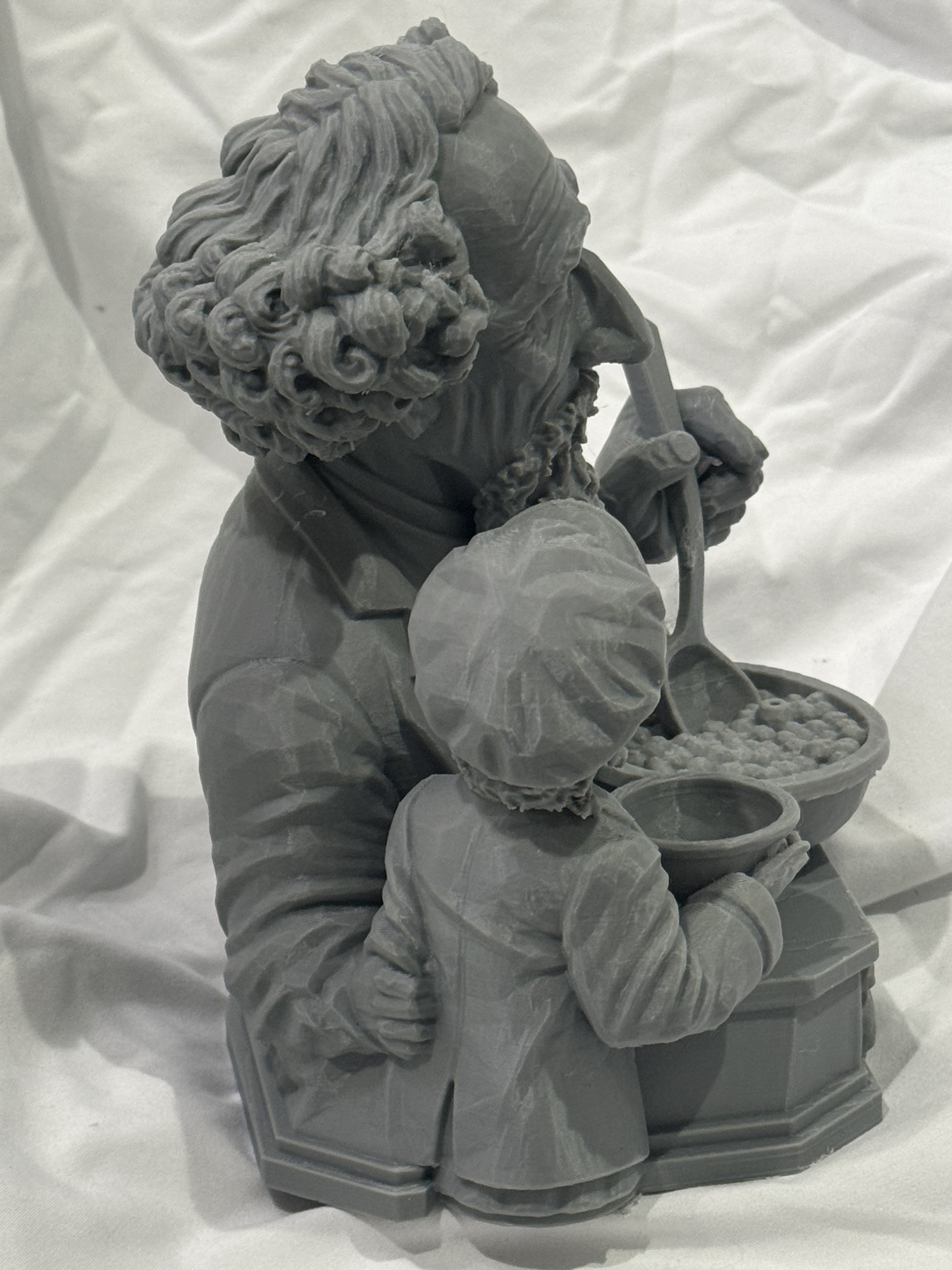
The broad table and richly ornamented foundation place the scene within the visual world associated with Victorian England.
Carved flourishes, layered molding, and decorative details give the base an appearance of prosperity and refinement. The table appears substantial enough to belong in a comfortable home or formal dining room.
That richness contrasts sharply with Oliver’s empty bowl.
The contrast reflects one of the central tensions within Dickens’s fiction. Victorian Britain possessed tremendous wealth, expanding industry, imperial power, elaborate architecture, and confident ideas about progress. At the same time, many people lived with hunger, dangerous labor, inadequate housing, untreated illness, and almost no protection from economic disaster.
Dickens repeatedly moved between these worlds.
His stories enter drawing rooms and workhouses, counting houses and prisons, respectable homes and crowded slums. He demonstrates that comfort and deprivation exist within the same society—and that the people enjoying one cannot pretend to have no connection to the other.
The ornamental base therefore does more than provide an attractive foundation. It places beauty and hardship beside one another.
Oliver’s bowl remains empty in the middle of abundance.
The Complete Composition
Viewed as a whole, the sculpture tells a story through gesture and scale.
Oliver stands small and vulnerable at one side. His bowl reaches into the open space before him. Dickens occupies the center, leaning forward rather than sitting apart. The laden dish rests between them, while the ladle creates a visual connection between the author’s hand and the child’s need.
The composition moves from hunger toward the possibility of care.
Dickens’s enormous, sorrowful eyes direct attention downward. Oliver’s face turns upward. Their expressions establish an emotional exchange before the viewer even notices the finer details of clothing, food, hair, or decoration.
The sculpture’s stylized proportions intensify that encounter. Dickens’s head, hand, and eyes are exaggerated because his acts of seeing, understanding, writing, and giving form the emotional center of the portrait.
This is not simply a bust of Charles Dickens with a reference to Oliver Twist placed beside him. It is a complete sculptural story about an author confronting the suffering that shaped his imagination.
The portrait asks what happens after suffering has been seen.
Will the bowl remain empty?
Or will someone finally decide to fill it?
About Charles Dickens
Charles John Huffam Dickens was born in Portsmouth, England, on February 7, 1812.
He was the second of eight children born to John and Elizabeth Dickens. His father worked as a clerk in the Navy Pay Office, and the family moved several times during Charles’s childhood, including a period in Chatham that he later remembered with affection.
Those relatively happy years did not last.
John Dickens struggled repeatedly with debt. In 1824, when Charles was twelve, his father was imprisoned in London’s Marshalsea debtors’ prison. Under the practices of the period, most of the family joined him there.
Charles was sent to work at Warren’s Blacking Warehouse, where he spent long days attaching labels to containers of boot polish. He lived apart from his family and experienced intense loneliness, humiliation, and fear that his education and future had been permanently lost.
The experience lasted only a matter of months, but its emotional effects remained with him for the rest of his life.
Dickens later drew upon those memories when describing abandoned children, exploitative labor, debt, social shame, and the terror of falling out of respectable society. The blacking warehouse became especially important to the partly autobiographical David Copperfield.
From Reporter to Novelist
Dickens did not begin his professional life as a novelist.
As a young man, he worked as a legal clerk, learned shorthand, and became a highly skilled reporter. He covered legal proceedings and parliamentary debates, developing both a close knowledge of British institutions and an exceptional ability to observe how people spoke and behaved.
His early sketches of London life appeared under the pen name “Boz.” These pieces revealed the qualities that would define his later fiction: sharp observation, humor, memorable personalities, sympathy for ordinary people, and fascination with the immense, chaotic city around him.
His first major popular success came with The Pickwick Papers, published in monthly installments beginning in 1836.
The series became a cultural sensation.
Dickens suddenly found himself transformed into one of the most recognizable writers in Britain. The public eagerly awaited each new installment, discussed its characters, and followed its unfolding story with an enthusiasm resembling the anticipation surrounding serialized television dramas today.
He was still in his twenties.
Oliver Twist and the Workhouse
While The Pickwick Papers was still appearing, Dickens began publishing Oliver Twist in serialized form.
The novel confronted readers with workhouses, child hunger, criminal exploitation, and the harsh treatment of people living in poverty. It appeared only a few years after the Poor Law Amendment Act of 1834 reorganized assistance to the poor around institutions intentionally made unpleasant enough to discourage people from seeking relief.
Dickens attacked the idea that deprivation resulted simply from laziness or moral weakness.
Through Oliver, he showed a child subjected to hunger and cruelty through no fault of his own. Through characters such as Fagin, Bill Sikes, Nancy, Mr. Bumble, and the Artful Dodger, he created a dangerous world in which poverty, crime, abuse, and survival became inseparably connected.
The novel combined melodrama, suspense, satire, humor, violence, and social criticism. That mixture became characteristic of Dickens’s work.
He did not write policy reports. He created characters readers worried about, laughed at, feared, loved, and remembered.
A Career of Extraordinary Productivity
Dickens followed his early success with an extraordinary sequence of novels:
- The Pickwick Papers
- Oliver Twist
- Nicholas Nickleby
- The Old Curiosity Shop
- Barnaby Rudge
- Martin Chuzzlewit
- Dombey and Son
- David Copperfield
- Bleak House
- Hard Times
- Little Dorrit
- A Tale of Two Cities
- Great Expectations
- Our Mutual Friend
- The Mystery of Edwin Drood
He also wrote novellas, short stories, essays, travel writing, journalism, theatrical pieces, and Christmas books, including the work that became one of his most enduring achievements: A Christmas Carol.
Published in 1843, the story of Ebenezer Scrooge joined social criticism with a deeply personal vision of moral transformation. Scrooge is not defeated by force. He is made to see the consequences of his choices and recognize his connection to other people.
That movement—from isolation toward sympathy—runs throughout Dickens’s work.
The World of Dickens’s Characters
Dickens created one of the largest and most recognizable populations in literature.
His fictional world includes Oliver Twist, the Artful Dodger, Fagin, Bill Sikes, Nancy, Ebenezer Scrooge, Tiny Tim, David Copperfield, Mr. Micawber, Uriah Heep, Esther Summerson, Lady Dedlock, Pip, Estella, Miss Havisham, Abel Magwitch, Sydney Carton, Madame Defarge, and hundreds of others.
Many possess exaggerated names, appearances, habits, gestures, and styles of speech. Dickens could establish a character within a few lines and make that person immediately recognizable whenever they returned.
The exaggeration was often comic, but it also had a moral purpose.
Characters who might otherwise disappear into the background became impossible to ignore. Clerks, debtors, servants, street children, prisoners, teachers, lawyers, performers, factory workers, shopkeepers, and eccentrics crowded into the foreground of his fiction.
Dickens understood that society was made not only by kings, ministers, and wealthy families, but by countless ordinary people whose lives were rarely preserved by history.
Social Criticism
Dickens’s novels repeatedly confronted the failures of Victorian institutions.
Nicholas Nickleby attacked abusive schools. Bleak House portrayed a legal system capable of consuming entire lives through delay and confusion. Hard Times criticized industrial exploitation and an education built around facts without imagination or compassion. Little Dorrit examined debt, imprisonment, bureaucracy, and the emotional consequences of social shame.
Dickens wrote about dangerous working conditions, inadequate sanitation, housing insecurity, child labor, class inequality, and the indifference of officials who treated human beings as administrative problems.
His fiction contributed to public conversations about reform, but its greatest force came from making institutional harm personal.
A system might appear abstract. A suffering character did not.
Dickens understood that readers who ignored statistics might still respond to a frightened child, a grieving parent, an exhausted worker, or a person trapped inside a machine no individual seemed willing to control.
Humor, Performance, and Voice
Dickens should not be remembered only as a solemn social reformer.
His work is filled with jokes, absurd situations, verbal inventions, theatrical confrontations, comic misunderstandings, strange habits, extravagant personalities, and sudden reversals.
He possessed a performer’s ear for speech. His characters reveal themselves through rhythm, repetition, vocabulary, interruption, and the distinctive ways they misunderstand the world.
Dickens loved theater and brought theatrical energy into his fiction. Scenes are staged vividly, entrances matter, physical gestures carry meaning, and conversations often feel written to be heard aloud.
Later in life, he became famous for giving public readings from his work. He did not simply recite passages. He performed the characters with different voices, expressions, movements, and emotional intensity.
Audiences across Britain and America attended these appearances in enormous numbers. The readings demonstrated that Dickens was not only a writer but also a commanding interpreter of his own fictional world.
Serialization and the Reading Public
Most of Dickens’s major novels first appeared in installments.
This method shaped the way he wrote. Each installment needed momentum, memorable scenes, developing mysteries, and enough uncertainty to keep readers waiting for the next part.
Serialization also created an unusually close relationship between Dickens and his audience. Readers encountered the novels gradually, often over many months. Characters seemed to live alongside them rather than arriving inside a completed book.
Dickens paid attention to public responses and understood how anticipation could build around a story. His fiction became part of popular culture while it was still being written.
He proved that ambitious literature, social criticism, comedy, suspense, and mass entertainment did not have to exist separately.
A Complicated Legacy
Dickens’s concern for the poor and vulnerable was genuine, but neither the man nor his work should be reduced to a simple image of flawless compassion.
His private relationships were complicated. His marriage to Catherine Hogarth, with whom he had ten children, ended in a painful public separation. His conduct during that period has become an important part of modern reassessments of his life.
Some characters and descriptions in his fiction also reflect prejudices, stereotypes, and social attitudes that deserve critical examination rather than silence or excuse.
At times, Dickens could grant extraordinary sympathy to fictional strangers while failing to extend the same understanding to people closest to him.
That contradiction does not erase his achievements, but it does remind us that artistic greatness and personal virtue are not the same thing.
The Archive preserves influential people for encounter and discussion—not worship. Understanding Dickens means recognizing his remarkable compassion, his limitations, and the distance that sometimes existed between the moral vision of his stories and the choices of the man who wrote them.
Final Years
Dickens maintained an exhausting pace throughout much of his adult life.
He wrote and edited publications, managed complex business affairs, traveled, supported charitable efforts, corresponded extensively, and continued his demanding schedule of public readings.
In 1865, he survived the Staplehurst rail disaster while traveling with companions. Several carriages left the tracks and fell from a bridge. Dickens assisted injured passengers and later returned to the wrecked carriage to retrieve the manuscript of Our Mutual Friend.
Although he survived physically, the experience affected him deeply.
Years of intense work and public performance placed increasing strain on his health. Charles Dickens died after suffering a stroke at his home, Gad’s Hill Place, on June 9, 1870. He was fifty-eight years old.
His final novel, The Mystery of Edwin Drood, remained unfinished.
Dickens had expressed a wish for a quiet burial, but he was interred in the Poets’ Corner of Westminster Abbey, placing him among the most honored figures in British literary history.
An Enduring Influence
More than 150 years after Dickens’s death, his characters and stories remain embedded in popular culture.
A Christmas Carol is retold continually in books, films, theater, television, animation, and music. Oliver Twist, Great Expectations, David Copperfield, and A Tale of Two Cities continue to be read, taught, performed, and adapted.
The word “Dickensian” now describes an entire imaginative world: fog-covered streets, crowded cities, eccentric names, cruel institutions, startling coincidences, dramatic secrets, unexpected generosity, and ordinary people struggling to preserve their humanity.
His influence extends beyond particular plots and characters.
Dickens demonstrated that widely popular storytelling could also challenge the values and institutions of its society. He showed that humor and grief could occupy the same page, that social criticism could become gripping entertainment, and that one memorable human story could make an enormous public problem feel immediate.
His world was Victorian.
The questions he asked remain painfully current.
What do prosperous societies owe their poorest members?
What happens to children when institutions value efficiency more than compassion?
Can people change after years of selfishness?
And what is the responsibility of those who have enough when someone beside them holds out an empty bowl?
Why Dickens Belongs in the Archive
Fame tells us that Charles Dickens is remembered.
Greatness asks us why.
Dickens belongs in The Archive of the Great & Famous because he changed the relationship between popular storytelling and social conscience.
He created novels that entertained enormous audiences while directing their attention toward poverty, child exploitation, debt, inequality, and institutional failure. He gave unforgettable identities to people respectable society often preferred not to see.
His influence does not depend upon treating him as a perfect man or accepting every aspect of his work without criticism. Dickens was brilliant, contradictory, compassionate, theatrical, ambitious, and flawed.
What makes him worthy of continued attention is the power with which he transformed observation into story.
Through Oliver’s empty bowl, Scrooge’s awakening, Pip’s shame, Esther’s compassion, Carton’s sacrifice, and the suffering of countless other characters, Dickens asked readers to recognize their obligations to people beyond themselves.
The Archive does not ask us to worship him.
It invites us to enter the crowded world he created, examine its humanity and limitations, and consider why its most urgent questions have never entirely disappeared.
Crafted by Fulcrum & Axis Studio
The Charles Dickens portrait is available in all four standard editions:
Archive • Studio • Gallery • Museum
Fulcrum & Axis Studio prepares each digital sculpture for physical production using precision 3D-printing technology. Every portrait is individually printed, inspected, cleaned, finished, labeled, and packaged in our Greenville, South Carolina studio.
Each Dickens portrait includes:
- Durable PLA construction
- Individual print-quality inspection
- Protective felt bottom
- Fulcrum & Axis Studio collection label
- Informational collector’s sheet
- An explanation of the sculpture’s symbolism
- Protective packaging for storage, gifting, or shipment
Each piece is produced in small batches or printed to order rather than mass-produced.
Part of The Archive of the Great & Famous
The Archive of the Great & Famous is Fulcrum & Axis Studio’s expanding collection of sculptural portraits honoring the writers, thinkers, artists, and historical figures whose lives, work, and ideas became larger than a single lifetime.
Each portrait combines a recognizable figure with symbols connected to the subject’s history, imagination, achievements, and influence—creating something that is part portrait, part biography, and part physical storytelling.
Charles Dickens is one of the inaugural figures in Volume One of the Archive.
Contact Fulcrum & Axis Studio for current availability, ordering information, or the complete Archive catalog.
 Frank M. Anderson's Writing
Leave a comment