


Archive Edition • Studio Edition • Gallery Edition • Museum Edition
“All the world’s a stage,
And all the men and women merely players.”
— William Shakespeare, As You Like It, Act II, Scene VII
A Portrait of the World’s Most Influential Playwright
Few writers have shaped language, literature, theater, and storytelling as profoundly as William Shakespeare.
His tragedies, comedies, histories, romances, sonnets, and unforgettable characters have crossed centuries, cultures, and languages to become part of the world’s shared imagination. His plays remain alive not only because they are studied, but because they continue to be performed, adapted, challenged, reinterpreted, and rediscovered.
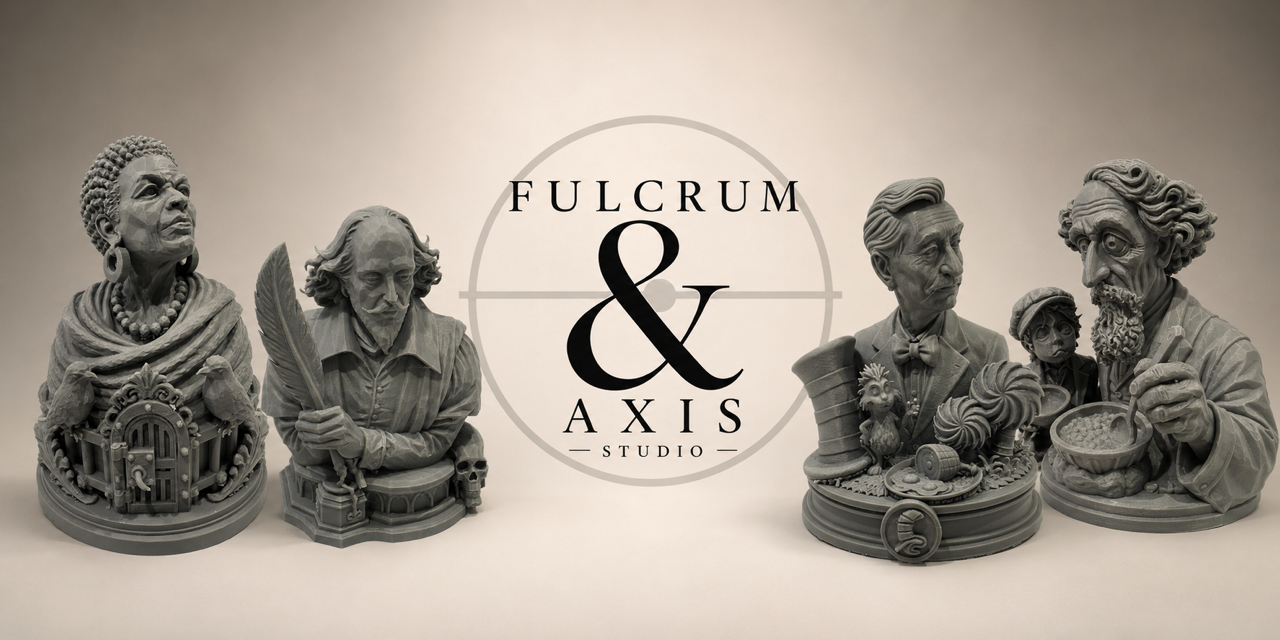
This Fulcrum & Axis Studio portrait presents Shakespeare surrounded by the instruments and symbols of that extraordinary legacy.
A monumental quill rises beside him. His hands gather around the act of writing while an inkwell and stacked books rest below. At his opposite side, a skull recalls Hamlet and Shakespeare’s lifelong fascination with mortality. Beneath everything stands a curved architectural base evoking the playhouse—the place where written language becomes living theater.
Shakespeare himself remains at the center of the composition. His lowered eyes and inward expression suggest a writer caught between thought and creation, as though the next character, speech, or tragedy is beginning to take shape somewhere within his imagination.
Presented as part of The Archive of the Great & Famous, the sculpture honors both the historical playwright and the astonishing body of work that continues to speak more than four centuries after his death.
The Story Within the Sculpture
The composition brings together several recognizable elements of Shakespeare’s life and legacy: the writer, the page, the stage, and the ever-present awareness of mortality.
Each detail contributes to the larger portrait.
The Portrait
Shakespeare appears in the broad collar, layered doublet, and full sleeves associated with the clothing of late Elizabethan and early Jacobean England.
His long forehead, narrow mustache, pointed beard, and curling hair draw upon the traditional visual image through which Shakespeare has become recognizable. Because no portrait of him can be treated as an unquestionable photographic likeness, the sculpture should not be understood as a claim to show precisely how he appeared in life. It presents the Shakespeare preserved within our cultural imagination.
His gaze is lowered rather than directed toward the viewer. The expression is serious and inward-looking, suggesting concentration rather than performance. He appears momentarily removed from the world around him, absorbed in whatever thought has yet to become language.
There is also a quiet weariness in the face. This is not Shakespeare depicted as a distant monument or untouchable genius. He appears human: thoughtful, burdened, observant, and surrounded by the work that will ultimately outlive him.
The curling hair that extends from either side of his head adds movement to the silhouette. Together with the rising feather and layered costume, it gives the portrait a theatrical energy without turning Shakespeare himself into a performer.
He remains the still point at the center of a world filled with words, characters, ambition, comedy, violence, love, and death.
The Quill
The oversized feather quill is the sculpture’s most dramatic visual element.
It rises almost as high as Shakespeare himself, making the act of writing physically inseparable from the portrait. Shakespeare is not merely shown holding a small historical accessory. His hands gather around an instrument monumental enough to symbolize the enormous reach of what was created through it.
Through Shakespeare’s writing came kings and rebels, lovers and murderers, soldiers and sorcerers, ghosts and witches, heroes, villains, fools, and ordinary people caught in extraordinary circumstances.
The exaggerated scale of the quill represents the power of written language to create entire lives from ink and imagination. Its upward movement also gives the composition a sense of possibility, as though the feather carries Shakespeare’s thoughts from the private space of the writer into the larger world.
The quill is both a practical instrument and an emblem of creation.
The Inkwell and Books
At the foot of the quill rests an inkwell surrounded by stacked volumes.
The inkwell connects the symbolic grandeur of the feather to the physical labor of writing. Shakespeare’s plays may now appear inevitable—as though they have always belonged to world literature—but they began through the difficult process of selecting, arranging, revising, rehearsing, and performing words.
The books represent preservation.
Shakespeare wrote primarily for the theater, but the survival of his work depended upon scripts being printed, collected, protected, and passed from one generation to the next. Many individual plays appeared during his lifetime in small printed editions called quartos. Seven years after his death, two of his fellow actors helped publish the great collected edition now known as the First Folio.
Without that volume, nearly half of the plays preserved under Shakespeare’s name might otherwise have been lost.
Together, the quill, ink, and books honor both forms of Shakespeare’s legacy: the living energy of performance and the written record that allowed his words to travel far beyond the stages and audiences of his own lifetime.
The Skull
At Shakespeare’s side rests a human skull, the sculpture’s most immediate connection to Hamlet.
During the play’s graveyard scene, Hamlet encounters the skull of Yorick, the court jester he knew as a child. What begins as the recognition of one familiar person expands into a meditation on the fate shared by every human being.
The skull therefore represents more than a famous theatrical prop. It evokes mortality, memory, grief, identity, and the inevitable disappearance of worldly power. Kings, jesters, conquerors, lovers, and writers all arrive at the same physical end.
Questions like these run throughout Shakespeare’s work:
What gives life meaning? What remains after death? What does power become when the person who possessed it is gone? How should we live while knowing that our time is limited?
Shakespeare repeatedly placed such questions in the mouths of people confronting uncertainty, loss, violence, betrayal, and change.
The skull also demonstrates his ability to transform a simple stage object into an enduring cultural symbol. A prop held by an actor became one of the most recognizable images in the history of theater.
Within the sculpture, the skull balances the quill. One represents creation; the other represents mortality. Shakespeare is positioned between them.
The Stage
The sculpture’s curved base, repeating arches, columns, and layered architectural details evoke the world of the Elizabethan playhouse.
It is not intended as a literal reconstruction of one particular theater. Instead, it creates the suggestion of a stage and reminds us that Shakespeare was not simply an author whose work belonged on a silent page.
His plays were created to be spoken, heard, watched, and shared.
They depended upon actors, costumes, music, entrances, exits, physical movement, audience reactions, and the transformation of an open platform into a palace, battlefield, forest, graveyard, island, or storm-tossed coast.
The stage is where Hamlet questions existence, Macbeth reaches for a crown, Lear walks into the storm, Juliet calls into the night, and Puck asks whether everything the audience has witnessed might have been a dream.
The architectural foundation therefore supports more than Shakespeare’s portrait. It supports the imaginative world created by his words.
Tragedy and Comedy
The skull, Shakespeare’s somber expression, and the weight of the architecture bring an atmosphere of tragedy to the sculpture. The flowing hair, rising feather, elaborate costume, and theatrical base introduce movement and performance.
That balance reflects the remarkable range of Shakespeare’s writing.
His tragedies explore murder, ambition, betrayal, jealousy, madness, political violence, family division, and death. His comedies turn toward mistaken identities, sharp exchanges of wit, romantic confusion, disguise, magic, reconciliation, and laughter.
Yet the boundaries between those forms are rarely absolute.
The darkest plays contain moments of comedy. The comedies acknowledge loneliness, cruelty, prejudice, danger, and loss. The later romances move through suffering toward forgiveness and reunion.
Shakespeare understood that human experience seldom belongs entirely to one genre. Love can be ridiculous and devastating. Power can be magnificent and hollow. Laughter can emerge beside grief, and tragedy can begin with choices that once appeared harmless.
The Complete Composition
Viewed as a whole, the sculpture creates a visual conversation between the page and the stage, imagination and performance, creation and death.
The quill rises on one side while the skull anchors the other. The inkwell and books preserve what Shakespeare writes. The architectural foundation prepares those words to be spoken before an audience.
Shakespeare stands at the center with his eyes lowered and his hands gathered around the instrument of creation.
The portrait does not attempt to illustrate one particular play or scene. Instead, it brings together the larger forces associated with Shakespeare’s legacy: language, theater, human conflict, imagination, memory, and mortality.
It presents him not simply as a famous face from literary history, but as a working playwright surrounded by the world his words helped create.
About William Shakespeare
William Shakespeare was born in Stratford-upon-Avon in 1564. His precise date of birth was not recorded, but he was baptized on April 26, and tradition has long observed his birthday on April 23.
His father, John Shakespeare, was a glove maker, merchant, and local official. His mother, Mary Arden, came from a landowning Warwickshire family.
No surviving record documents Shakespeare’s education directly, but he was likely educated at Stratford’s grammar school, where students studied Latin language, rhetoric, history, poetry, and classical literature. Those traditions would later become important sources for his plays.
In 1582, at eighteen, Shakespeare married Anne Hathaway. They had three children: Susanna and the twins Hamnet and Judith. Hamnet died in 1596 at only eleven years old.
The surviving record does not tell us precisely when Shakespeare left Stratford or how he first entered the theater. By the early 1590s, however, he was established in London as an actor, playwright, and increasingly prominent figure in the theatrical world.
He became a leading member and shareholder of the Lord Chamberlain’s Men, one of the most successful acting companies of the period. After James I came to the English throne in 1603, the company received royal patronage and became known as the King’s Men.
This was important to Shakespeare’s career. He was not simply a solitary poet handing completed manuscripts to strangers. He worked inside a collaborative theatrical company as a writer, actor, shareholder, and businessman.
He understood the practical demands of performance: what could be staged, what actors could accomplish, how an audience might react, and how language sounded when spoken aloud.
The company performed at several venues, most famously the Globe Theatre, built on the south bank of the Thames in 1599. The open-air theater could hold a large and socially diverse audience, from people standing near the stage to wealthier patrons seated in the galleries.
Shakespeare’s writing had to reach all of them.
The Plays
Shakespeare wrote across an extraordinary range of theatrical forms.
His histories dramatized struggles over the English crown, national identity, legitimacy, rebellion, warfare, and the uses and abuses of political power. These include Richard II, Henry IV, Henry V, Richard III, and the plays depicting the Wars of the Roses.
His comedies explored romance, disguise, mistaken identity, social expectation, language, desire, and transformation. Among them are A Midsummer Night’s Dream, Much Ado About Nothing, Twelfth Night, As You Like It, and The Merchant of Venice.
His great tragedies placed intensely recognizable people inside situations of overwhelming moral, political, and psychological pressure. Hamlet, Macbeth, Othello, and King Lear remain among the most frequently performed and examined plays ever written.
In his later romances—including The Winter’s Tale, Cymbeline, and The Tempest—Shakespeare often moved through jealousy, separation, and apparent death toward recognition, forgiveness, reunion, and renewal.
Some plays were written collaboratively, reflecting the communal nature of early modern theater. Shakespeare worked within a living artistic environment rather than creating every text in complete isolation.
The Poems
Shakespeare’s reputation rests not only upon the plays.
His narrative poems, including Venus and Adonis and The Rape of Lucrece, attracted considerable attention during his lifetime. His collection of 154 sonnets, published in 1609, explores love, beauty, desire, betrayal, aging, poetry, and the human effort to resist time.
Throughout the sonnets, language becomes a form of preservation. Beauty fades and bodies disappear, but the poem may carry some part of a person forward.
That idea lies close to the heart of Shakespeare’s own legacy. The man died, the original actors disappeared, and the first audiences passed away—but the words continued.
Characters Who Remain Human
Shakespeare’s characters endure because they seldom function as simple representations of good or evil.
They are jealous, ambitious, frightened, loving, foolish, courageous, cruel, witty, indecisive, generous, selfish, and painfully human. They misunderstand others and deceive themselves. They make choices for understandable reasons and discover consequences they never intended.
Hamlet thinks until thought becomes its own kind of prison. Macbeth recognizes the horror of his ambition but continues forward. Othello loves deeply and believes disastrously. Lear demands public declarations of devotion while failing to recognize genuine love. Falstaff is selfish, dishonest, hilarious, affectionate, and impossible to reduce to a single judgment.
Through these characters, Shakespeare explored power, identity, love, prejudice, revenge, family, mortality, political legitimacy, social performance, and the uncertain boundary between appearance and reality.
He rarely provides easy answers. Instead, he places different arguments, motives, and possibilities into conflict and allows the audience to wrestle with them.
Shakespeare and the English Language
Shakespeare possessed an extraordinary ability to make language feel immediate, memorable, and alive.
His writing moves between formal poetry and ordinary conversation, philosophical reflection and insult, ceremony and wordplay. A single play may contain royal speeches, private confessions, jokes, songs, threats, riddles, and moments of complete emotional exposure.
Many phrases associated with Shakespeare remain familiar because his plays gave them memorable dramatic form. His influence can be heard whenever people speak of a “wild-goose chase,” a “foregone conclusion,” “break the ice,” or declare that “all that glitters is not gold.”
Claims about precisely how many words Shakespeare “invented” are difficult to prove, because surviving texts do not always reveal how language was used in ordinary speech. What can be said confidently is that he displayed remarkable freedom in adapting words, shifting their grammatical functions, combining familiar terms, and using language in new and enduring ways.
The First Folio
During Shakespeare’s lifetime, many of his plays appeared individually in print, but no complete authorized collection was published.
In 1623, seven years after Shakespeare’s death, his fellow actors John Heminges and Henry Condell assembled a large volume titled Mr. William Shakespeare’s Comedies, Histories, & Tragedies—now commonly known as the First Folio.
The First Folio preserved thirty-six plays. Eighteen had not previously appeared in print, including Macbeth, The Tempest, Twelfth Night, Julius Caesar, and As You Like It.
Without that effort, some of Shakespeare’s most celebrated works might have disappeared.
The books beneath Shakespeare’s hands in this sculpture can therefore be understood as more than general symbols of literature. They also recall the physical preservation that allowed a theatrical career to become a worldwide literary inheritance.
His Final Years and Legacy
Shakespeare appears to have spent more time in Stratford during the later years of his life, although he maintained connections to London and the theater.
He died on April 23, 1616, and was buried inside Holy Trinity Church in Stratford-upon-Avon.
His death did not fix his work permanently in the past.
Every generation has returned to Shakespeare with new questions. His plays have been shortened, expanded, translated, modernized, relocated, filmed, musicalized, and interpreted through changing cultural perspectives. Productions have used his work to examine race, gender, class, empire, family, political authority, and personal identity.
His stories have inspired operas, ballets, novels, paintings, films, television programs, musicals, and works set in worlds he could never have imagined.
More than four centuries after his death, Shakespeare’s characters still enter rooms, fall in love, seize power, make mistakes, tell jokes, betray one another, ask impossible questions, and speak directly to audiences.
The stages have changed.
The players have changed.
The words continue.
Why Shakespeare Belongs in the Archive
Fame tells us that William Shakespeare is remembered.
Greatness asks us why.
Shakespeare belongs in The Archive of the Great & Famous not because he should be treated as an untouchable monument, but because his work continues to reveal something recognizable about human beings.
He understood that people perform different versions of themselves for lovers, families, rivals, rulers, and strangers. He recognized how power can corrupt judgment, how fear can distort love, how language can conceal or reveal truth, and how quickly comedy can turn toward pain.
His work helped shape the development of English-language theater and left a profound mark on literature throughout the world. Yet the plays have survived because they remain capable of becoming new again whenever actors step onto a stage.
Shakespeare was also a working writer and theatrical professional whose real life remains partially hidden behind incomplete records, later legends, and centuries of cultural reverence.
The Archive does not ask us to worship him. It invites us to encounter the work, consider its influence, question its assumptions, and decide why these words and characters continue to matter.
Crafted by Fulcrum & Axis Studio
The William Shakespeare portrait is available in all four standard editions:
Archive • Studio • Gallery • Museum
Fulcrum & Axis Studio prepares each digital sculpture for physical production using precision 3D-printing technology. Every portrait is individually printed, inspected, cleaned, finished, labeled, and packaged in our Greenville, South Carolina studio.
Each Shakespeare portrait includes:
- Durable PLA construction
- Individual print-quality inspection
- Informational collector’s sheet
- An explanation of the sculpture’s symbolism
- Protective packaging for storage, gifting, or shipment
Each piece is produced in small batches or printed to order rather than mass-produced.
Part of The Archive of the Great & Famous
The Archive of the Great & Famous is Fulcrum & Axis Studio’s expanding collection of sculptural portraits honoring the writers, thinkers, artists, and historical figures whose lives, work, and ideas became larger than a single lifetime.
Each portrait combines a recognizable historical figure with symbols connected to the subject’s life, imagination, achievements, and influence—creating something that is part portrait, part biography, and part physical storytelling.
William Shakespeare is one of the inaugural figures in Volume One of the Archive.
Contact Fulcrum & Axis Studio for current availability, ordering information, or the complete Archive catalog.
Leave a Reply