
Welcome Back to Seen / Unseen Greenville
This blog will still wander where life takes it—family, politics, recovery, culture, memory, whatever feels worth examining.
But I wanted to mark a direction I’m especially excited about.
THis will be an ongoing series exploring this place more deeply—its history, growth, contradictions, bright spots, blind spots, and the stories beneath the polished surface.
I’m not approaching it as an expert with all the answers.
Just someone from here who wants to look closer.
Greenville is a great town.
It is also a real one.
That’s where things get interesting.
The idea for this project did not arrive in some dramatic flash of inspiration.
It came while texting my friend Kate.
She asked what I had been working on, and I told her I had become interested in Greenville again—not just as the place where I live, but as a place with layers I may have taken for granted. The more I looked, the more it felt like there was more here than the usual version we are handed.
Kate told me she liked what I was doing with Greenville and that if I had the chance to pursue something meaningful, I should do it. She also asked if I had found cool people to interview yet.
I told her yes, a few possibilities, but that I had drifted into something else first.
I had gone online looking for videos about Greenville history and found surprisingly little with much depth. What I found instead were relocation videos, real estate channels, smiling drone footage, and polished summaries about why Greenville is one of the best places to move.
That has its place, I suppose.
But it also got me thinking.
I told Kate I love Greenville and wanted to understand my own roots here better. Then I said something half joking and half serious: sometimes it feels like people imagine Greenville history as nothing, then the Civil War, then rednecks, then today.
She laughed and asked, “Do they?”
Maybe not exactly. Maybe I was being unfair for the sake of humor. But I do think many of us carry simplified versions of where we live. We know stereotypes. We know civic talking points. We know the era when our own family entered the picture.
Then Kate said her dad moved here in 1972 because there was an airport and not many natural disasters.
And that, she said, is how she ended up here.
I loved that answer.
Because history is not always grand or poetic. Sometimes it is practical. Sometimes families land somewhere because jobs are available, roads make sense, the weather seems manageable, or life simply nudges them there.
I told her, “And textiles somewhere in there.”
She said yes, she definitely thinks of textiles.
Of course she does. Most of us do. Mills loom large in the Upstate story. They shaped towns, fortunes, labor, neighborhoods, identities, and generations of family life.
But even that story is not the beginning.
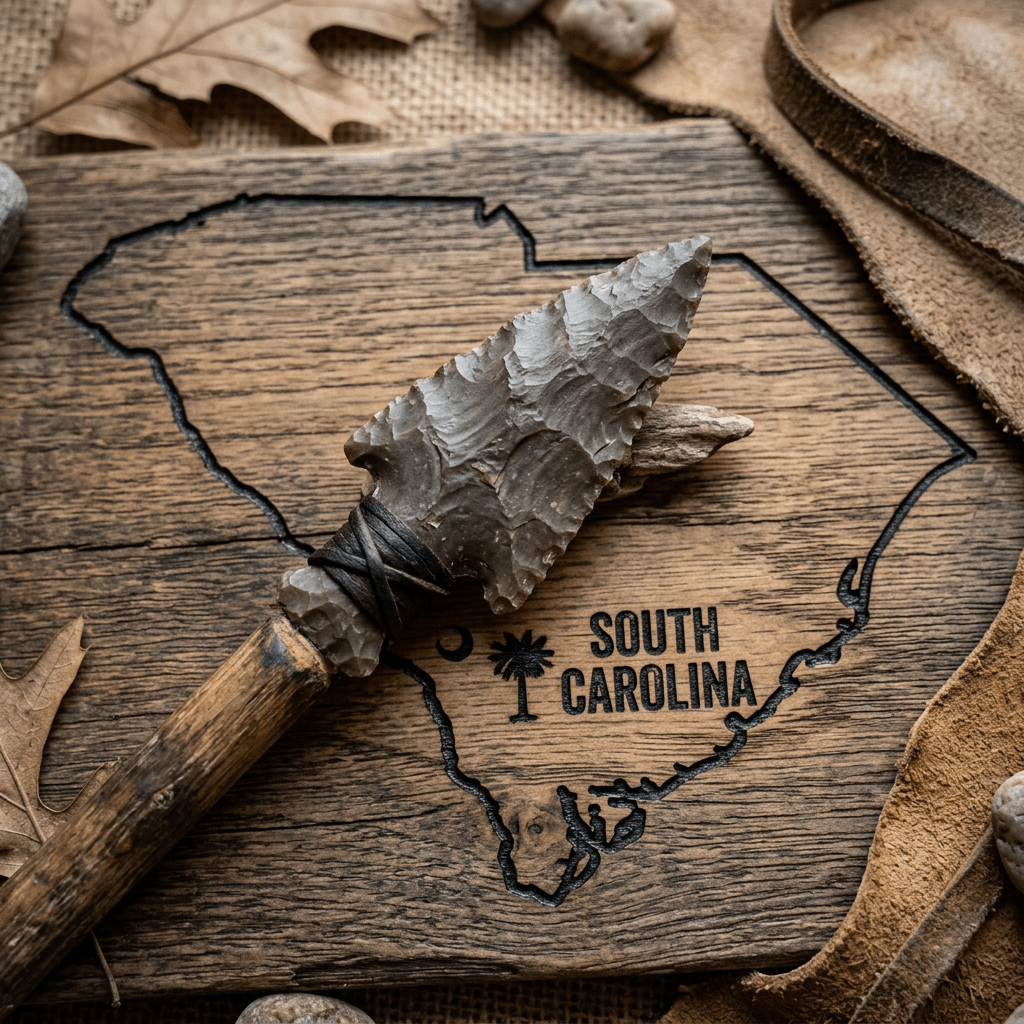
Later, my mom mentioned something I had forgotten. The lake house we recently sold at Lake Saluda, near Furman and Berea, had areas around it where Cherokee arrowheads were often found.
That made me stop for a moment.
I also remembered being in the mountains as a kid and finding arrowheads myself.
When you are young, discoveries like that feel like treasure. A mysterious old thing in the dirt.
When you are older, they begin to feel like evidence.
They suggest movement. Hunting routes. Campsites. Families. Repeated presence over long periods of time. People who knew this land in ways most of us no longer do.
If arrowheads were commonly found around Lake Saluda, in the foothills, and in the mountains, then this was not some empty place waiting for modern life to arrive.
It was active ground.
Known ground.
Lived-in ground.
That matters.
One thing I keep noticing is how easy it is to imagine history beginning when it becomes our history. When our family moved here. When our church was built. When our street was paved. When downtown became attractive again. When someone made a promotional video with soft music and a list of accolades.
But the land keeps older records.
Greenville is older than the version many of us know.
Older than mills.
Older than Main Street.
Older than us.
This does not need to become a lecture or a ritual of guilt. It can simply be an invitation to look more honestly at the place we live.
That is part of what I hope Seen Greenville / Unseen Greenville can become.
Not me pretending to be the authority.
Just a local person paying attention in public and inviting others to do the same.
So let me ask:
What do you know about Cherokee roots in the Upstate?
What places around Greenville, Berea, Travelers Rest, Furman, Paris Mountain, Lake Saluda, or the wider foothills hold stories people have forgotten?
Are there books, family stories, historians, trails, landmarks, names, or overlooked sites worth learning from?
Tell me.
Point me somewhere worth exploring.
Come be part of it.
Because maybe one of the best ways to love a place is not only to celebrate what it became, but to stay curious about what it was long before we arrived.
Want to Explore Greenville History Further?
If this piece stirred your curiosity, good. It did the same for me. I’m learning as I go, and part of this project is inviting others to learn alongside me. If you’d like to keep digging into Cherokee history, Greenville’s older roots, and the wider Indigenous story, here are strong places to begin.
Cherokee History in South Carolina & the Upstate
South Carolina Encyclopedia
Excellent starting point for readable history on the Cherokee in South Carolina, colonial encounters, trade, conflict, and removal.
https://www.scencyclopedia.org/South Carolina Department of Archives and History
Great for records, maps, treaties, and broader historical context.
https://scdah.sc.gov/University of South Carolina Digital Collections
Useful for old maps, documents, and regional records.
https://digital.tcl.sc.edu/Visit Oconee County / Keowee / Tamassee History
Western Upstate areas with deeper direct Cherokee historical ties than many Greenville residents realize.Museums & Places to Visit
Museum of the Cherokee People (Cherokee, NC)
One of the best nearby resources for Cherokee history, culture, language, and continuity.
https://motcp.org/Oconaluftee Indian Village
Living-history educational experience near Cherokee, NC.
https://cherokeehistorical.org/Cowpens National Battlefield
Helpful for understanding the Revolutionary-era Upstate and Native alliances of the period.
https://www.nps.gov/cowp/index.htmParis Mountain / Travelers Rest / Foothills Areas
Worth exploring with fresh eyes. Many modern routes and settlements often sit near much older pathways.Books Worth Reading
Cherokee Women by Theda Perdue
A respected and important perspective on Cherokee society and gender roles.The Trail of Tears: The Rise and Fall of the Cherokee Nation by John Ehle
Cherokee Removal collections and primary source readers
Look for Cherokee authors and scholars directly whenever possible.
Cherokee Communities Today
The Cherokee story did not end in the past tense. Explore the living nations:
Cherokee Nation
https://cherokee.org/Eastern Band of Cherokee Indians
https://ebci.com/United Keetoowah Band of Cherokee Indians
https://www.ukb-nsn.gov/Wider / Global Context

 Frank M. Anderson's Writing
Leave a comment