
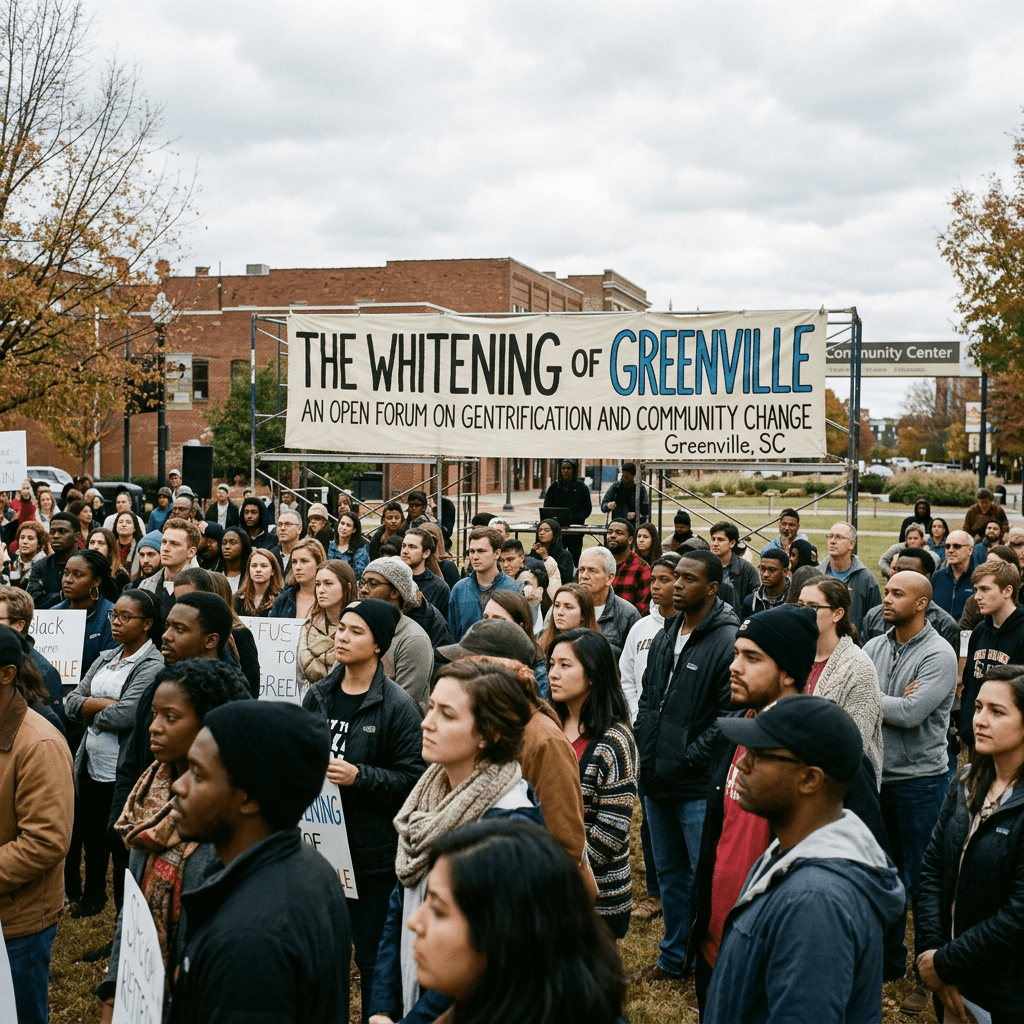
Greenville’s Favorite Story About Itself
Greenville loves the story it tells about itself. It is a story of redemption, polish, and smart civic leadership. A former mill town that once struggled with decline reinvented itself into one of the most celebrated small cities in America. Downtown was revived. Main Street became a destination. Falls Park on the Reedy became the postcard image. National magazines praised the city. Recruiters used it to attract talent. Realtors used it to attract buyers. Residents used it as proof that Greenville had finally arrived.
And to be fair, much of that story is true. Greenville is more vibrant, more attractive, and more economically active than it was decades ago. Public spaces matter. Civic pride matters. Beauty matters. No serious person should pretend the city gained nothing from its transformation.
But success stories are often selective. They focus on what was built while avoiding questions about what was displaced. They celebrate rising value while ignoring who could no longer afford to remain close enough to share in it. They praise momentum while staying quiet about the people asked to absorb its costs.
That is where the conversation about gentrification begins.
What Gentrification Actually Means
Gentrification is one of those words that gets thrown around so often it risks meaning nothing. Some use it to describe any new apartment building, any coffee shop, or any change they personally dislike. But the term has a more precise meaning.
Gentrification occurs when investment and higher-income residents move into historically lower-income or working-class communities, causing property values, rents, and taxes to rise until longtime residents are pressured out. New businesses emerge to serve a wealthier customer base. Neighborhood identity changes. What was once affordable becomes aspirational.
It is not simply development. It is development tied to displacement.
That distinction matters because Greenville defenders often respond to criticism as if the only options were stagnation or luxury growth. Cities need investment. They need renewal. They need jobs. But when growth is designed in ways that predictably remove poorer people from desirable areas, then growth deserves scrutiny, not automatic applause.
Greenville’s Favorite Myth: Growth Helps Everyone
Modern Greenville often operates on a comforting myth: that enough upscale development will eventually lift everyone else along with it.
Build the premium apartments. Build the boutique hotels. Build the townhomes, rooftop bars, mixed-use districts, entertainment corridors, and branded lifestyle spaces. Let wealth concentrate downtown and assume some of the benefits will trickle outward.
What usually spreads first, however, is not prosperity. It is rising land values, speculation, rent pressure, and a sense that neighborhoods once ignored are suddenly valuable only because wealthier people now want them.
When city leaders repeatedly prioritize expensive housing near opportunity centers while treating workforce housing like a burden or controversy, they are making a statement about who belongs near the center of civic life.
That is not just economics. It is values expressed through policy.
Downtown as Stage Set
Downtown Greenville is real. It is attractive. It is lively. It is also curated.
Walk through Main Street and you encounter a city built to impress. Restaurants, manicured streetscapes, festivals, high-end residential options, visitors taking photos, professionals gathering after work, couples on weekend getaways. It is a carefully assembled image of success, and again, there is nothing inherently wrong with that.
The problem comes when the stage set becomes the city’s moral argument.
Because once a place looks prosperous, many people stop asking deeper questions. Can a teacher comfortably live nearby? Can a line cook? Can the nursing assistant who works night shift? Can the retiree who has lived in the area for decades remain when taxes rise? Can a young family buy anything remotely close to downtown without outside wealth?
If the answer increasingly becomes no, then downtown has not become inclusive prosperity. It has become selective prosperity wearing the language of civic success.
The Quiet Removal of Black Proximity
One of the least discussed truths of Southern redevelopment is that proximity itself has value.
Many Black communities historically existed close to city centers because of segregation, labor patterns, and exclusion from suburban wealth-building. Those same locations were often underinvested in for generations. Streets needed repair. Services lagged. Schools struggled. The land was treated as less valuable because the people on it were treated as less valuable.
Then something changed. Downtown living became fashionable again. Walkability became desirable. Historic neighborhoods became marketable. Suddenly land once neglected became prime territory.
What was tolerated when Black and poor became coveted when profitable.
No public official has to announce racial intent for the outcome to carry racial meaning. In a society where wealth remains unevenly distributed along racial lines, a market-led reshuffling of who can live near the city center often produces a whiter outcome whether anyone says the quiet part aloud or not.
“No One Forced Anyone Out”
This is the standard defense of modern displacement. No bulldozers flattened blocks overnight. No one stood at a podium and declared that minority or working-class residents must leave. No openly racist ordinance was passed.
But twenty-first century displacement is usually cleaner than that.
A landlord raises rent. Property taxes climb faster than fixed incomes. Insurance costs rise. An investor buys several older homes on a street and reprices the standard. Wages stagnate while housing costs surge. A neighborhood slowly changes until longtime residents realize they no longer fit economically in the place they helped hold together.
You do not need force when monthly bills can perform the same function.
That is why so many discussions of gentrification become dishonest. People look for dramatic villainy while ignoring slow pressure. Yet slow pressure can be just as effective.
Woodruff Road and the Two Greenvilles
Woodruff Road tells the second half of the story.
While downtown was polished into a brand, outward growth spilled into traffic corridors, chain retail zones, apartment clusters, parking lots, and endless car dependency. Greenville did not simply become one better city. It split into two versions of itself.
One Greenville is the celebrated showcase—walkable, photogenic, expensive, nationally admired.
The other Greenville is the commuter landscape—crowded roads, rising suburban rents, long drives, functional but draining daily life.
Many workers help sustain the first Greenville while living in the second.
That arrangement is not unique, but it reveals how prosperity can be spatially organized so that comfort concentrates in one zone while inconvenience is distributed elsewhere.
Who Benefited, Who Paid
We should be honest about winners and losers.
Those who owned desirable property near growth zones often gained wealth. Developers and investors profited from rising demand. Businesses benefited from a stronger image and more visitors. Affluent newcomers gained access to a polished city at a moment of ascent.
Meanwhile, renters absorbed rising costs with no equity upside. First-time homebuyers found themselves priced out. Elderly residents on fixed incomes faced new pressure. Service workers commuted farther. Families with fewer resources had to choose between housing costs and proximity to jobs, schools, and community ties.
Growth was not neutral. It redistributed advantage upward.
Who Is to Blame?
People often soften this question by saying everyone is responsible a little. That is only partly true.
Power matters. Responsibility follows power.
Political leadership deserves the greatest scrutiny because leadership sets the rules. Officials determine zoning, incentives, infrastructure priorities, transit seriousness, and whether affordability is central or secondary. Greenville’s leaders deserve praise for helping create momentum. But they also deserve criticism for too often equating rising property values with public good.
Development interests did what such interests usually do: maximize return. That is predictable. But cities are supposed to govern markets, not simply celebrate them.
Comfortable residents also play a role when they support fairness rhetorically but oppose apartments, density, shelters, or lower-cost housing near themselves. Many communities want service workers nearby in theory, but not next door in practice.
So yes, responsibility is shared. But it is not equal.
The greatest blame belongs to those with the greatest power to shape outcomes and who chose image, growth, and rising value without equal commitment to belonging.
The Hardest Truth
Greenville did not simply become better.
It became more profitable.
Many people confuse those two things because they personally benefited from the transformation or enjoyed its visible results.
But a city should not be judged only by how well it markets itself, how many tourists it attracts, or how expensive its real estate becomes. It should also be judged by whether ordinary people can still live meaningful lives within it.
What Real Progress Would Look Like
Real progress would mean building housing for workers near opportunity, not only premium units for investors. It would mean protecting longtime residents from tax-driven displacement. It would mean taking transit seriously, not treating it as an afterthought. It would mean measuring success not just in cranes, ribbon cuttings, and rankings, but in whether teachers, mechanics, artists, nurses, restaurant staff, and retirees can still belong.
Greenville has mastered how to market itself.
It has not yet proven it knows how to share itself.

 Frank M. Anderson's Writing
Leave a comment