
Greenville is a city that likes to talk about what comes next.
We talk about growth, new restaurants, bike trails, development, rankings, housing prices, and whether traffic has finally become unbearable. We talk about what Greenville is becoming. That makes sense. Growing places often become a little obsessed with the future.
But places are not only future. They are also accumulated past.
One of the easiest mistakes modern people make is assuming history begins when it starts to look familiar to us—when our family arrives, when streets get names, when churches are built, when mills open, when photographs exist, when downtown becomes recognizable, when memory becomes convenient.
By that standard, Greenville can seem fairly young.
By any deeper standard, it is not young at all.
Long before Greenville was Greenville, long before Main Street or Augusta Road or Furman or Falls Park or suburban neighborhoods with tidy entrances and homeowner rules, this land was already known. Its rivers were known. Its ridges were known. Its valleys were known. The places where deer moved, where water ran clean, where storms rolled in, where paths were easier, where winter felt harsher, where shelter could be found—those things were known too.
This was not empty land waiting for history to begin.
It was already part of one.
That is where any honest story of Greenville should start.
The name Greenville belongs to a later chapter. Like many American place names, it came with settlement, governance, and the habit of renaming land as though giving it a new name made it new land. But land is older than names.
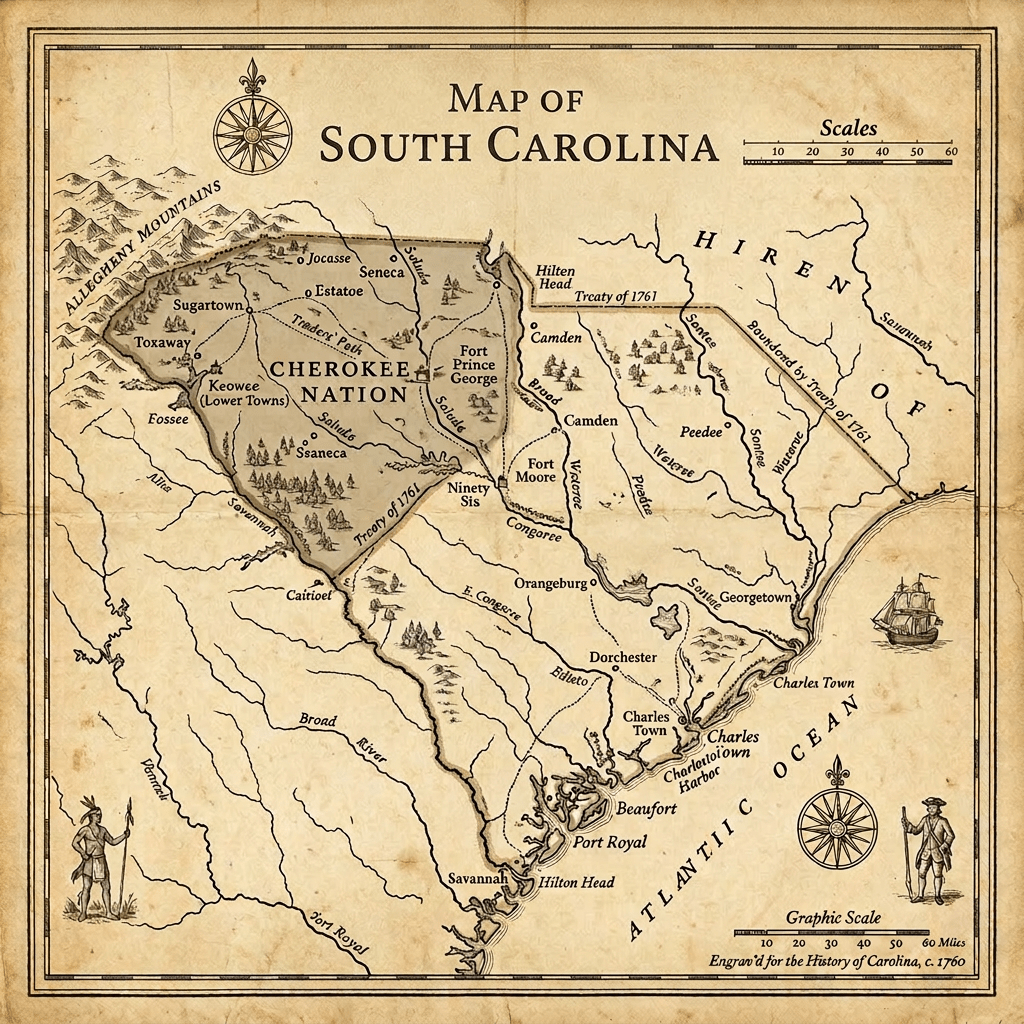
Before English names and county lines, this part of the Upstate existed within a larger Indigenous world. By the time Europeans entered the Southeast in greater numbers, the Cherokee were one of the major Native nations of the southern Appalachian region. Their communities and influence stretched across what is now western North Carolina, east Tennessee, north Georgia, northeast Alabama, and western South Carolina.
The strongest Cherokee towns in South Carolina were farther west, closer to mountain corridors and major rivers. Places like Keowee, Tugaloo, Estatoe, and Tamassee still echo through maps and road signs. Greenville likely sat more on the eastern edge of stronger population centers, but edges matter. Borderlands matter. Routes matter. Land between places often matters just as much as the places themselves.
That is one of the ways modern people misunderstand history. We look for cities because we know cities. We look for courthouses, skylines, plaques, and official centers. But older worlds often worked differently. A place could matter because people hunted there, traveled through it, gathered food there, crossed rivers there, met there, rested there, or simply knew it well across generations.
Greenville’s location made it useful long before it became prosperous.
Look at a physical map rather than a real estate brochure. Greenville sits near the Blue Ridge foothills, between mountain country and lower terrain, with streams, ridges, varied ecology, and natural movement corridors. That kind of land tends to attract people. It attracts animals too, which attracts people even more. Waterways like the Reedy River and the broader Saluda watershed would have mattered in practical ways for movement, fishing, hunting, orientation, and survival.
Before Falls Park was scenic, water was useful.
Before neighborhoods were desirable, terrain was meaningful.
Part of what pushed me deeper into this subject was something small and personal. My mother mentioned that the lake house our family recently sold at Lake Saluda had areas nearby where Cherokee arrowheads were often found. I also remembered finding arrowheads myself in the mountains as a child.
When you are young, those things feel like treasure. Strange little artifacts from some mysterious old time.
When you get older, they begin to feel like evidence.
They suggest repeated presence. Skill. Hunting. Travel. Craftsmanship. They suggest people who understood the land in ways most of us no longer do. We often expect history to announce itself through monuments and buildings, but sometimes the oldest evidence fits in the palm of your hand.
Modern Greenville can make older history hard to see. Development has a way of flattening memory. Parking lots cover soil. Subdivisions standardize terrain. Roads overwrite paths. Water gets landscaped and lit. Creeks hide behind shopping centers. The land becomes so built over that people forget why anyone built there in the first place.
But older logic still shows through if you pay attention.
Some roads curve in ways that feel older than modern engineering preference. Certain corridors still naturally pull movement north toward Travelers Rest and into mountain country. Neighborhoods cluster where useful land has always been useful. We inherit geography even when we forget it.
Then came settlement, and with it a different understanding of the land.
What had been homeland, route, hunting ground, and lived landscape became acreage, speculation, county territory, and future profit. Trade relationships with Europeans brought both opportunity and instability. Disease spread. Conflict increased. Pressure for land intensified. Treaties reduced Native control piece by piece, often under unequal conditions. By the Revolutionary era and after, settler expansion accelerated across the Upstate.
What some families later remembered as beginnings often began as someone else’s loss.
That can make people uncomfortable, but discomfort is not the same thing as accusation. No one living in Greenville today created the eighteenth century. Most of us are simply living ordinary lives inside inherited circumstances.
Still, inheritance can be examined honestly.
Acknowledging older dispossession does not require rejecting modern Greenville. It simply means refusing childish myths about empty land and uncomplicated progress. A mature love of place can hold more than one truth at a time.
Greenville can be beautiful and layered.
Successful and forgetful.
Warm and unequal.
Forward-looking and historically shallow.
Those tensions are not reasons to hate a place. They are reasons to know it better.
That is part of why this matters now. The way a city tells its beginnings shapes the way it understands belonging in the present. If Greenville began as empty ground transformed by effort, then success feels simple and self-created. If Greenville rose on already meaningful land shaped by older peoples and later displacement, then success becomes more complicated—and more honest.
Humility enters the story.
And humility is healthy for growing places.
Even now, traces of older worlds remain. Some survive in regional names like Keowee, Oconee, Jocassee, Tamassee, and Saluda. Some survive in artifacts found in fields and near water. Some survive in routes. Some survive in living Cherokee communities today, especially the Eastern Band of Cherokee Indians in nearby western North Carolina.
The Cherokee story did not disappear.
It adapted under pressure.
That distinction matters.
I do not want Seen / Unseen Greenville to become a place where people perform expertise or outrage. I would rather it be a place of better questions.
What Cherokee routes once passed near present-day Greenville?
What archaeological evidence exists in Greenville County?
How did settlers describe the land they entered?
What parts of this history were minimized because they complicated the local success story?
What public places in Greenville could acknowledge older truths more honestly?
Those are questions worth asking.
Greenville often markets itself through confidence. There is nothing wrong with confidence. But there is another kind of civic pride available too—the pride of a place willing to know itself more fully.
Not just the polished version.
Not just the profitable version.
Not just the version that begins when we became comfortable.
The fuller version.
Before Greenville was mills, before downtown revival, before rankings and relocation lists, before my childhood or yours, this region already had paths without pavement, names many of us no longer know, people who understood every ridge and waterway, and stories older than the city remembers.
Greenville did not begin with us.
We arrived in the middle of an already ancient story.

 Frank M. Anderson's Writing
Leave a comment