
Welcome Back to Seen / Unseen Greenville
This blog will still go wherever life takes it—family, politics, recovery, culture, memory, and whatever else feels worth talking about.
But I wanted to mark a direction I’m especially excited about.
Seen / Unseen Greenville will be an ongoing series where I take a closer look at this place—its history, growth, contradictions, bright spots, blind spots, and the stories beneath the polished surface.
I’m not coming at this as an expert with all the answers.
Just someone from here who wants to understand home a little better.
Greenville is a great town.
It is also a real one.
That’s where things get interesting.
This first piece is a bit of a rant, if I’m being honest. Before we dig deeper into Cherokee history and some of the older layers of this region, I think we have to talk about a few truths that are still right in front of us.
Greenville has become very good at presenting itself.
We know how to photograph downtown at the right angle. We know how to talk about growth, awards, restaurants, trails, revitalization, and quality of life. We know how to market ourselves as one of the South’s success stories.
Some of that story is true.
Greenville has many good things going for it. It can be beautiful here. There are kind people here. There has been real progress. I love this place enough to want to understand it honestly.
But polished surfaces can hide a lot.
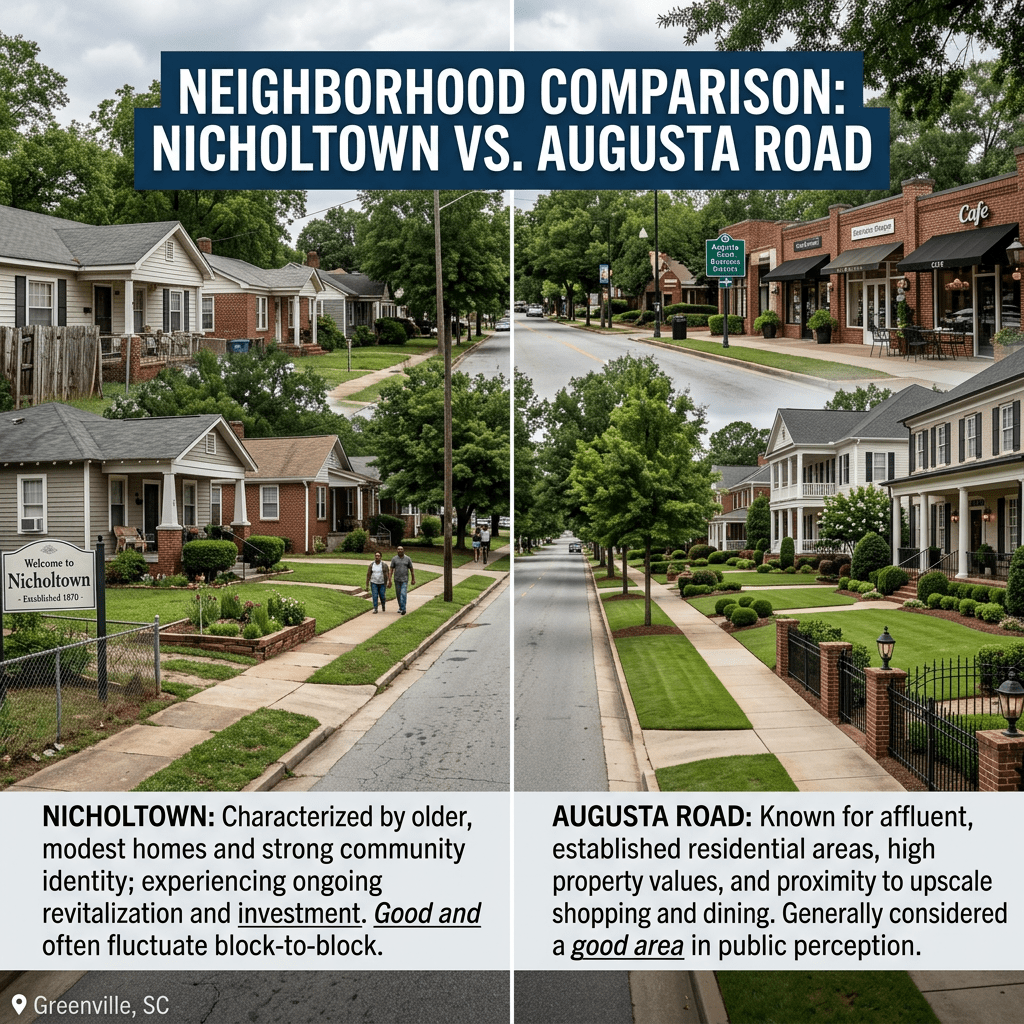
I grew up in the Augusta Road area, only a short distance from Nicholtown. On paper, we were close neighbors. In lived reality, it often felt like different worlds separated by more than a few streets.
We had our parks.
They had theirs.
We had neighborhoods that felt protected, desirable, and consistently cared for. Other neighborhoods often felt discussed only when something had gone wrong, or when someone outside them had decided they needed to be “fixed.”
That contrast stays with me.
It would be easy to pretend all of that belongs to the distant past, but much of Greenville’s present still sits on foundations laid during segregation. Sometimes those foundations are visible. Sometimes they are disguised as normal patterns, market outcomes, tradition, or simple coincidence.
Where people live is rarely random.
Where investment flows is rarely random.
Which schools are celebrated and which struggle is rarely random.
Which neighborhoods are described as charming, historic, up-and-coming, dangerous, transitional, or forgotten is rarely random.
We inherit maps whether we realize it or not.
Greenville did not invent these dynamics. Nearly every American city has them. But our local version often hides behind courtesy and civic pride.
We are generally polite people.
We do not always like direct conversations about race or class.
We prefer smoother language.
We talk about traffic, growth, crime, schools, “changing areas,” and protecting neighborhood character. Sometimes those phrases mean exactly what they say. Sometimes they carry older meanings just beneath the surface.
That surface becomes even more revealing when we look at labor.
We all see who is helping build modern Greenville.
Construction crews in the heat. Landscaping teams in front yards. Hospitality workers. Kitchen staffs. Cleaning crews. Roofers. Painters. Delivery drivers. People doing difficult work that keeps the local economy moving.
Yet public conversations about immigrants can be filled with suspicion, resentment, or convenient political outrage.
That contradiction deserves honesty.
A city cannot quietly depend on people’s labor while loudly denying their dignity.
The same can be said of race more broadly. Greenville often wants the benefits of diversity without the discomfort of integration. We enjoy cultural variety, food, festivals, and workforce growth more easily than we confront unequal power, unequal opportunity, or the lingering geography of exclusion.
Even some old neighborhood covenants and deed language tell their own story. Though legally unenforceable now, remnants of those restrictions still exist in documents and memory. They are reminders that separation here was not accidental.
It was designed.
That does not mean everyone living here today is guilty of something. It does mean everyone living here today inherits something.
And inheritance can be examined.
To be clear, this is not an argument that Greenville is uniquely bad. It is not. There are many places with harsher divides, deeper corruption, uglier tensions, and less progress.
But that comparison can become an escape hatch.
The question is not whether Greenville is worse than somewhere else.
The question is whether we are willing to see ourselves clearly.
Because Greenville is, in many ways, a genuinely good town.
It is also a real town.
Real towns have winners and losers. They have neighborhoods treated differently. They have people welcomed publicly and excluded quietly. They have histories that continue after the headlines move on.
That is why I wanted to begin this series here.
Before we talk about Cherokee displacement, mill power, old money, downtown reinvention, or the stories buried under modern branding, we should admit something simpler first:
We still struggle with the stories right in front of us.
So let me ask:
What divides in Greenville have you seen that people prefer not to discuss?
What bridges have you seen built?
What neighborhoods changed, improved, declined, or were overlooked?
What truths are uncomfortable but worth saying?
This project is not about attacking Greenville.
It is about refusing to flatter it into shallowness.
Because the places worth loving are usually the places worth telling the truth about.
Want to Explore Greenville History Further?
If this piece stirred your curiosity, good. It did the same for me. I’m learning as I go, and part of this project is inviting others to learn alongside me. If you’d like to keep digging into Greenville’s history, identity, contradictions, and older roots, here are a few places to begin.
Earlier Seen / Unseen Greenville Posts
Seen / Unseen Greenville: Let’s Begin With Our Cherokee Roots
A starting point on the older story beneath modern Greenville, and why Cherokee history deserves a closer look.
https://fulcrumandaxis.com/2026/04/25/seen-unseen-greenville-lets-begin-with-our-cherokee-roots/Seen / Unseen Greenville: This Place Has Never Been One Thing
On Greenville’s shifting identity, multiple eras, and why simple narratives rarely tell the full truth.
https://fulcrumandaxis.com/2026/04/24/seen-unseen-greenville-this-place-has-never-been-one-thing/What’s Going On Here? And Who I Am
A broader introduction to the project, the blog, and why I’m trying to look more honestly at life and place.
https://fulcrumandaxis.com/2026/04/24/whats-going-on-here-and-who-i-am/Helpful Research Sources
South Carolina Encyclopedia
A strong resource for state and regional history.
https://www.scencyclopedia.org/South Carolina Department of Archives and History
Records, maps, timelines, and primary source materials.
https://scdah.sc.gov/Greenville County Library System
Often one of the best overlooked resources for local history books and archives.
https://www.greenvillelibrary.org/Museum of the Cherokee People
One of the best nearby places to learn Cherokee history and continuity.
https://motcp.org/Questions Worth Asking
- What story of Greenville did you grow up with?
- What parts were left out?
- Which neighborhoods changed the most?
- What older histories still shape present-day life?
- What local voices should be heard more?
If You Know Something
If you have books, memories, corrections, resources, or stories worth sharing, send them my way.
This project is not about pretending to know everything.
It is about paying better attention together.

 Frank M. Anderson's Writing
Leave a comment