
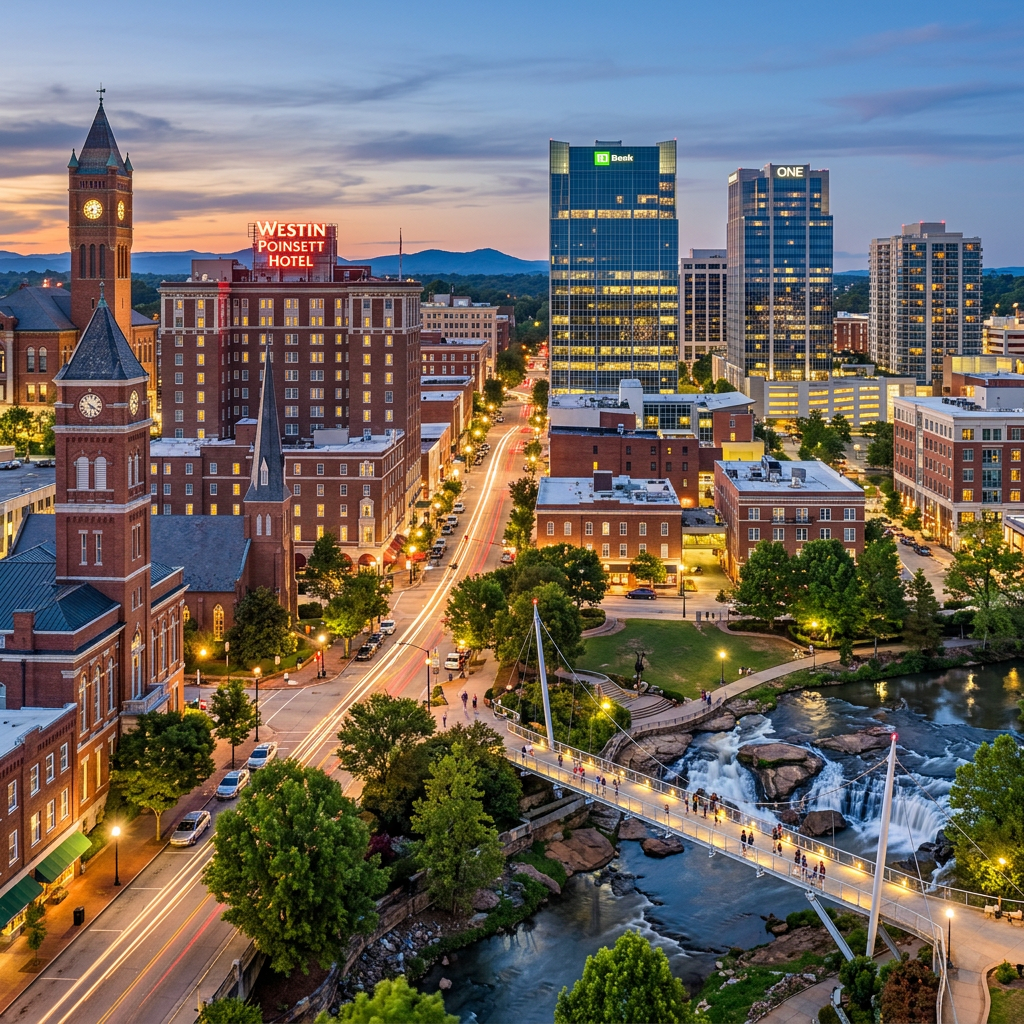
When people talk about Greenville, they usually talk about it like it is one place with one shared experience. A single city moving in one direction with one story to tell.
But that has never really been true.
Greenville is several Greenvilles at once. Different versions of the same city, living beside each other, shaping each other, sometimes helping each other, sometimes barely noticing one another. You can move through multiple economic realities in the time it takes to run a few errands.
That is part of what makes Greenville interesting. It is also part of what makes it complicated.
When I think about Greenville honestly, I tend to think about four broad Greenvilles: Rich Greenville, Working Greenville, Changing Greenville, and Forgotten Greenville.
Rich Greenville
Rich Greenville is the version most likely to end up in brochures, relocation rankings, and polished real estate videos. It is the Greenville of beautiful homes, established neighborhoods, mature trees, and a sense of comfort that feels settled in.
You see a lot of this on the east and southeast side of the city and in some of the most desirable in-town neighborhoods. Augusta Road, Alta Vista, Cleveland Forest, Parkins Mill, parts of North Main, and some nearby suburban enclaves all fit somewhere into this picture.
There is nothing wrong with prosperous neighborhoods. Every city should want places that are safe, stable, and attractive. Success is not the enemy.
But wealth often brings influence. These areas tend to have more access, stronger networks, and a louder voice when decisions get made. That is not a conspiracy. It is simply how power often works.
Working Greenville
Working Greenville is the version of the city that keeps everything running.
It is the Greenville of teachers, nurses, retail workers, cooks, mechanics, office staff, warehouse crews, delivery drivers, tradespeople, and families trying to make a life while juggling rising costs.
You find Working Greenville all over the map, but especially in middle-income neighborhoods, apartment communities, modest subdivisions, and county-edge areas where people moved because they could still afford a little space. Parts of Berea, Wade Hampton areas, Taylors, west side neighborhoods, southern apartment corridors, and many stretches outside the postcard version of town carry a lot of this reality.
This Greenville often feels every squeeze first. Rent goes up. Insurance goes up. Gas goes up. Childcare goes up. The commute gets longer. Yet these are the people who make daily life possible.
A lot of Greenville’s success stands on shoulders that do not always get much recognition.
Changing Greenville
Changing Greenville is where tension lives.
This is the Greenville of neighborhoods in transition. Older homes being renovated. New apartments rising where warehouses or empty lots once stood. Formerly overlooked areas suddenly being marketed as the next hot place to live.
You see this in parts of the west side, Village of West Greenville, Poe Mill surroundings, southern corridors, edge areas near downtown, and scattered pockets wherever investment has started to notice undervalued land.
Some of this change is good. Buildings get restored. Streets feel safer. New businesses arrive. Neglected spaces come back to life.
But change also creates fear. Longtime residents worry about taxes, rent increases, and whether the place they helped hold together will soon belong to someone else. They worry that local character gets replaced by branding.
That fear is not always irrational. Sometimes it is memory speaking.
Forgotten Greenville
Forgotten Greenville is the version that receives the least attention unless something goes wrong.
These are the roads people pass through but rarely stop in. Aging commercial strips. Tired apartment clusters. Infrastructure that feels patched instead of renewed. Places that do not make lifestyle magazines or chamber-of-commerce videos.
You can find pieces of this along neglected corridors, older industrial edges, certain motel stretches, underinvested pockets outside downtown’s glow, and scattered areas in both city and county where people feel overlooked.
Forgotten Greenville does not mean empty Greenville. People live there, work there, love there, and build lives there.
It simply means the broader civic story does not spend much time looking in that direction.
The Real Story of Greenville
What makes Greenville so fascinating is that all four of these places exist close together.
You can leave a wealthy historic neighborhood, drive through a changing corridor, pass a struggling commercial strip, and end up in a middle-class subdivision in less than twenty minutes.
That closeness creates misunderstanding. People assume their Greenville is the only Greenville.
But it also creates possibility. Resources are not far from needs. Success is not far from struggle. Opportunity is not far from neglect.
What I Hope We Aim For
I do not think the goal should be attacking successful neighborhoods or pretending growth is bad.
And I do not think the goal should be acting like every new building equals progress.
The better goal is making Greenville’s growth feel broader and more shared.
Can working people still afford to live here? Can neighborhoods improve without losing their soul? Can overlooked areas receive real investment? Can prosperity feel like something more than a few favored pockets doing well?
Those are harder questions than where to build the next trendy restaurant district, but they matter more.
End Thought
I love Greenville enough not to flatten it into a slogan.
It is beautiful in some places, strained in some places, hopeful in some places, and unfair in some places.
Like most real cities.
If we can be honest about all four Greenvilles, we might have a chance to build a fifth one that belongs to more people.

 Frank M. Anderson's Writing
Leave a comment