
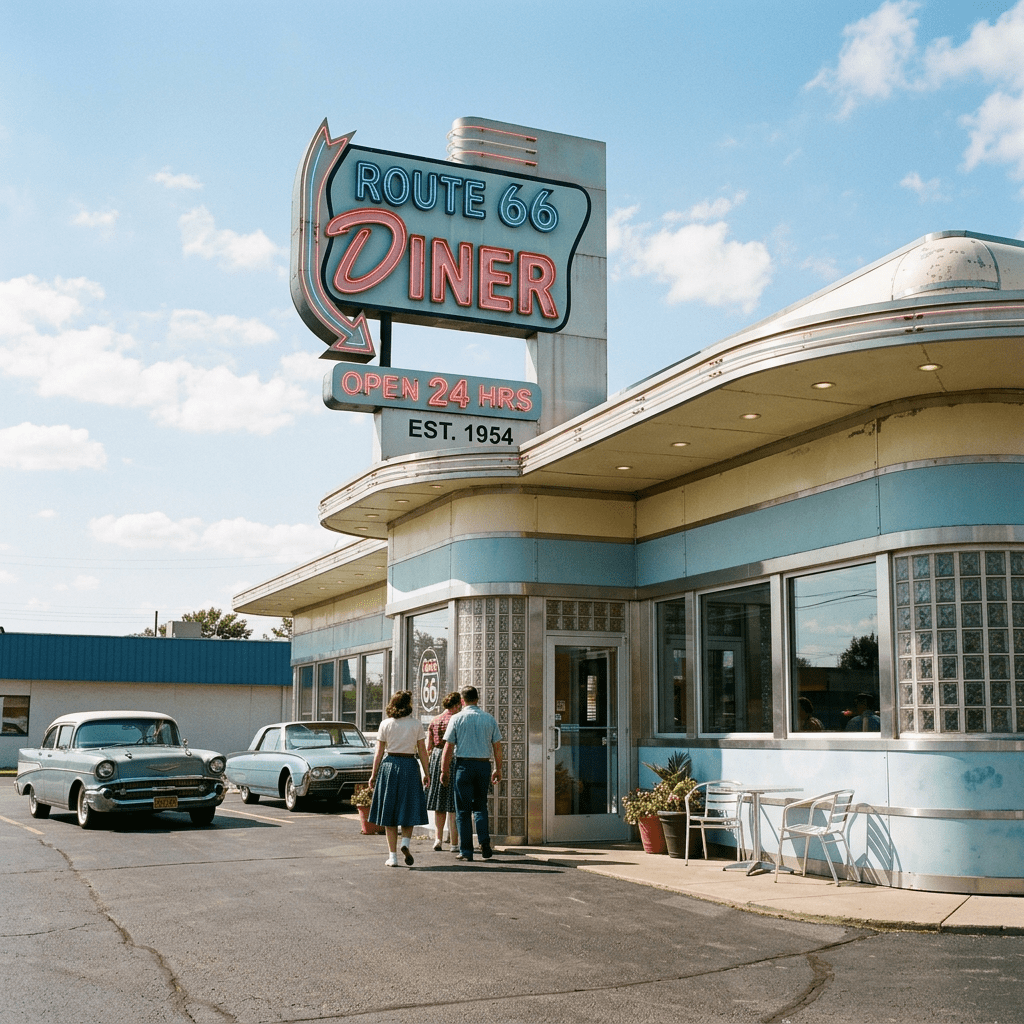
If you grew up in Greenville, chances are you have a Clock story.
I do too.
But before I even think about The Clock or Pete’s, I think about Como’s Pete’s.
As a kid, that place felt permanent.
I can still see it clearly — sitting in the booth, staring at the menu longer than I needed to, already knowing what I was going to get but reading it anyway. The way the plates were laid out. The mix of burgers and fries, pasta, Greek food, and everything else that didn’t quite make sense together but somehow worked.
It wasn’t just a restaurant. It was a place you returned to without thinking about it.
And I think that’s what a lot of these Greek-style family restaurants were.
Now, for me, that role has shifted to places like Palmetto Fine Foods on Laurens Road — one of the last nearby spots that still carries that same feeling. A place where you can sit down, take your time, and order something that feels like it came from a tradition instead of a system.
But even that feels like it belongs to a fading category.
Because places like Como’s Pete’s didn’t just change — they drifted.
Ownership shifts. Menu changes. Renovations. Rebranding. A slow erosion of whatever made them feel fixed in time. You don’t always notice it happening while it’s happening. One day you just realize the place you remember isn’t really there anymore, even if the building still is.
And that’s when you start asking questions.
Like the one I’ve heard my entire life:
“What’s the deal with all the Clocks?”
Especially the two that sit practically next to each other. The story everyone seems to know — or thinks they know — is that two brothers inherited the property, didn’t get along, and split into separate restaurants.
I don’t know if that story is completely true.
But it feels true in a deeper way.
Because the real history of Greenville’s Clock and Pete’s restaurants isn’t one clean origin story. It’s something more human — and more complicated.
Greek immigrants began building restaurants across the South in the early-to-mid 1900s as one of the most accessible paths into business ownership. In places like Greenville, those restaurants didn’t just succeed — they multiplied.
Someone would start at one restaurant.
Learn the business.
Save money.
Then open another.
A cousin would join.
A nephew would branch off.
A partnership would split.
Another location would appear across town.
Over time, what you got wasn’t a chain.
You got a network.
That’s why Greenville ended up with this strangely familiar but loosely connected landscape:
The Clock.
The Big Clock.
Pete’s.
Petee’s.
Jimmy & Pete’s.
Como’s Pete’s.
Some are related.
Some were related.
Some insist they never were.
The lines blur.
And honestly, that organic weirdness is part of what made them feel real.
These places weren’t designed.
They evolved.
Family disagreements, inheritance splits, handshake deals, long hours, second chances — all of it became embedded in the physical landscape of the city.
In a strange way, those restaurants are like family trees you can sit inside.
And maybe that’s why the “two brothers” story sticks around.
Even if the details aren’t exactly right, it captures something essential:
These places were built by people, not systems.
They weren’t optimized.
They were lived in.
You could feel it in everything.
The massive menus.
Breakfast at any hour.
Greek salads next to burgers next to spaghetti next to country fried steak.
Waitresses who remembered faces.
Construction workers at sunrise.
Teenagers late at night.
Families after church.
People sitting alone with coffee, taking their time.
Those restaurants occupied a middle ground we’re slowly losing.
Not fast food.
Not luxury dining.
Not curated “experiences.”
Just somewhere you could go and stay awhile.
As Greenville has grown, a lot of those places have quietly disappeared, changed, or been pushed to the margins. In their place, we’ve gotten something cleaner, more polished, more efficient.
And to be fair, some of that change is good. Greenville is more vibrant than it used to be. Downtown is beautiful. There are incredible local businesses here.
But there’s also a tradeoff.
Because when everything becomes more curated, more optimized, more expensive, you start to lose the spaces that weren’t trying to be anything other than useful.
The Clocks and Pete’s weren’t trendy.
They weren’t designed for tourists.
They weren’t built around branding.
They were practical.
Affordable.
Flexible.
Human.
And they served a purpose that’s getting harder to find.
They were third places.
Not home.
Not work.
Not something you had to plan or book.
Just somewhere you could exist around other people.
That matters more than we like to admit.
Especially now.
Because for all the convenience we’ve built into modern life — drive-thrus, apps, delivery, speed — something has been lost in the process.
A sense of permanence.
A sense of familiarity.
A sense that a place will still be there when you come back.
When I think about Como’s Pete’s, I don’t just think about food.
I think about being a kid and assuming it would always be there.
I think about the weight of the menu in my hands.
The sound of the room.
The feeling that nobody was in a hurry to push you out the door.
That kind of place is hard to recreate.
And easy to lose.
Now, when I walk into somewhere like Palmetto Fine Foods, I can still feel a piece of it. Not exactly the same — it never is — but close enough to remind me what those restaurants once provided.
Not just meals.
Continuity.
Belonging.
A place in the rhythm of a city.
And maybe that’s why people still talk about the Clocks the way they do.
Not just as restaurants.
But as something that used to hold a little more of Greenville together than we realized at the time.
As the city keeps growing and changing, the question isn’t just what gets built next.
It’s what we’re willing to let disappear.
Because once those places are gone, they don’t come back the same way.
And we don’t always notice what they meant until they’re already fading.

 Frank M. Anderson's Writing
Leave a comment