
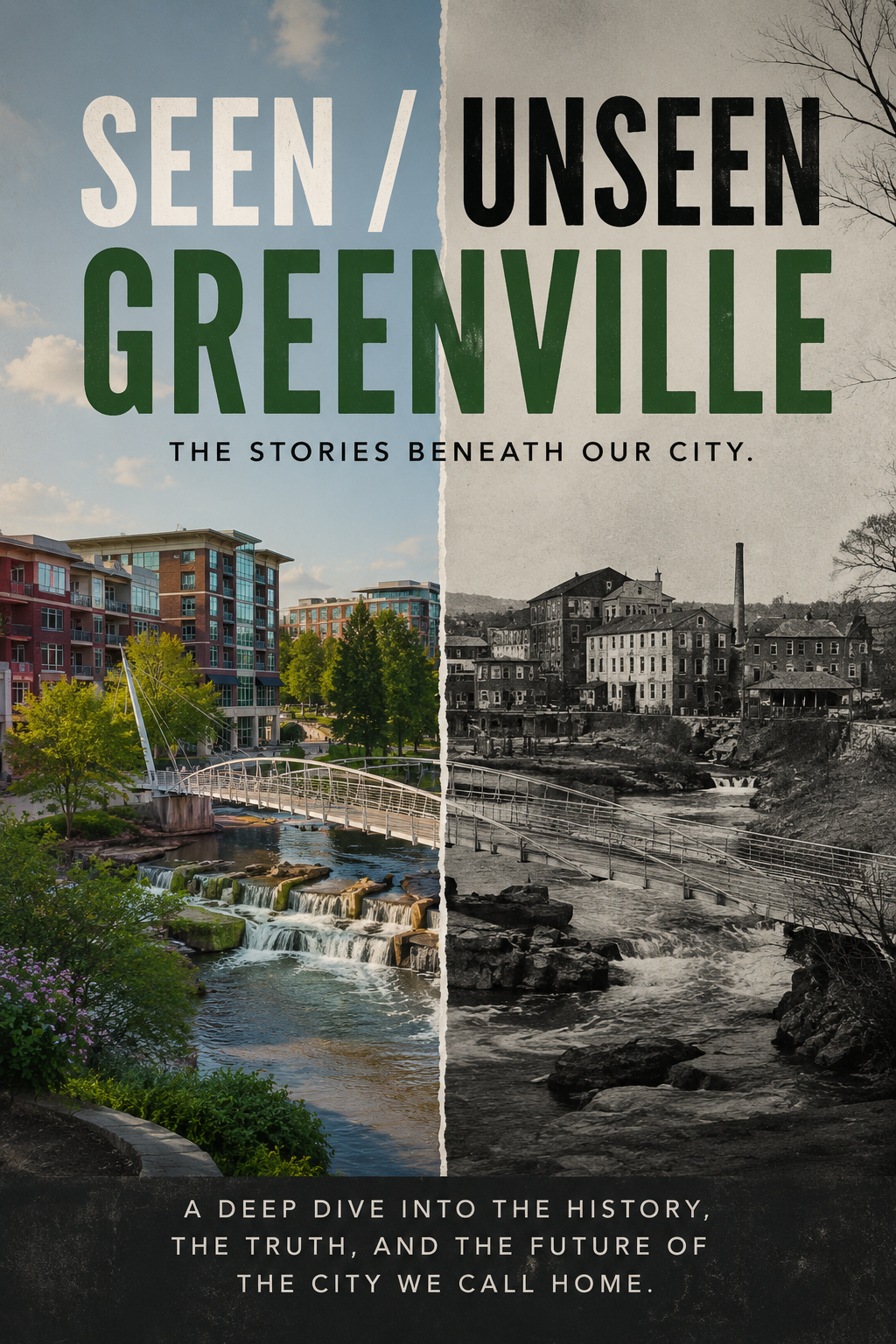

Many Versions of Kind explores the moral and emotional side of Greenville’s growth and identity.
This path asks harder questions about what it actually means for a city to be “good,” not just successful, polished, or profitable.
It examines the difference between being nice and being kind, how systems affect belonging, who benefits from growth, who gets left behind, and how communities balance progress, responsibility, empathy, and reality.
At its core, Many Versions of Kind is about the human side of civic life:
how people live together,
what they owe each other,
and what kind of city Greenville is becoming beneath the surface.
One thing I’ve been thinking about lately is how uncomfortable it is to exist in the middle of complicated things.
Not the fake middle.
Not the “both sides are always equally right” middle.
Not the lazy middle where people refuse to take a stance on anything.
I mean the weird middle.
The place where you realize multiple things can be true at once.
I was thinking about this while watching a local argument unfold over a housing bill. One side framed it as administrative efficiency — a simple procedural modernization to help housing authorities function more effectively in Magistrate Court. The other side saw it as another system tilting institutional power further away from vulnerable tenants in a city already struggling with housing pressure and eviction realities.
And honestly?
I could see parts of both arguments.
That’s the uncomfortable part.
Because once you start engaging with systems honestly, certainty becomes harder to maintain.
You start realizing:
businesses matter, but unchecked profit motives can absolutely distort communities.
Development creates opportunity, but displacement is real.
Social programs help people, but bureaucracy can become rigid and self-protective.
Markets create innovation, but markets alone do not create justice.
Personal responsibility matters, but people are also shaped by the systems around them.
That tension is exhausting.
It would honestly be easier to fully slide into one political tribe or another and let the group do the thinking for me. I’ve thought about that many times. Human beings naturally want certainty. We want moral clarity. We want our side to feel fully correct and the other side to feel fully wrong.
Simple answers are emotionally satisfying.
That’s part of why modern politics keeps drifting toward simplification. Trump is probably the easiest modern example because his political style turns incredibly complicated social and economic systems into emotionally clean narratives with villains, heroes, betrayal, nostalgia, and certainty.
But Democrats fall into the same trap too, just in different ways.
Everyone does.
Social media rewards certainty far more than reflection. Outrage spreads faster than nuance. “Here’s the villain” will always outperform “Here’s a complicated system with competing incentives and unintended consequences.”
The older I get, the more I think this same tension exists everywhere — even in the difference between a city being nice and a city being kind.
I wrote recently that Greenville has become very good at being nice. Clean spaces. Polished development. Comfortable experiences. The kind of city that photographs well and makes visitors feel welcome.
But kindness is harder.
Kindness asks who gets left behind.
Who absorbs the cost of growth.
Who can still afford to belong here as the city improves.
Who systems are actually built to serve.
Nice doesn’t require hard tradeoffs.
Kind does.
And honestly, I think that may also be true politically.
It is easy to sound compassionate.
Easy to sound strong.
Easy to simplify problems into heroes and villains.
It is much harder to wrestle honestly with competing needs, unintended consequences, incentives, and imperfect systems while still trying to remain humane.
That’s the weird middle.
Not because balance is always correct.
Sometimes one side really is more right about something.
But because reality itself is complicated.
And Greenville is a perfect example of that complexity.
This city wants growth and preservation.
Investment and authenticity.
Walkability and car infrastructure.
Luxury development and affordability.
Tourism and local identity.
Business expansion and small-town character.
We want Greenville to grow without becoming Atlanta.
We want density without traffic.
Development without displacement.
Progress without losing ourselves.
That is not an easy equation to solve.
And honestly, I think a lot of the frustration people feel right now comes from realizing that civic life is much harder than slogans make it sound.
Balance doesn’t sell well.
Balance requires restraint.
Foresight.
Compromise.
Humility.
Long-term thinking.
The willingness to admit your own side can be wrong sometimes.
That’s difficult work.
I think about this personally too.
My dad owns a lot of property. He’s much more of a businessman than I am. I probably lean more idealistic than he does. Sometimes I question whether businesspeople fully live up to the level of responsibility I think ownership should require.
But I also understand that systems cost money. Buildings cost money. Maintenance costs money. Bad decisions have consequences. Reality is messier than pure idealism wants to admit.
So even there, I end up back in the weird middle:
trying to weigh responsibility against practicality,
justice against efficiency,
idealism against reality.
Maybe that’s what maturity actually is — personal or civic.
Not becoming cynical.
Not becoming blindly ideological.
But learning how to sit inside uncomfortable truths without immediately running toward simple answers.
Maybe the hardest thing a city can do is resist becoming addicted to certainty.
And that may be the hardest thing a person can do, also.
Leave a Reply