
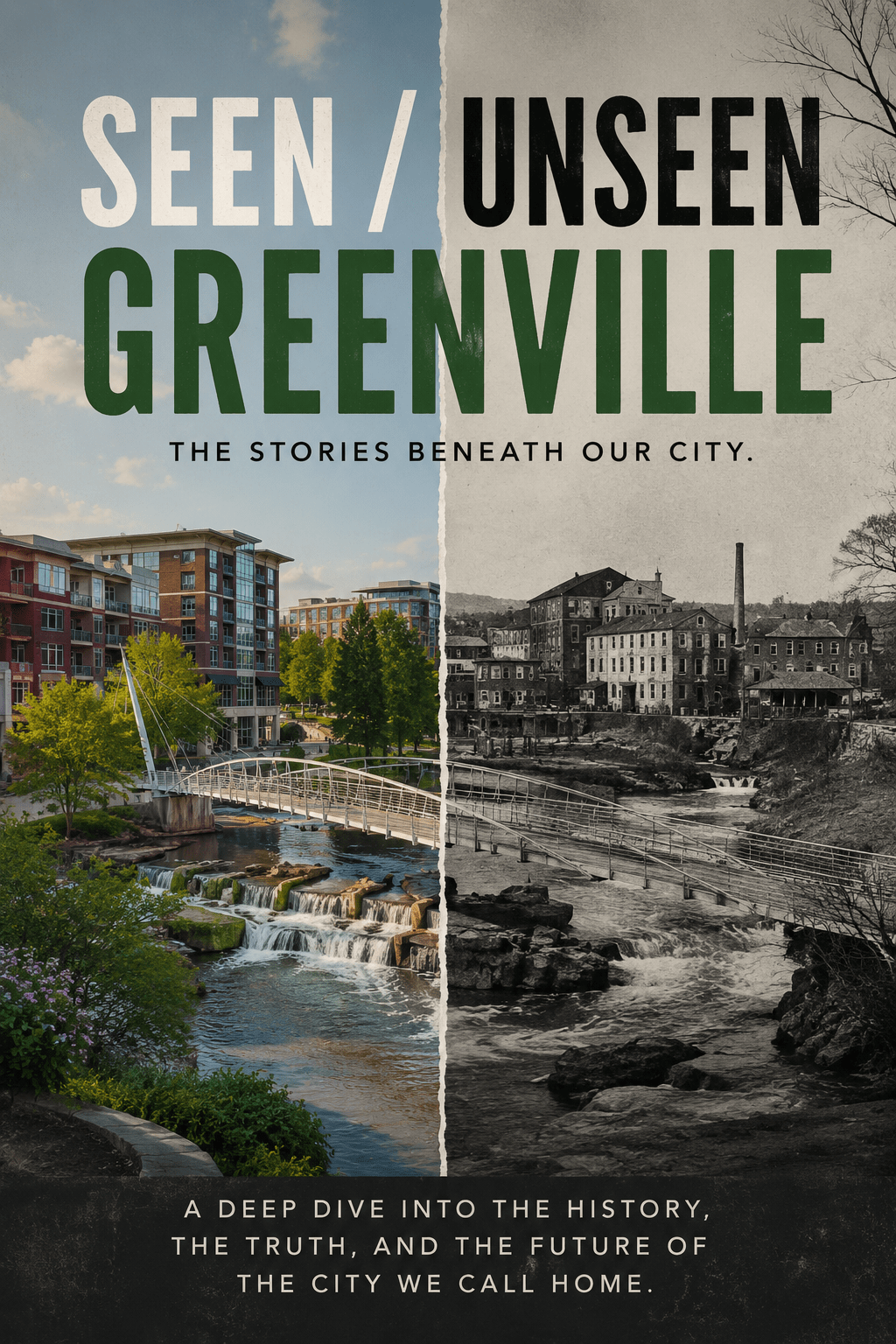
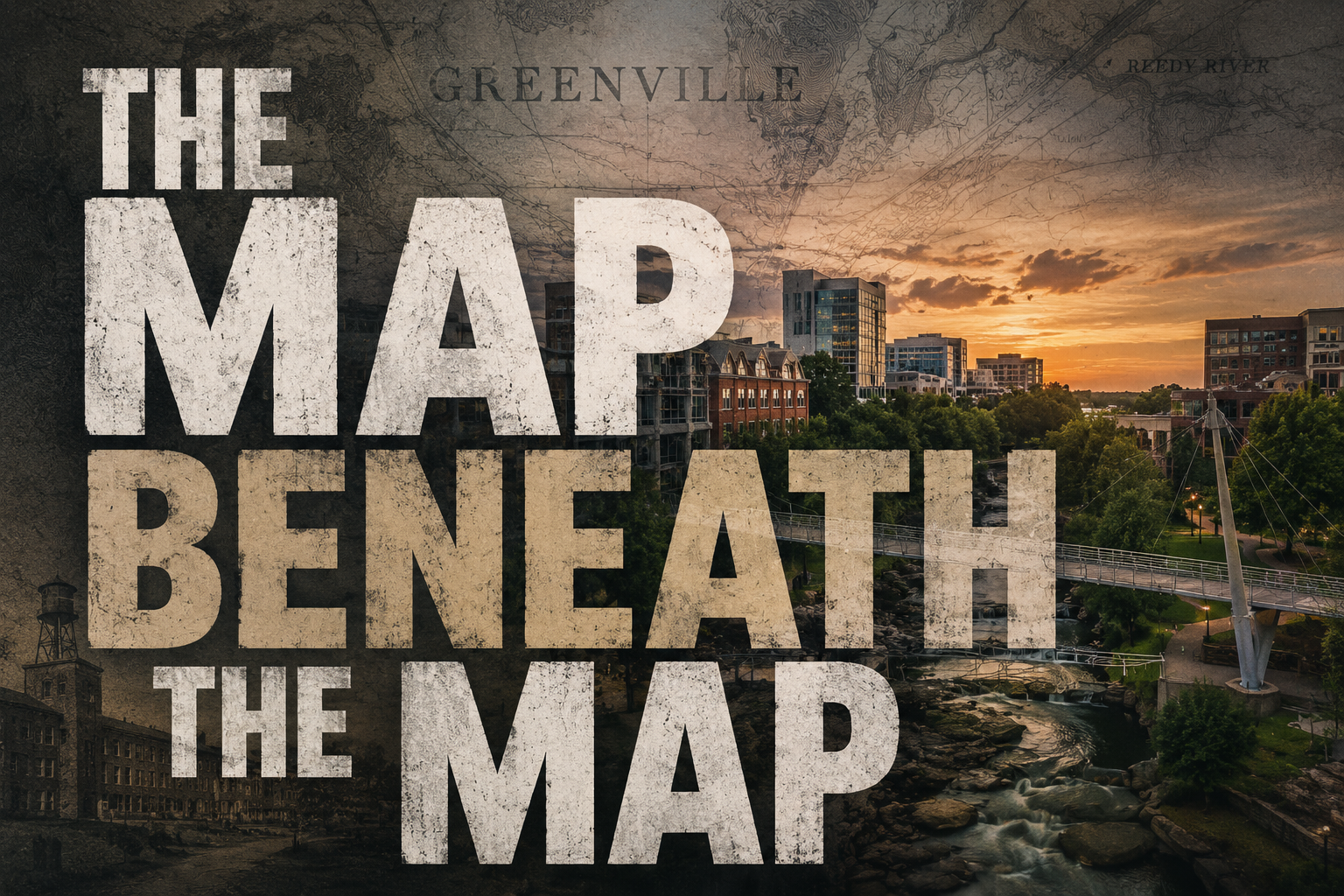
The Map Beneath the Map is the historical spine of the Seen / Unseen Greenville project.
It explores the idea that cities are layered — that modern Greenville was built on top of older systems, older neighborhoods, older conflicts, and older ways of life that still shape the city today, even when we no longer see them clearly.
In 1946, Greenville was a very different city.
Downtown was smaller. The skyline barely existed compared to today. Textile mills still dominated much of the local economy, shaping not just employment but entire neighborhoods and daily routines. Many roads were narrower, rougher, and less connected. Cars existed, of course, but Greenville still felt much closer to a mill town than the polished small city people recognize today.
Segregation shaped where people lived, worked, learned, worshipped, and accumulated wealth. Entire neighborhoods operated almost like self-contained worlds built around mills, churches, laundries, warehouses, rail corridors, and local stores. Life was more localized. More physical. More tied to the immediate geography around you.
And laundries mattered more than we might immediately think today.
Before home washers and dryers became commonplace, industrial laundries were critical infrastructure. Hotels, hospitals, restaurants, textile businesses, and countless families depended on them. These facilities ran constantly using steam systems, boilers, fuel tanks, chemicals, and industrial machinery. They were part factory, part utility service — noisy, hot, mechanical places sitting close to residential neighborhoods because workers needed to be nearby.
I actually first stumbled onto this story while talking with my mom.
When I mentioned the Ideal Laundry explosion, she immediately knew what I was talking about. To her generation, it was one of those Greenville stories people simply knew. But she was surprised I had never heard of it before.
Honestly, that moment captures a huge part of why I started Seen / Unseen Greenville in the first place.
There are entire layers of this city that quietly disappear between generations unless someone keeps talking about them. Stories that once felt enormous slowly fade into the background as the city grows, rebuilds, and reinvents itself. A tragedy that once dominated local conversation can eventually become something younger residents drive past every day without ever realizing it happened.
That was the world of Ideal Laundry.
Then, in November of 1946, something went catastrophically wrong.
A propane explosion tore through the facility with enormous force. The blast reportedly destroyed or severely damaged more than 100 nearby homes, killed several people, injured many more, and left hundreds homeless. Witnesses said the explosion could be felt miles away.
One historical account described the scene this way:
“The laundry itself was leveled as if it had taken a direct hit from a 2000-pound demolition bomb.”
That comparison feels almost impossible to imagine in modern Greenville.
But photographs from afterward show scenes that barely resemble the city people picture today.
Homes reduced to splintered frames.
Roofs collapsed inward.
Furniture scattered across streets and yards.
Entire blocks transformed into debris fields.
For a brief moment, parts of Greenville looked less like a growing Southern city and more like a war zone.
It is difficult to fully imagine what that must have felt like at the time.
Not modern Greenville with smartphones, emergency alerts, interstate access, trauma response systems, and instant communication.
1946 Greenville.
A city still deeply tied to industrial labor. A city where many homes were modest wooden structures sitting close together. A city where entire families often lived paycheck to paycheck with little financial cushion if disaster struck.
Then suddenly:
a blast powerful enough to shatter windows, collapse walls, and throw entire neighborhoods into chaos.
And like so many disasters throughout American history, the destruction was not evenly distributed.
Many Black residents lived nearby and suffered disproportionately from both the explosion and its aftermath because segregation and economic inequality had already limited where they could live, what resources they could access, and how quickly recovery could happen afterward.
That becomes one of the deeper themes underneath this story — and honestly, underneath much of Greenville’s history:
disasters rarely affect everyone equally.
Floods.
Urban renewal.
Highway construction.
Industrial decline.
Environmental hazards.
Housing displacement.
Redevelopment pressure.
Again and again, the people with the fewest resources often absorb the greatest shocks when systems fail.
The Ideal Laundry explosion exposed that reality in brutal fashion.
One of the most haunting details involves nearby Third Presbyterian Church. The explosion damaged the structure so severely that some reports suggest the building carried lingering structural effects for decades afterward.
That detail feels strangely symbolic to me.
Sometimes cities carry damage long after people stop talking about the event itself.
The cracks remain hidden beneath newer layers.
And that may be the most fascinating part of this entire story:
how completely it faded from public memory.
Today, many Greenville residents have never even heard of the Ideal Laundry explosion.
The area has been absorbed into the modern city. Traffic moves through it normally. Businesses operate. People live nearby without realizing one of the worst industrial disasters in Greenville history happened there.
What is especially striking is how little public memorialization seems to exist for the disaster itself.
Greenville has plaques, statues, and historical markers for many parts of its history:
political figures,
wars,
historic buildings,
redevelopment achievements,
and civic milestones.
But one of the deadliest explosions in the city’s history — one that devastated largely working-class neighborhoods and disproportionately affected Black residents — has mostly faded into archival photographs and aging memory.
That absence becomes part of the story too.
Because cities are selective about what they preserve publicly.
That is part of the larger Seen / Unseen Greenville idea.
Cities are often very good at remembering triumphs:
beautiful downtown photos,
new parks,
economic growth,
carefully curated branding,
success stories.
But cities are often much worse at remembering trauma — especially trauma experienced by working-class neighborhoods and marginalized communities.
What gets remembered?
What gets buried?
Who gets memorialized?
Who quietly disappears from the story?
Those questions matter because cities are not just buildings and infrastructure.
They are accumulated memory.
And beneath modern Greenville — beneath the restaurants, apartments, breweries, coffee shops, and polished civic identity — older shockwaves still echo faintly underneath the surface.
The roads remember.
The neighborhoods remember.
Even when the city itself forgets.

 Frank M. Anderson's Writing
Leave a comment