
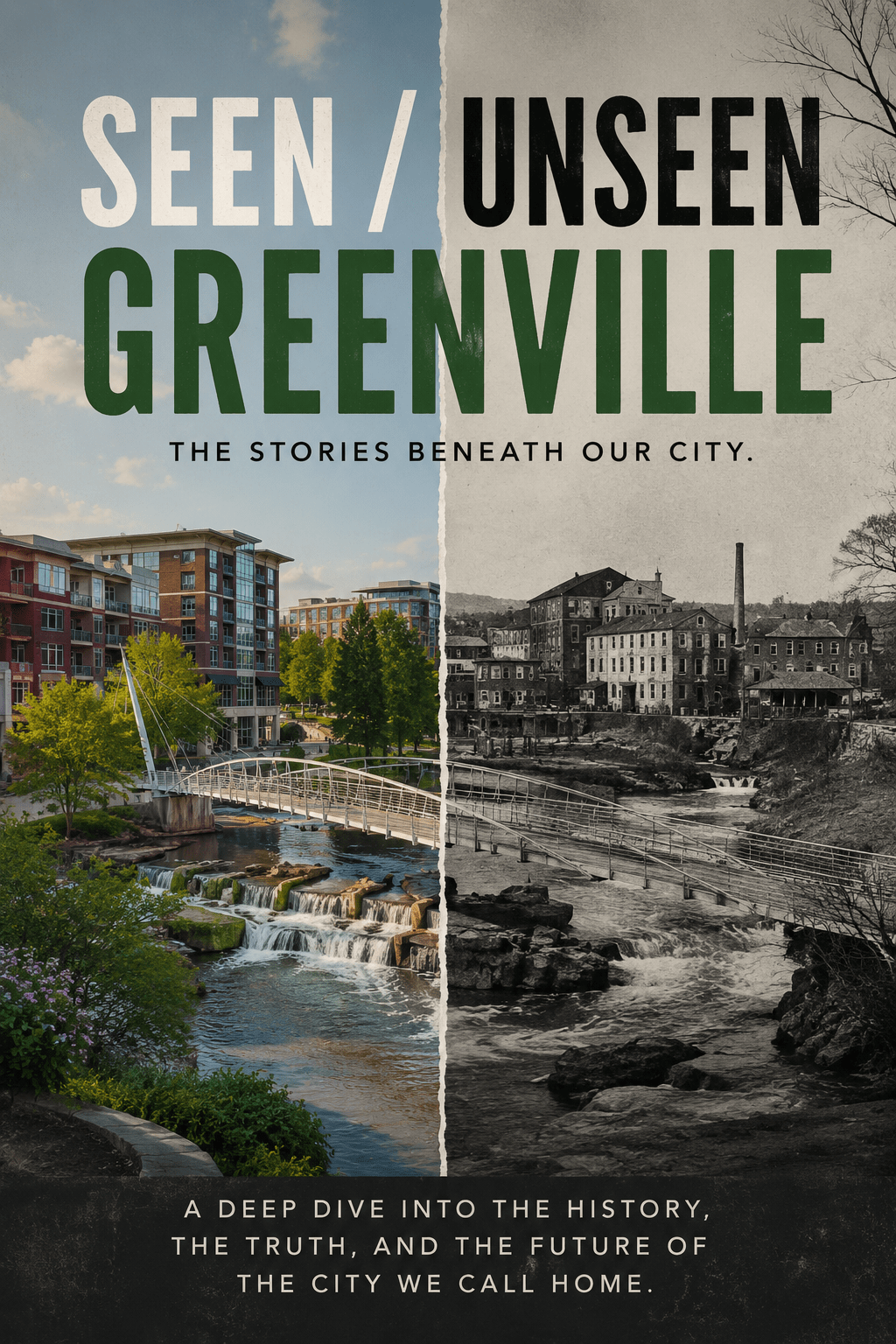
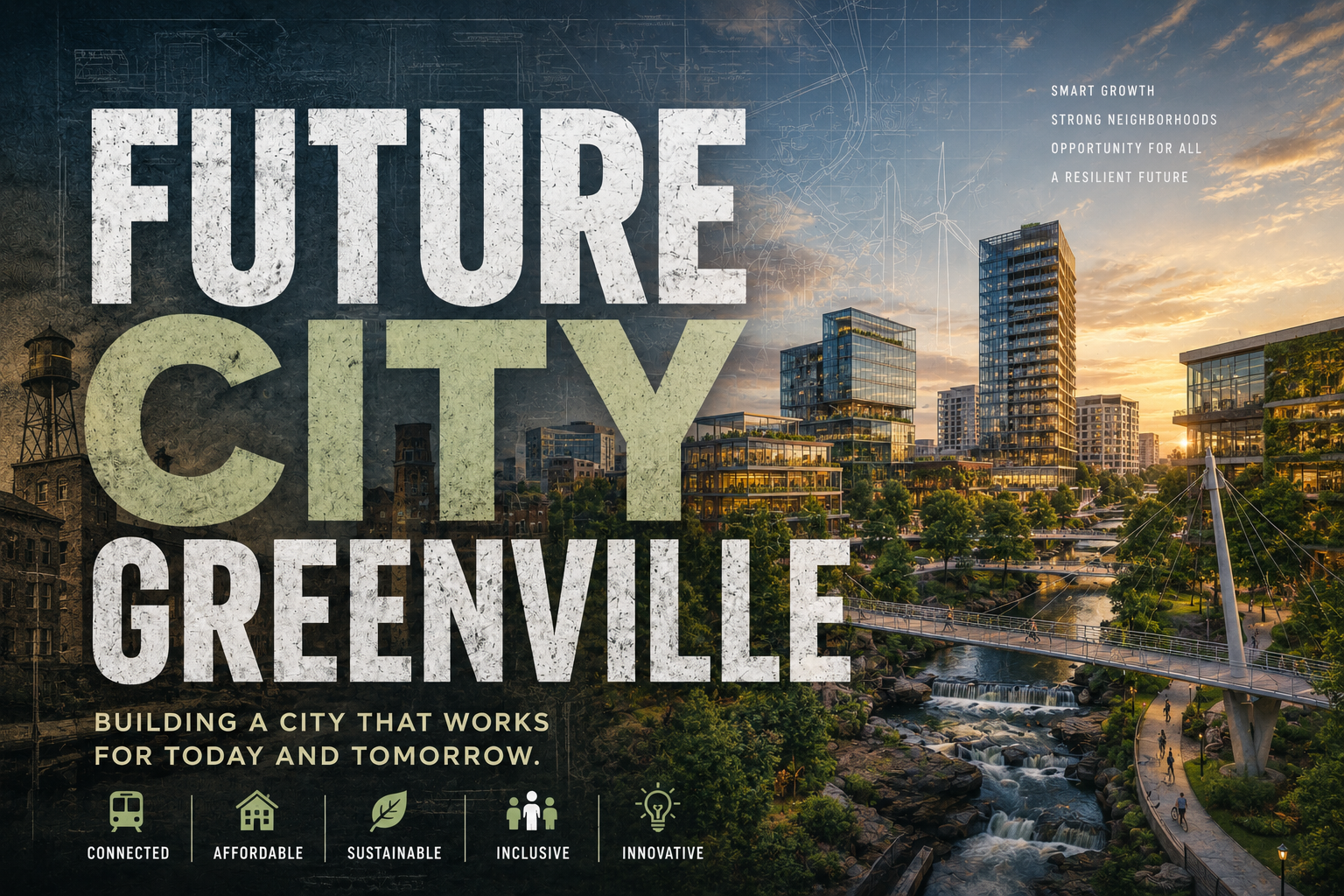
Future City Greenville is the systems and planning side of Seen / Unseen Greenville.
Instead of focusing mainly on history, it explores where Greenville is headed and how growth, infrastructure, development, traffic, housing, and city-county coordination shape daily life.
At its core, it asks a simple question:
What kind of regional system are we actually building as Greenville continues to grow?
I don’t actually think the recent frustration around Woodruff Road is really just about Woodruff Road.
I think it points toward something bigger happening in Greenville itself.
Recently, another restaurant announcement on Woodruff sparked the usual reactions online. People joked about traffic, complained about overcrowding, and made sarcastic comments about “just what Woodruff needs.” There were even jokes about Whataburger eventually becoming another empty building, which is remarkable considering the place basically just opened.
At first glance, it sounds like standard internet complaining. But honestly, I think the reactions point toward something deeper people are beginning to feel about Greenville itself. Not that Greenville is failing, but that Greenville may be reaching a scale where some of its older development patterns are starting to strain under the weight of their own success.
For a long time, Greenville’s story was relatively simple: more people, more investment, more businesses, more construction. And in many ways, that transformation has been genuinely impressive. Downtown Greenville reinvented itself. The county attracted major employers. The region became far more economically dynamic and nationally visible than almost anyone would have predicted decades ago.
But eventually every growing city reaches a point where growth alone stops being the main question. The question becomes how you coordinate expansion in a way that remains functional, productive, and livable. That increasingly feels like where Greenville is now.
Because many of the conversations happening around development still feel fragmented. The City of Greenville often emphasizes walkability, bikeability, public spaces, downtown identity, density, and quality of life. Meanwhile, much of the county’s commercial energy still revolves around large suburban corridors, automobile infrastructure, and outward expansion. Neither approach is inherently wrong, but they are not always fully aligned either.
And the important thing is that residents do not experience these systems separately. People do not emotionally experience “city Greenville” and “county Greenville” as two different places. They experience one interconnected flow of traffic, housing, commerce, work, recreation, and movement. Which means tensions between city planning priorities and county development realities eventually become visible in everyday life.
Woodruff Road is probably the clearest example of that tension. Not because Woodruff is uniquely evil or uniquely broken. In many ways, Woodruff is functioning exactly as highly successful suburban commercial corridors tend to function all across America. The problem is concentration. Too much pressure, too much retail intensity, too much traffic, and too many overlapping commercial demands concentrated into the same handful of corridors.
And honestly, I share some of the frustration people feel. I’ve learned ways to get around parts of the chaos, but some sections increasingly feel overwhelming by design. The stretch around Costco especially stands out to me. You have Costco sitting right near one of the major entrances, combined with Target traffic, Lowe’s, Best Buy, Greenridge, Magnolia Park spillover, restaurants, apartments, and constant interstate access pressure all layered into the same general area.
Individually, most of these developments make sense. I understand why businesses want to be there. The corridor clearly produces enormous economic activity. But at some point the cumulative effect begins to feel less like coordinated planning and more like stacking commercial intensity on top of itself simply because the corridor already generates money.
That’s where I think many residents begin sensing a systems problem rather than just a traffic problem.
I live near 385 now, and one thing you quickly notice is how interconnected all of these traffic patterns really are. People across Greenville already know what it feels like to get trapped on 85 or 385 when congestion spills over from bottlenecks elsewhere in the region. The backups become surprisingly predictable. Downtown pressure affects highway flow. Highway congestion spills back into commercial corridors and neighborhoods. What happens on Woodruff rarely stays confined to Woodruff.
And that’s part of why Greenville increasingly has to think of itself less as a collection of separate towns and corridors and more as a shared regional ecosystem. Places like Greer, Simpsonville, Mauldin, Easley, Travelers Rest, Fountain Inn, and even Piedmont are all becoming tied together economically and socially in ways that feel much larger than they did twenty years ago.
That growth has brought real benefits to many of these communities. Places that once felt disconnected from Greenville’s momentum are now seeing investment, housing growth, new businesses, and new opportunities. But some of those same places are also beginning to experience versions of the exact same strain. Rapid expansion can quickly become overdevelopment if infrastructure, planning, and coordination do not keep pace.
And honestly, parts of Greenville already feel like they are approaching that threshold.
The Laurens Road corridor is a good example of both the challenge and the opportunity. The stretch from near downtown toward I-85 already contains older commercial buildings, industrial remnants, adaptable lots, interstate access, and existing infrastructure. Parts of it feel underutilized relative to how strategically positioned they actually are.
At the same time, the I-85 and Laurens Road interchange itself desperately needs attention. The exit ramps there already feel dangerously short and increasingly overloaded, especially as traffic continues growing around that corridor. If Greenville wants to spread pressure more intelligently outside of Woodruff Road, infrastructure upgrades in places like that become essential rather than optional.
Because the goal should not simply be moving congestion from one corridor to another.
The goal should be creating a more balanced region where infrastructure improvements happen alongside expansion instead of years afterward.
Right now, development can sometimes feel like it follows immediate opportunity more than long-term strategy. The easiest place to put the next thing becomes the place where the next thing goes, even if that corridor is already overloaded.
But Greenville may be reaching the point where simply following momentum is no longer enough.
Not every successful development needs to begin with clearing new land for another giant retail cluster. Some of Greenville’s future may come from retrofitting, reusing, reimagining, and redistributing what already exists. That may ultimately require stronger coordination between the city and county, along with a broader willingness to think regionally instead of project-by-project.
Part of me also wonders whether Greenville eventually has to begin thinking more seriously about transportation itself. People already know what it feels like to lose huge portions of their day sitting in predictable bottlenecks on 85, 385, Woodruff, or downtown overflow routes. As Greenville increasingly functions like a connected metro area, it becomes harder to imagine the long-term future being solved entirely through adding lanes, widening roads, or stacking more traffic lights onto already stressed systems.
Whether that eventually means expanded transit, rapid bus systems, park-and-ride networks, or even some kind of hyper-local rail connection decades from now, I think the larger point is that Greenville’s future may require bigger systems thinking than it historically has.
Greenville may eventually have to ask itself whether it wants to drift toward the same congestion and reactive growth patterns that frustrate people in larger regional cities, or whether it wants to become more proactive while it still has the ability to shape its future intentionally. Success brings responsibility. The systems that worked for Greenville twenty years ago may not be enough for the Greenville that exists now.
Because at some point, growth stops being something a city simply experiences.
It becomes something a region has to actively shape.

 Frank M. Anderson's Writing
Leave a comment