
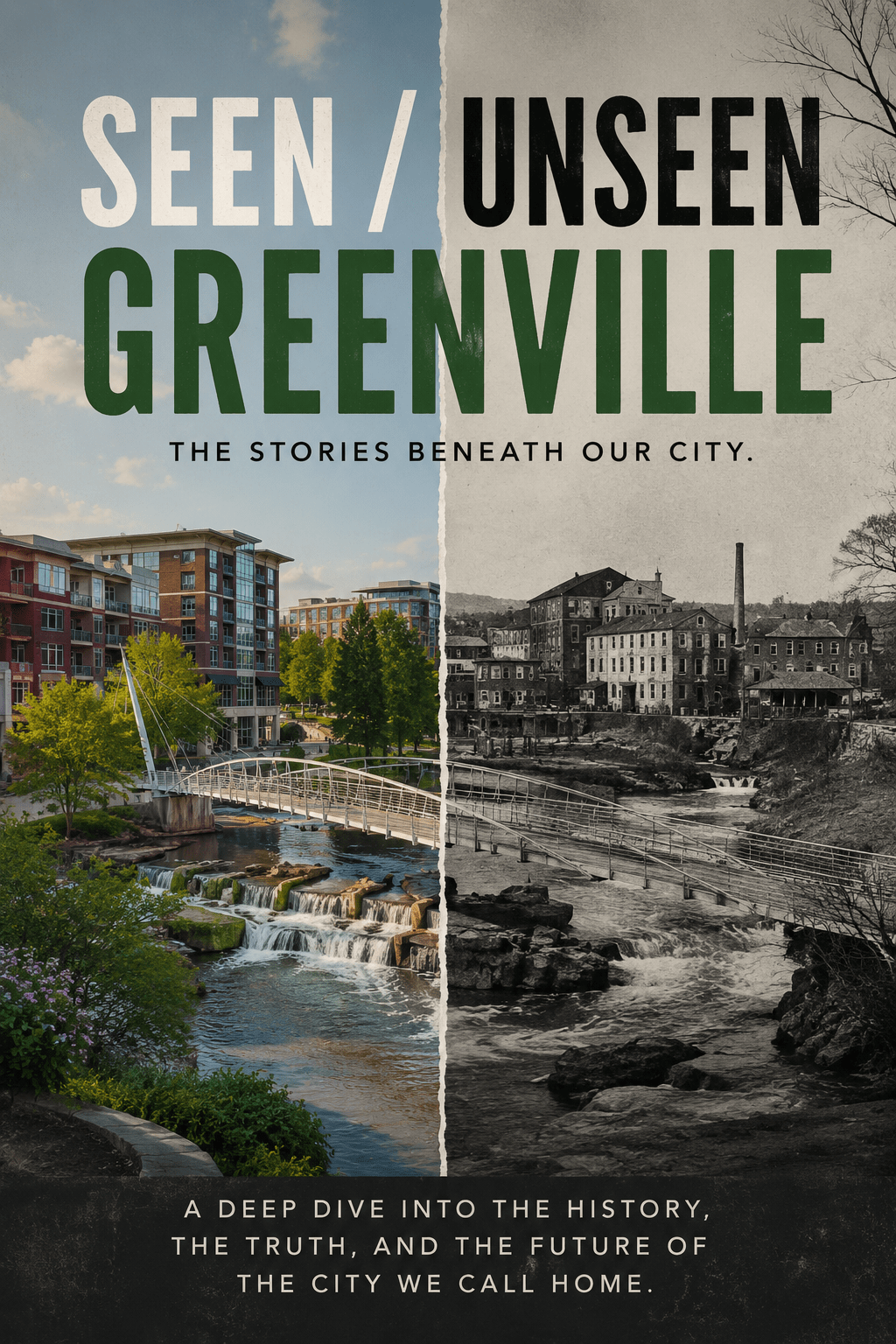
Over the past few weeks, this project has honestly felt a little chaotic at times.
I’ve produced a flood of material:
-history posts,
-city planning discussions,
-maps,
-timelines,
-personal memories,
-civic frustrations,
-philosophical essays,
-local observations,
-and probably far too many long-form posts for the average Facebook scroll session.
At times, I imagine it has looked less like a coherent project and more like someone dumping an entire city onto a table piece by piece and trying to figure out how it all connects.
But somewhere inside all that mess, a structure has slowly started emerging.
And I think I can finally see it clearly now.
To the recurring readers: thank you for continuing to come back and follow along with this strange and evolving experiment. The fact that people are actually staying to read these pieces, revisiting posts, and following the larger thread means more to me than I can properly explain.
And to the new readers arriving through the recent Facebook ads: welcome.
You are arriving in the middle of an excavation project.
Part history project.
Part civic discussion.
Part philosophical wandering.
Part local archive.
And honestly, the deeper I go into Greenville, the more I realize this city cannot really be understood through only one lens.
So the project itself has started naturally dividing into three major directions.
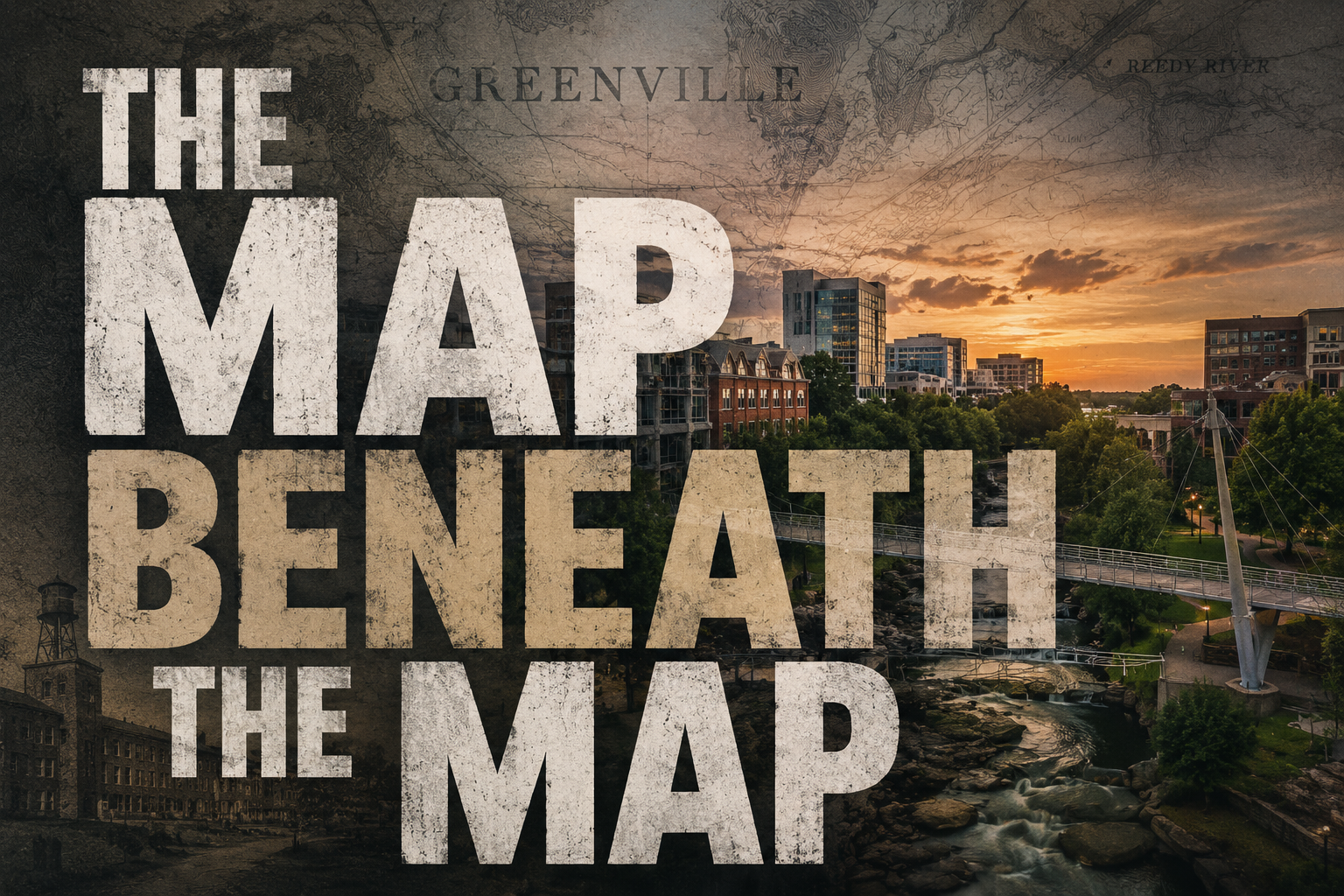
The Map Beneath the Map
This is the historical layer of the project.
The core idea is simple:
Cities do not replace themselves.
They accumulate.
The roads remember.
The geography remembers.
The systems remember.
Modern Greenville sits on top of older Greenvilles:
Cherokee paths,
mill villages,
railroads,
segregation,
textile expansion,
suburban migration,
downtown collapse,
downtown reinvention,
and generations of invisible decisions that still shape how people move through the city today.
This section explores the inherited city beneath the visible one.
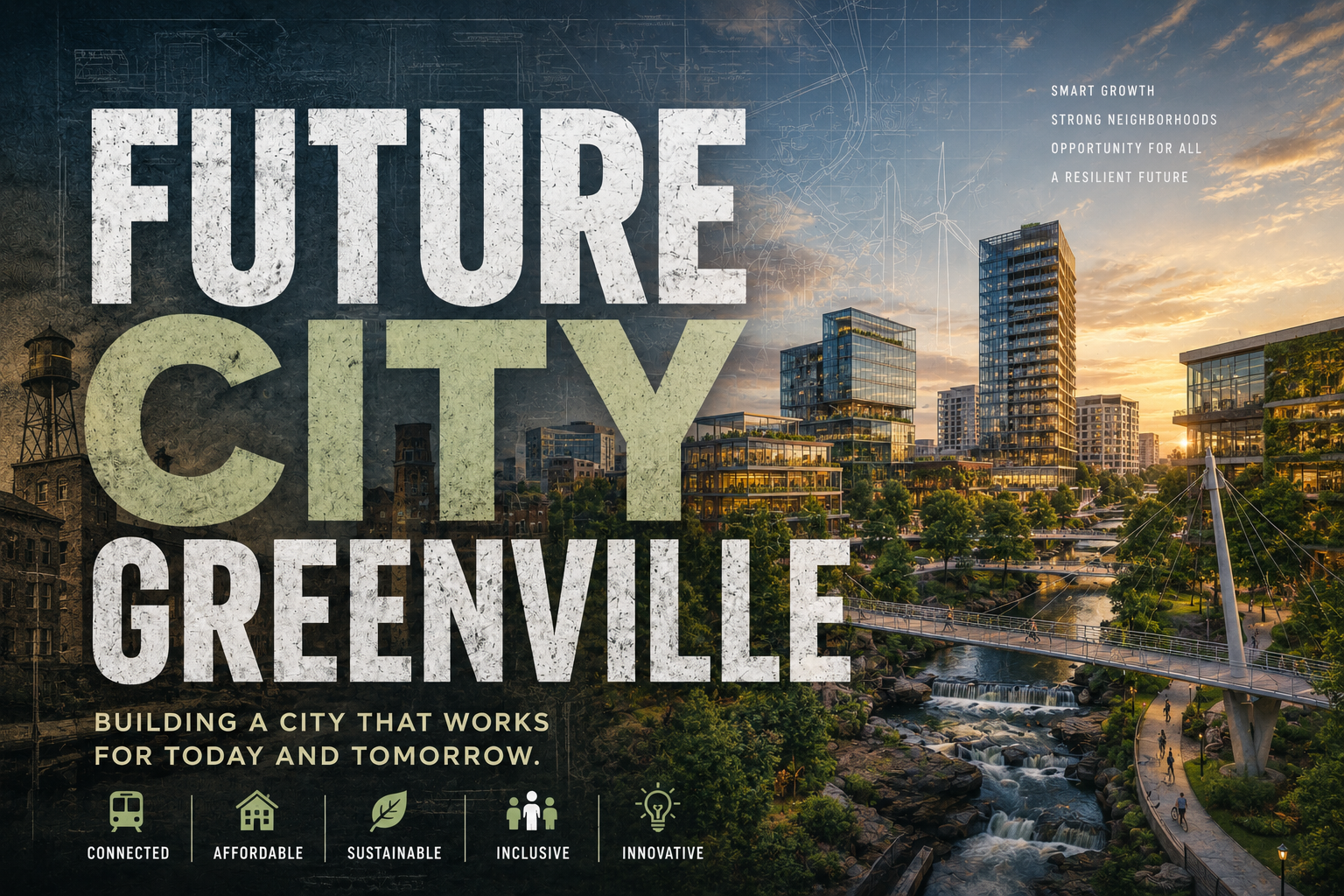
Future City Greenville
This is the civic and future-focused layer of the project.
And honestly, this direction emerged somewhat unexpectedly.
A friend of mine named Kate teaches in Greenville County, and every year she works with students on a project called Future City, where students imagine and design cities of the future:
how they function,
how people move through them,
what systems they prioritize,
what problems they solve,
and what kind of lives they make possible.
For a long time, I mostly thought about cities in pretty practical terms:
roads,
traffic,
development,
economics,
infrastructure,
growth.
But somewhere during this entire Seen / Unseen Greenville process, something shifted in the way I think about cities altogether.
Because the more I’ve written about Greenville’s history, neighborhoods, development patterns, downtown, contradictions, and identity, the more I’ve realized cities are not just collections of buildings and roads.
They are systems.
Economic systems.
Social systems.
Psychological systems.
Production systems.
Moral systems.
And eventually, if you stare at a city long enough, you stop asking:
“How do we make downtown nicer?”
or
“How do we attract more investment?”
You start asking:
What kind of civilization model are we actually building here?
That question keeps pulling me back toward Greenville itself.
Because I honestly believe Greenville has the potential to become more progressive, adaptive, creative, resilient, and community-focused than it currently is.
Not “progressive” in the shallow partisan sense people immediately jump to online.
I mean progressive in the sense of:
forward-thinking,
problem-solving,
human-centered,
flexible,
and willing to experiment with new ideas instead of simply repeating inherited systems forever.
Greenville already does many things well.
The parks are active.
Downtown is alive.
The Swamp Rabbit Trail genuinely changed the city.
Public spaces matter here in ways they did not decades ago.
The city is trying in many ways.
But I also think Greenville is standing at the edge of much larger questions now:
housing,
infrastructure,
walkability,
economic inequality,
technology,
AI,
the gig economy,
local resilience,
and what happens when growth itself becomes harder to sustain indefinitely.
Future City Greenville is where I want to explore those questions more deeply.
Not just:
“How do we grow?”
But:
“How do we build a healthier and more capable city?”
How do we invest not only in attracting outside money, but in helping Greenville residents become more adaptable, skilled, connected, creative, and capable of participating meaningfully in the future of the city itself?
How do we avoid becoming a place that only knows how to consume growth instead of cultivating resilience from within?
And maybe most importantly:
How do we continue evolving without losing the sense that ordinary people still belong here?
Parts of the thinking behind this direction grew directly out of earlier reflections on Greenville’s evolving civic identity, affordability pressures, downtown transformation, and long-term resilience.
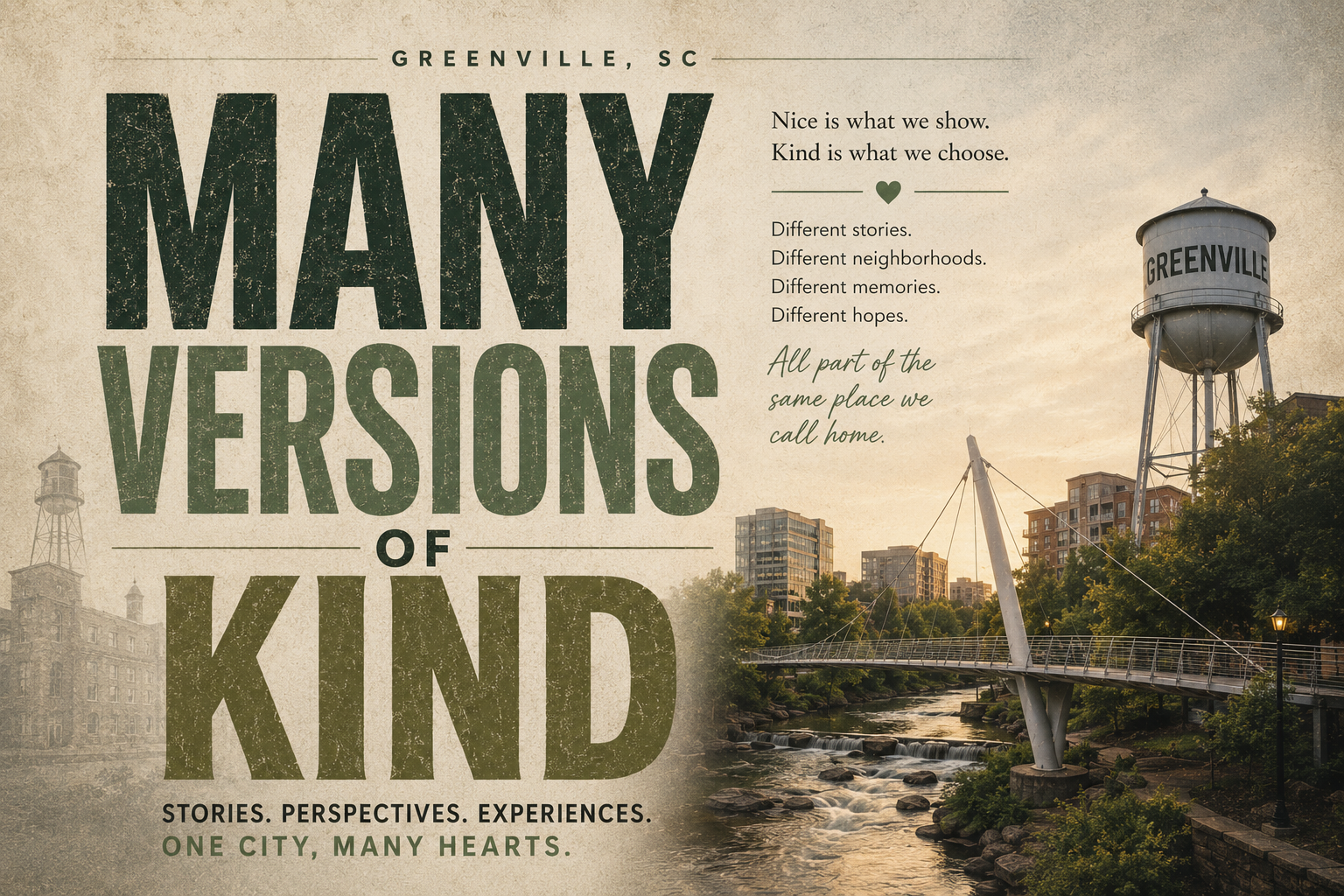
Many Versions of Kind
This may ultimately become the philosophical heart of the entire project.
One idea I keep returning to is the difference between a city being nice and a city being kind.
Those are not always the same thing.
A city can be polished,
clean,
marketable,
walkable,
and visually beautiful
while still leaving large groups of people feeling disconnected from it.
At the same time, cities are complicated. Greenville is not a villain in some simplistic story. In many ways, the city genuinely is trying:
investing in parks,
public spaces,
recreation,
connectivity,
corridor redevelopment,
and community projects.
But different people experience the exact same city in radically different ways.
And I think that tension matters.
Because there is no single Greenville.
There are many versions of it occupying the same geography at the same time.
This section explores:
identity,
culture,
class,
memory,
Southernness,
reinvention,
belonging,
civic mythology,
and the emotional relationship people have with the city around them.
Honestly, one of the biggest realizations I’ve had through this entire project is that Greenville is not just an interesting Southern city.
It is an incredibly American city.
A city wrestling in real time with growth, image, affordability, identity, consumption, nostalgia, technology, inequality, reinvention, and the tension between progress and belonging.
And I think those tensions are only going to become more important over the next twenty years.
Which is part of why I want this project to keep widening beyond:
one guy,
an AI assistant,
and a pile of books and notes.
So if you have:
story ideas,
forgotten local history,
family memories,
old photographs,
interesting places,
business stories,
infrastructure frustrations,
city observations,
neighborhood lore,
or topics you think deserve attention,
please reach out.
Because I want this to become something more layered, collaborative, and alive over time.
There is still a lot beneath the surface of Greenville.
And honestly, I think we’re only beginning to uncover it.

 Frank M. Anderson's Writing
Leave a comment