
My brother died in 2023.
Around the same time, I was already dealing with cancer, mental health struggles, questions about survival, and the growing realization that the life I thought I understood no longer entirely made sense to me.
So I started writing.
At first, that writing became The Cancer Diet, a memoir about illness, grief, identity, collapse, survival, and trying to rebuild a life after parts of it had fallen apart.
But somewhere along the way, my attention started drifting outward.
Toward Greenville.
Toward the roads I had driven my entire life.
Toward old mill neighborhoods.
Toward downtown.
Toward traffic patterns.
Toward disappearing local culture.
Toward development.
Toward the strange tension between growth and memory.
Toward the people being pulled forward by the city and the people quietly disappearing beneath it.
I started realizing that cities carry grief too.
That places remember things.
That development rarely erases older systems completely—it mostly builds on top of them.
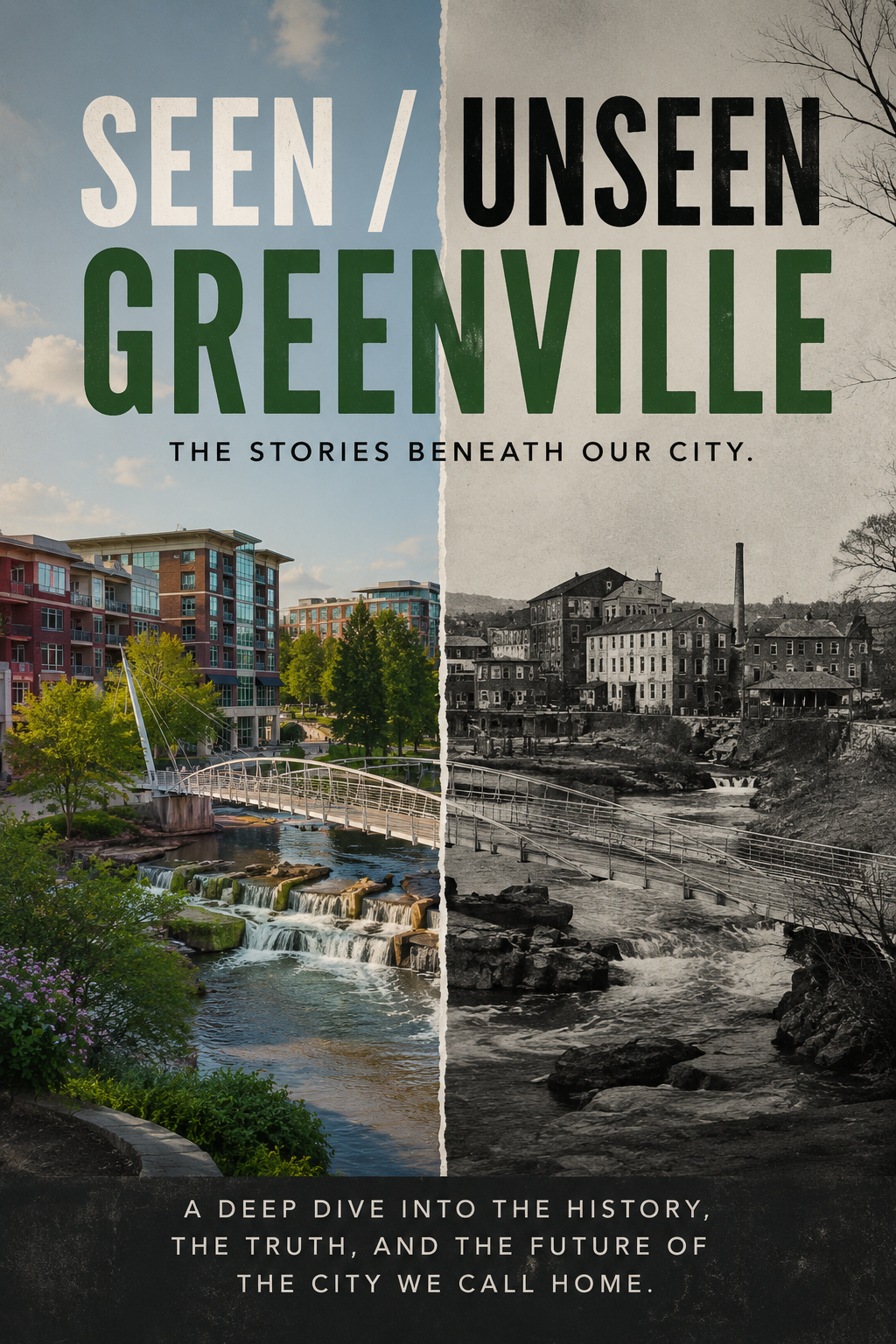
And slowly, without entirely meaning to, Seen / Unseen Greenville began to emerge.
Not as journalism.
Not as activism.
Not as nostalgia.
Not as a political campaign.
But as an attempt to understand the visible city and the invisible one beneath it.
The polished version and the inherited version.
The marketed version and the lived version.
The future Greenville is trying to become and the older Greenvilles still lingering underneath.
At some point, I realized I was no longer just writing about Greenville.
I was using Greenville to think about:
memory,
systems,
modern America,
belonging,
morality,
growth,
technology,
identity,
grief,
and the strange process of becoming.
And one of the strangest parts is that I didn’t fully plan any of this.
The project revealed itself through repetition.
The same tensions kept returning:
growth vs belonging,
development vs preservation,
nice vs kind,
efficiency vs humanity,
vision vs reality,
systems vs lived experience.
The writing kept circling the same questions from different angles until a larger shape slowly began to appear.
The Beginning: Drifting, Politics, and Trying to Understand the World Again
Some of the earliest pieces weren’t even explicitly about Greenville yet.
They were about drift.
About exhaustion.
About identity.
About modern fragmentation.
About trying to reconnect morality, politics, and ordinary human life in a world increasingly shaped by noise, performance, and disconnection.
Looking back now, I can see that the seeds of the entire project were already there.
The questions about systems.
The discomfort with simplistic certainty.
The tension between personal responsibility and structural reality.
The feeling that modern life was accelerating faster than people emotionally understood it.
Eventually, those questions started turning outward toward Greenville itself.
And that’s when the project truly began to change.
Posts from this phase:
- Tales of a Midlife Drifter
https://fulcrumandaxis.com/2026/04/14/tales-of-a-midlife-drifter/ - Roundup Post: What I’ve Been Writing Lately (And Why)
https://fulcrumandaxis.com/2026/04/14/roundup-post-what-ive-been-writing-lately-and-why/ - Politics, Morality, and the Cost of Tuning Out
https://fulcrumandaxis.com/2026/04/14/politics-morality-and-the-cost-of-tuning-out/ - Who Tells the Story of Greenville, SC?
https://fulcrumandaxis.com/2026/04/21/who-tells-the-story-of-greenville-sc/ - Greenville, SC and the Business of Drinking
https://fulcrumandaxis.com/2026/04/22/greenville-sc-and-the-business-of-drinking/ - What’s Going On Here (And Who I Am)
https://fulcrumandaxis.com/2026/04/24/whats-going-on-here-and-who-i-am/
This Place Has Never Been One Thing
One of the earliest revelations of the project was also one of the simplest:
Greenville has never been one thing.
Not culturally.
Not politically.
Not economically.
Not historically.
The more I looked, the more I realized Greenville was not a single city but multiple overlapping Greenvilles existing simultaneously.
The polished downtown version.
The old mill village version.
The wealthy Greenville.
The struggling Greenville.
The remembered Greenville.
The marketed Greenville.
The disappearing Greenville.
The future Greenville still trying to invent itself.
That realization changed everything.
Because once I stopped trying to reduce Greenville into a single narrative, the project suddenly had permission to become layered, contradictory, recursive, and complicated.
Posts from this phase:
- Seen / Unseen Greenville: This Place Has Never Been One Thing
https://fulcrumandaxis.com/2026/04/24/seen-unseen-greenville-this-place-has-never-been-one-thing/ - Seen / Unseen Greenville: Let’s Begin With Our Cherokee Roots
https://fulcrumandaxis.com/2026/04/25/seen-unseen-greenville-lets-begin-with-our-cherokee-roots/ - Seen / Unseen Greenville: Polished Surface, Divided Ground
https://fulcrumandaxis.com/2026/04/26/seen-unseen-greenville-polished-surface-divided-ground/ - Seen / Unseen Greenville: Cherokee Ground Beneath Greenville
https://fulcrumandaxis.com/2026/04/28/seen-unseen-greenville-cherokee-ground-beneath-greenville/ - The Whitening of Greenville: Gentrification and Pushed-Out People
https://fulcrumandaxis.com/2026/04/29/the-whitening-of-greenville-gentrification-and-pushed-out-people/ - Greenville Is Too Small
https://fulcrumandaxis.com/2026/04/30/greenville-is-too-small/ - Fear of a Post-Knox White Greenville
https://fulcrumandaxis.com/2026/04/30/fear-of-a-post-knox-white-greenville/ - Four Greenvilles
https://fulcrumandaxis.com/2026/05/01/four-greenvilles/
The Map Beneath the Map
As the writing evolved, another idea began emerging repeatedly:
Cities behave like sediment layers.
New systems build over older ones without fully erasing them.
Roads remember older movement patterns.
Neighborhoods remember segregation.
School systems remember wealth distribution.
Development remembers old economic priorities.
The land itself remembers histories older than the city currently standing on top of it.
The more I researched Greenville, the more I realized how much of the present city was still quietly shaped by older decisions, older power structures, older geographies, and older identities.
That realization eventually became one of the core frameworks of Seen / Unseen Greenville:
the map beneath the map.
Posts from this phase:
- Seen / Unseen Greenville: A City Divided
https://fulcrumandaxis.com/2026/05/09/seen-unseen-greenville-a-city-divided/ - Seen / Unseen Greenville: The Hidden Origins of Segregation
https://fulcrumandaxis.com/2026/05/09/seen-unseen-greenville-the-hidden-origins-of-segregation/ - Seen / Unseen Greenville: The Map of Schools
https://fulcrumandaxis.com/2026/05/09/seen-unseen-greenville-the-map-of-schools/ - Seen / Unseen Greenville: A Timeline of the City Beneath the City
https://fulcrumandaxis.com/2026/05/11/seen-unseen-greenville-a-timeline-of-the-city-beneath-the-city/ - Seen / Unseen Greenville: The 1946 Ideal Laundry Explosion — The Forgotten Explosion
https://fulcrumandaxis.com/2026/05/15/seen-unseen-greenville-the-1946-ideal-laundry-explosion-the-forgotten-explosion/
Growth, Systems, and the Future City
At the same time, the project increasingly became about systems.
Traffic.
Infrastructure.
Planning.
Development.
Housing.
Institutional incentives.
Growth pressure.
The strange challenge of preserving identity while rapidly modernizing.
Greenville started feeling less like an isolated city and more like a concentrated version of broader American tensions.
The questions became larger:
What happens when growth outpaces infrastructure?
What happens when development becomes identity?
Can a city remain livable while becoming increasingly desirable?
Can systems remain humane while scaling upward?
And perhaps most importantly:
What kind of city are we actually building?
Posts from this phase:
- Seen / Unseen Greenville: GVL2040 and the Gap Between Plan and Reality
https://fulcrumandaxis.com/2026/05/05/seen-unseen-greenville-gvl2040-and-the-gap-between-plan-and-reality/ - Seen / Unseen Greenville: Can We Avoid Woodruff Road (Part 2)?
https://fulcrumandaxis.com/2026/05/06/seen-unseen-greenville-can-we-avoid-woodruff-road-part-2/ - Seen / Unseen Greenville: When Everything Started Pointing Downtown
https://fulcrumandaxis.com/2026/05/08/seen-unseen-greenville-when-everything-started-pointing-downtown/ - Seen / Unseen Greenville: Pleasant Roast — A Case Study
https://fulcrumandaxis.com/2026/05/10/seen-unseen-greenville-pleasant-roast-a-case-study/ - Seen / Unseen Greenville: Reading the Budget Like a Map
https://fulcrumandaxis.com/2026/05/12/seen-unseen-greenville-reading-the-budget-like-a-map/ - Seen / Unseen Greenville: What Kind of City Are We Becoming?
https://fulcrumandaxis.com/2026/05/13/seen-unseen-greenville-what-kind-of-city-are-we-becoming/ - Seen / Unseen Greenville: Woodruff Road and Greenville’s Growing System Problem
https://fulcrumandaxis.com/2026/05/14/seen-unseen-greenville-woodruff-road-and-greenvilles-growing-system-problem/
Many Versions of Kind
Eventually the project became more explicitly moral and philosophical too.
I started realizing there was a difference between a city being nice and a city being kind.
Nice is polish.
Presentation.
Comfort.
Aesthetic success.
Kindness is harder.
Kindness asks:
Who benefits?
Who gets left behind?
Who absorbs the cost of growth?
Who can still afford to belong?
What systems actually help human beings build lives rather than simply consume environments?
And politically, this led me toward what I eventually started calling “the weird middle.”
Not false equivalence.
Not empty centrism.
But the uncomfortable reality that modern systems often contain competing truths simultaneously.
Businesses matter.
But unchecked profit motives distort communities.
Development creates opportunity.
But displacement is real.
Markets create innovation.
But markets alone do not create justice.
The older I get, the more I think maturity—personal or civic—may involve learning how to sit inside uncomfortable truths without immediately running toward simplistic certainty.
Posts from this phase:
- Seen / Unseen Greenville: Unity Park, Social Justice, and the Tower to Nowhere
https://fulcrumandaxis.com/2026/05/03/seen-unseen-greenville-unity-park-social-justice-and-the-tower-to-nowhere/ - Seen / Unseen Greenville: A Nice Greenville Isn’t the Same as a Kind One
https://fulcrumandaxis.com/2026/05/07/seen-unseen-greenville-a-nice-greenville-isnt-the-same-as-a-kind-one/ - Seen / Unseen Greenville: What Is This Actually About?
https://fulcrumandaxis.com/2026/05/09/seen-unseen-greenville-what-is-this-actually-about/ - The Fulcrum and Axis: The Seen and Unseen — A Diatribe on Trying to Figure Out Life, the Universe, and Everything
https://fulcrumandaxis.com/2026/05/10/the-fulcrum-and-axis-the-seen-and-unseen-a-diatribe-on-trying-to-figure-out-life-the-universe-and-everything/ - Seen / Unseen Greenville: Distinctly American. Distinctly Southern.
https://fulcrumandaxis.com/2026/05/11/seen-unseen-greenville-distinctly-american-distinctly-southern/ - Seen / Unseen Greenville: The Weird Middle
https://fulcrumandaxis.com/2026/05/15/seen-unseen-greenville-the-weird-middle/
The Observer Is Part of the System
Another strange thing happened as the project evolved.
I realized I wasn’t standing outside Greenville observing it objectively.
The city itself had shaped me.
Its roads.
Its music.
Its churches.
Its stories.
Its restaurants.
Its contradictions.
Its aspirations.
Its silences.
The project stopped being only about civic systems and became partially about consciousness itself:
how places shape identity,
how fiction shapes perception,
how nostalgia rewrites memory,
how cities become emotional landscapes as much as physical ones.
And eventually I realized something even stranger:
The writing itself had started reshaping me too.
Posts from this phase:
- Seen / Unseen Greenville: How Fiction Influenced My Reality
https://fulcrumandaxis.com/2026/05/07/seen-unseen-greenville-how-fiction-influenced-my-reality/ - Seen / Unseen Greenville: Whatever Happened to the Clock Restaurants?
https://fulcrumandaxis.com/2026/05/07/seen-unseen-greenville-whatever-happened-to-the-clock-restaurants/ - Seen / Unseen Greenville: How Greenville Got Its Name
https://fulcrumandaxis.com/2026/05/08/seen-unseen-greenville-how-greenville-got-its-name/ - The Soundtrack of Becoming
https://fulcrumandaxis.com/2026/05/08/the-soundtrack-of-becoming/ - I Enjoy AI, But Don’t Trust the Rollout
https://fulcrumandaxis.com/2026/05/02/i-enjoy-ai-but-dont-trust-the-rollout/
What This Project Actually Is
At some point, I realized Seen / Unseen Greenville was no longer just a blog series.
It had become:
a civic memoir,
a philosophical archive,
a systems-thinking project,
a historical exploration,
a moral framework,
and an attempt to map the emotional and structural layers of a rapidly changing Southern city.
But even that feels incomplete.
Because ultimately this project is probably about something simpler:
trying to understand what kind of lives, cities, systems, and communities we are actually building.
Greenville is simply the lens I happen to know best.
And this project is not finished.
If anything, it feels like it’s only beginning.
Because the roads remember.
The rivers remember.
The neighborhoods remember.
And maybe people do too.
 Frank M. Anderson's Writing
Leave a comment