
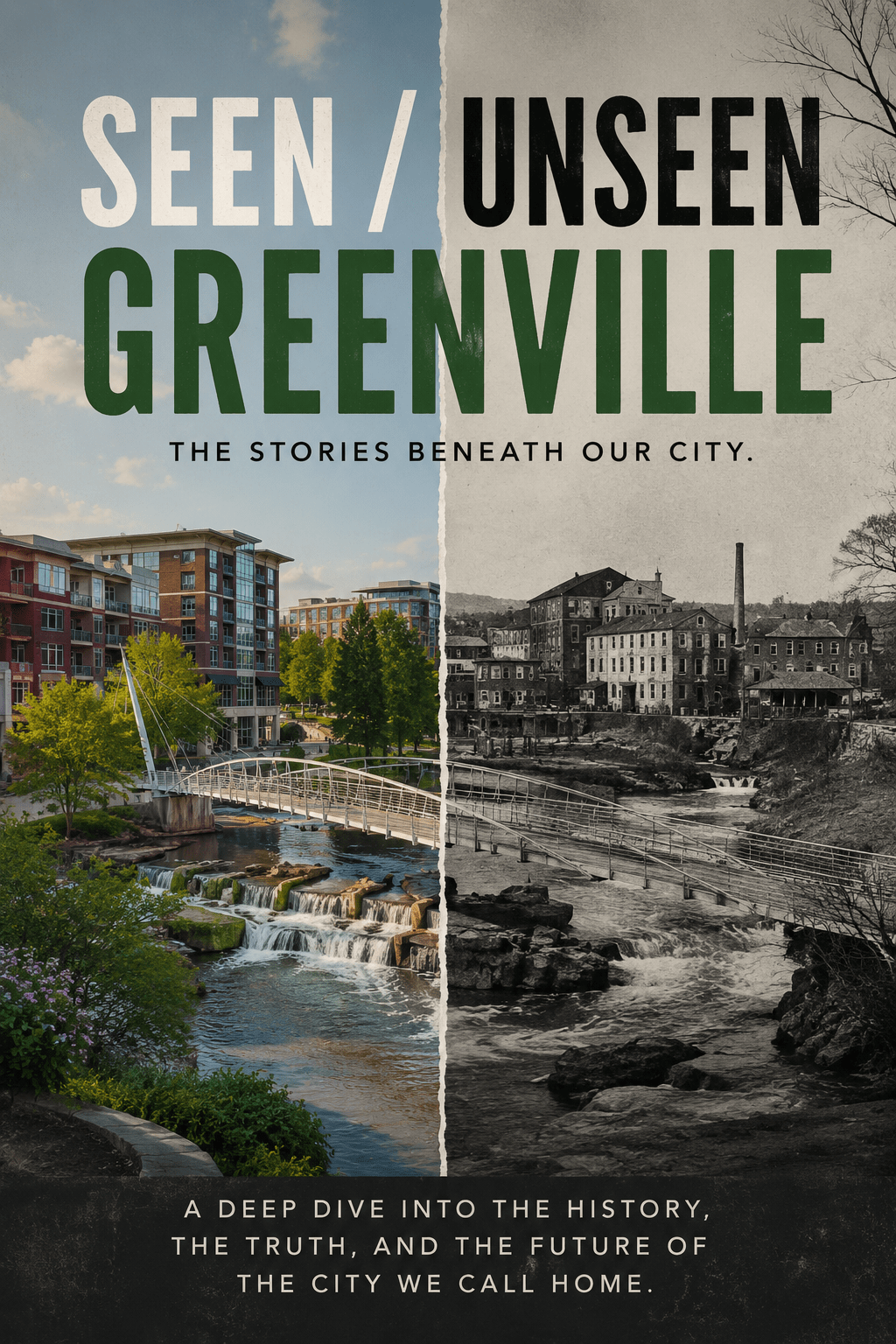
How a city reveals itself through money, priorities, and infrastructure.
I’ll admit something upfront:
I did not sit down and fully read Greenville’s entire proposed FY2027 budget.
What actually caught my attention was a Facebook post from the City of Greenville summarizing some of the major priorities: transportation improvements, trails and greenways, affordable housing initiatives, infrastructure upgrades, public safety technology, parks, and community investments.
And honestly, that alone got my brain going.
Because after spending weeks writing this Seen / Unseen Greenville series, I’ve started noticing that even small official statements can reveal larger patterns about how a city sees itself—and what kind of future it is trying to build.
That does not mean there is some conspiracy hiding beneath every bike lane or park project. Far from it. A lot of these investments are genuinely good things. Greenville has clearly invested real energy into public spaces, infrastructure, recreation, and making the city feel more connected and alive.
And I think it is important to say clearly that the city is trying in many ways.
Around the same time I saw the budget post, I also saw discussion of new investment and facilities in Nicholtown. Greenville talks constantly about affordability, community spaces, parks, infrastructure, and quality of life. I do not think most city leaders wake up every morning trying to push working-class people out of town. Honestly, I think many of them genuinely care about making Greenville better.
But I also think there are limits to what cities can realistically accomplish when the larger economic incentives are pulling in another direction.
The city can encourage affordable housing. It can incentivize it. It can talk about it. But it cannot magically force private investors to become less profit-driven. And right now, Greenville is desirable enough that luxury apartments, higher-end mixed-use projects, and experience-driven development simply make more financial sense for many investors than deeply affordable projects do.
That creates a strange tension where the city may honestly want affordability while operating inside a system that rewards the opposite.
And Greenville is hardly alone in that.
The more attractive a city becomes, the more pressure builds. Property values rise. Outside investment increases. Wealthier residents move in. Eventually, “affordability” becomes something almost everyone supports rhetorically while the market itself keeps drifting upward.
At the same time, I also think we have to be honest about why these conversations become emotionally complicated so quickly.
When people hear “affordable housing,” some hear teachers, service workers, young families, older residents on fixed incomes, or people who simply want to continue living in the city they helped build.
Other people hear fears about strained infrastructure, rising crime, instability, declining property values, or public systems being overwhelmed.
Whether all those fears are fair or not, pretending they do not exist does not help the conversation.
The reality is that concentrated poverty absolutely can create serious challenges if support systems are weak. Housing policy connects directly to addiction treatment, mental health care, transportation, education, healthcare, policing, and economic opportunity. If a city dramatically expands lower-income housing without also expanding support systems, many people worry the problems will grow faster than the city’s ability to manage them.
At the same time, a city that becomes too expensive for ordinary workers creates another kind of instability entirely. Teachers end up commuting long distances. Service workers cannot afford to live near their jobs. Families get pushed farther outward. And eventually the city begins feeling increasingly curated for the affluent.
That tension feels very present in Greenville right now.
One thing that keeps standing out to me is how quickly Greenville can mobilize energy, planning, investment, and civic excitement around highly visible projects.
Take the old Memorial Auditorium site. That land has understandably become a major civic question. What should go there? What kind of anchor project best represents Greenville’s future? How can the city maximize tourism, activity, and long-term economic value?
Now add in the growing conversations about potentially bringing a new convention center downtown as well.
And honestly, I understand the appeal. A downtown convention center would create more centralized activity, more tourism, more business traffic, and reinforce Greenville’s image as a rising Southern destination city. From an economic-development perspective, it makes complete sense why people are interested in that possibility.
But it also highlights something else I keep noticing:
Greenville often seems much better at assembling momentum around high-visibility transformational projects than around slower, less glamorous investments tied directly to the working community itself.
Part of that is simply economic reality.
Prestige projects generate headlines, excitement, tourism, civic pride, and profit potential. It is easier to gather investors around entertainment districts, destination spaces, convention infrastructure, and highly visible redevelopment than around addiction treatment, workforce stabilization, deeply affordable housing, or long-term support services.
And to be fair, Greenville does invest in community programs and services. This is not a claim that the city does nothing.
But there is still a broader imbalance that feels important to acknowledge:
American cities increasingly compete through aesthetics, branding, experience, and desirability, while many of the hardest human problems remain slower, costlier, and less rewarding politically to solve.
Meanwhile, Greenville clearly has become very good at building a certain kind of modern Southern city:
walkable,
curated,
experience-driven,
economically competitive,
and aesthetically attractive.
And honestly?
A lot of that vision has worked.
Downtown is alive. The parks are active. The Swamp Rabbit Trail genuinely changed the city. People want to live here now in ways they did not twenty or thirty years ago.
But honestly, there is another layer to this conversation that I am not even sure Greenville is fully ready to talk about yet:
What is the actual long-term health of downtown itself?
Because on the surface, downtown Greenville looks incredibly successful. It is clean, active, attractive, and constantly photographed. The restaurants are busy. The parks are full. Events bring huge crowds.
But beneath that surface, I sometimes wonder if the ecosystem is becoming a little unbalanced.
Downtown increasingly feels optimized toward a fairly narrow slice of upper-middle-class consumption:
high-end boutiques,
expensive apartments,
curated experiences,
destination dining,
and lifestyle branding.
And there is nothing inherently wrong with those things. In moderation, they help create energy and identity.
But when too much of downtown starts targeting roughly the same affluent demographic, cities can begin losing variety and resilience.
Restaurants and bars especially can end up in a brutal environment where rents are high, expectations are high, trends change quickly, and businesses constantly cycle in and out trying to survive.
Meanwhile, some of the places that seem to thrive long-term are the ones that feel broader, more accessible, and more grounded in everyday life.
Honestly, I think part of why Mast General Store works so well downtown is because it cuts across demographics better than many surrounding businesses. You can walk in there and buy a small local jam, candy from your childhood, hiking socks, a toy for your kid, a Greenville shirt, or just wander around for twenty minutes without feeling like you need to spend two hundred dollars to belong there.
It feels approachable.
And that matters more than cities sometimes realize.
A truly healthy downtown probably needs a mix of tourism and ordinary life, high-end experiences and affordable ones, curated spaces and weird local character, destination businesses and practical businesses.
Otherwise downtown risks becoming less of a living city center and more of a polished consumption district.
And again, this is not uniquely Greenville.
This is happening all over America.
The irony is that the very success of revitalized downtowns can sometimes begin pricing out the unpredictability, accessibility, and texture that made people fall in love with them in the first place.
I do not think Greenville is uniquely evil.
Honestly, I think Greenville is uniquely American.
That is part of why this project keeps growing beyond nostalgia and local history. Because once you start looking closely, you realize Greenville reflects many of the same tensions happening across the country:
growth versus belonging,
development versus memory,
beautification versus displacement,
public vision versus market reality.
And even something as simple as a Facebook budget post can accidentally reveal those tensions if you stare at it long enough.
That is really what this entire Seen / Unseen Greenville project has become:
Trying to read the city beneath the city.
Sidebar: The Changing Price of Downtown
One of the quieter transformations in downtown Greenville has been the steady shift upward in class identity and affordability.
Not all at once.
Not through some single master plan.
Just gradually, year by year, business by business.Older Greenville still had downtown spaces that felt accessible to almost everybody. You had places like Hot Dog King, old diners, simpler storefronts, practical businesses, family-owned spots where regular people could casually exist downtown without feeling like they were entering a luxury district.
Even some of the older “nice” restaurants carried a different energy. There was a time when places like Chophouse ’47 or Steaks & Ale-style dining represented “special occasion” Greenville without downtown itself feeling entirely financially gated off.
Now compare that to the modern downtown ecosystem:
Ruth’s Chris,
high-end cocktail bars,
boutique retail,
luxury apartments,
chef-driven concepts,
carefully curated aesthetics,
and increasingly expensive experiences layered on top of each other.Again, none of this is inherently bad by itself. Successful cities naturally evolve, and Greenville genuinely has become more vibrant, attractive, and economically active than it once was.
But the cumulative effect matters.
Downtown increasingly feels like a place many average residents visit occasionally rather than inhabit naturally.
For a lot of people, downtown Greenville has quietly shifted from:
“a place you casually go”
to
“a place you budget for.”That changes the emotional relationship people have with the city center.
And it may partially explain why places like Mast General Store stand out so much. It still feels possible to simply wander in there without pressure. You can buy something inexpensive, look around, interact with local culture, or just exist downtown without the entire experience revolving around upscale consumption.
A healthy downtown probably needs some friction between polished and ordinary life. Too much polish can unintentionally create emotional distance.
Because eventually, if every experience feels premium, curated, or expensive, downtown stops feeling like the shared living room of the city and starts feeling more like a lifestyle product.

 Frank M. Anderson's Writing
Leave a comment