
(What Does It Even Mean to Be American—or Southern—Right Now?)
People usually look to places like New York, Los Angeles, Chicago, or Washington when they want to explain America to itself.
That makes sense. Those cities dominate media, finance, politics, entertainment, and cultural mythology.
But honestly, I think cities like Greenville may tell us more about modern America than the obvious places do.
Not because Greenville is the “most important” city in America.
But because it is distinctly American and distinctly Southern at the same time—and right now, it’s not entirely clear what either of those things actually mean.
What Does “American” Even Mean Anymore?
For a long time, “American” felt easier to define.
It meant growth.
Movement.
Opportunity.
Reinvention.
It meant you could leave something behind and become something new.
That idea still exists.
You can see it in Greenville’s downtown:
carefully designed public spaces,
new restaurants,
luxury apartments,
a city branding itself as one of the “best places to live.”
This is a very recognizable version of America—
optimized, curated, forward-looking.
But it’s only part of the story now.
Because modern America also feels:
fragmented,
uneven,
economically stratified,
hyperconnected but strangely isolated.
And Greenville reflects that too.
What Does “Southern” Mean Right Now?
The South used to feel easier to define as well.
Tradition.
Church.
Land.
Community.
History—sometimes honored, sometimes avoided.
But the South isn’t static anymore.
It’s growing.
Changing.
Absorbing people from everywhere.
And yet, it still carries something distinct:
a sense that the past is not gone,
that relationships matter more than systems,
that place still shapes identity in a deeper way.
You can feel that in Greenville too:
in church presence,
in generational ties,
in the way certain neighborhoods hold onto older identities,
in the way history still quietly influences who lives where and how.
Where It Gets Interesting: The Overlap
Most cities lean heavily into one identity or the other.
Greenville doesn’t.
It holds both at the same time.
And not cleanly.
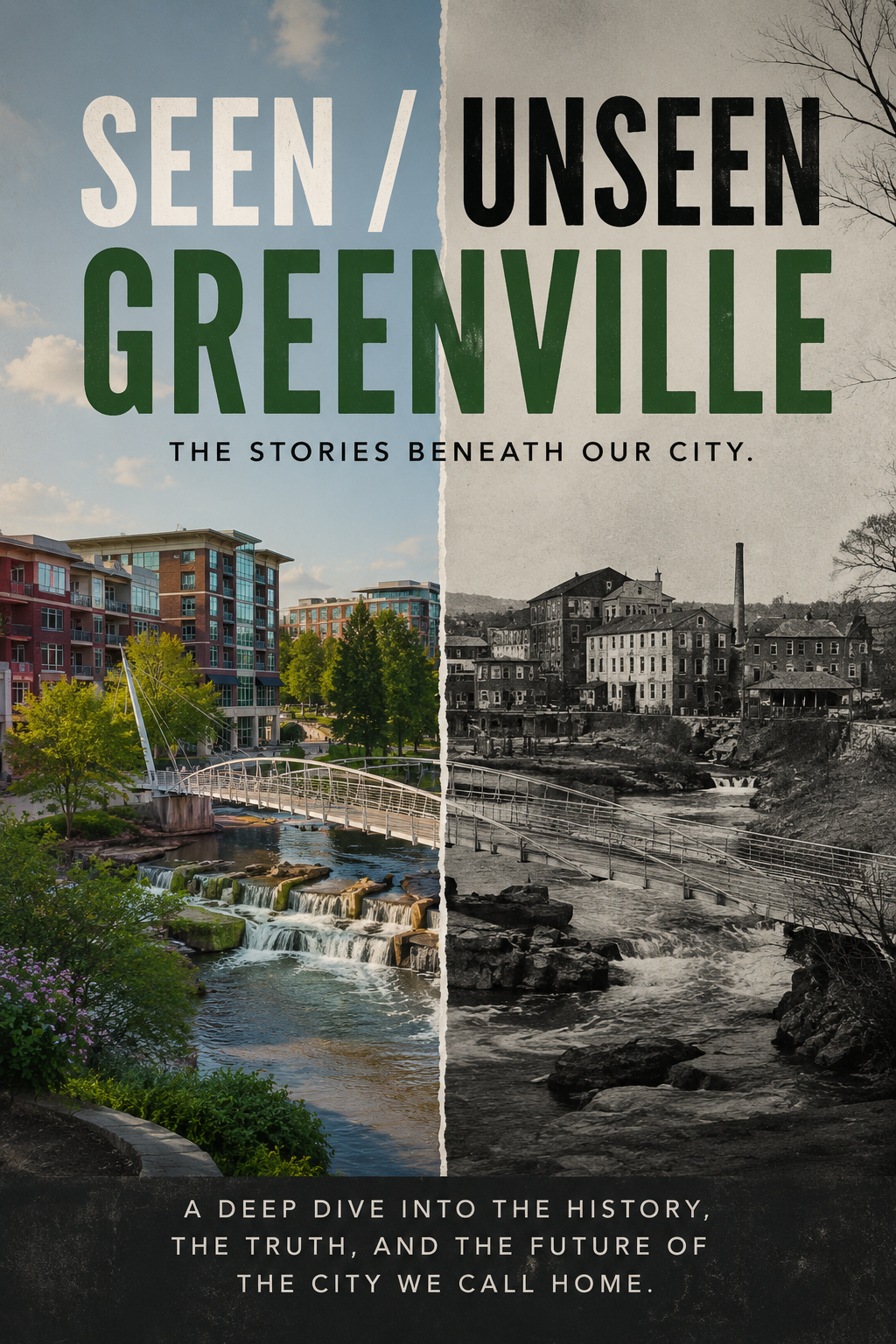
Downtown Greenville feels like modern America trying to define itself.
Five minutes away feels like the South reminding it that it doesn’t get to start from scratch.
That tension isn’t a flaw.
It’s the point.
A Cross Section of a Uniquely American Experience
What makes Greenville compelling isn’t that it’s perfect.
It’s that it’s representative—in a way that’s hard to see in bigger, more fully defined cities.
Because here, you can still see the layers:
The frontier South.
The mill economy.
Railroads and industrial expansion.
Segregation and its aftermath.
Suburban sprawl.
Downtown reinvention.
Lifestyle branding.
All existing at once.
Sometimes on the same road.
That layering creates something very specific:
a place where people are living inside multiple versions of America at the same time.
The Questions Greenville Forces
Because of that, Greenville naturally raises bigger questions:
Can a place reinvent itself without erasing what came before?
Who benefits from growth—and who absorbs the cost?
What does “community” mean when a city becomes a product?
Is identity something you preserve—or something you build?
These aren’t just local questions anymore.
They’re American questions.
Why Greenville Matters More Than It Looks
Greenville isn’t New York.
It isn’t Los Angeles.
It isn’t trying to be.
And that’s exactly why it’s interesting.
Because it sits in a space where:
American ambition is still being built,
Southern identity is still being felt,
and neither one has fully resolved what it is.
The Real Idea
Maybe the question isn’t:
Is Greenville the most American city?
Maybe the better question is:
Is Greenville a place where you can still clearly see what America actually is right now?
A country trying to move forward
without fully understanding what it’s leaving behind.
A country redefining itself
while still being shaped by where it came from.
A country that is—at the same time—
deeply American
and deeply something else.
In Closing
The deeper I look into Greenville, the less it feels like I’m only writing about one city.
It starts to feel like I’m watching a version of America that hasn’t fully decided what it is yet.
And that uncertainty—
that tension between reinvention and memory—
might be the most honest thing about both Greenville
and the country right now.
Leave a Reply