
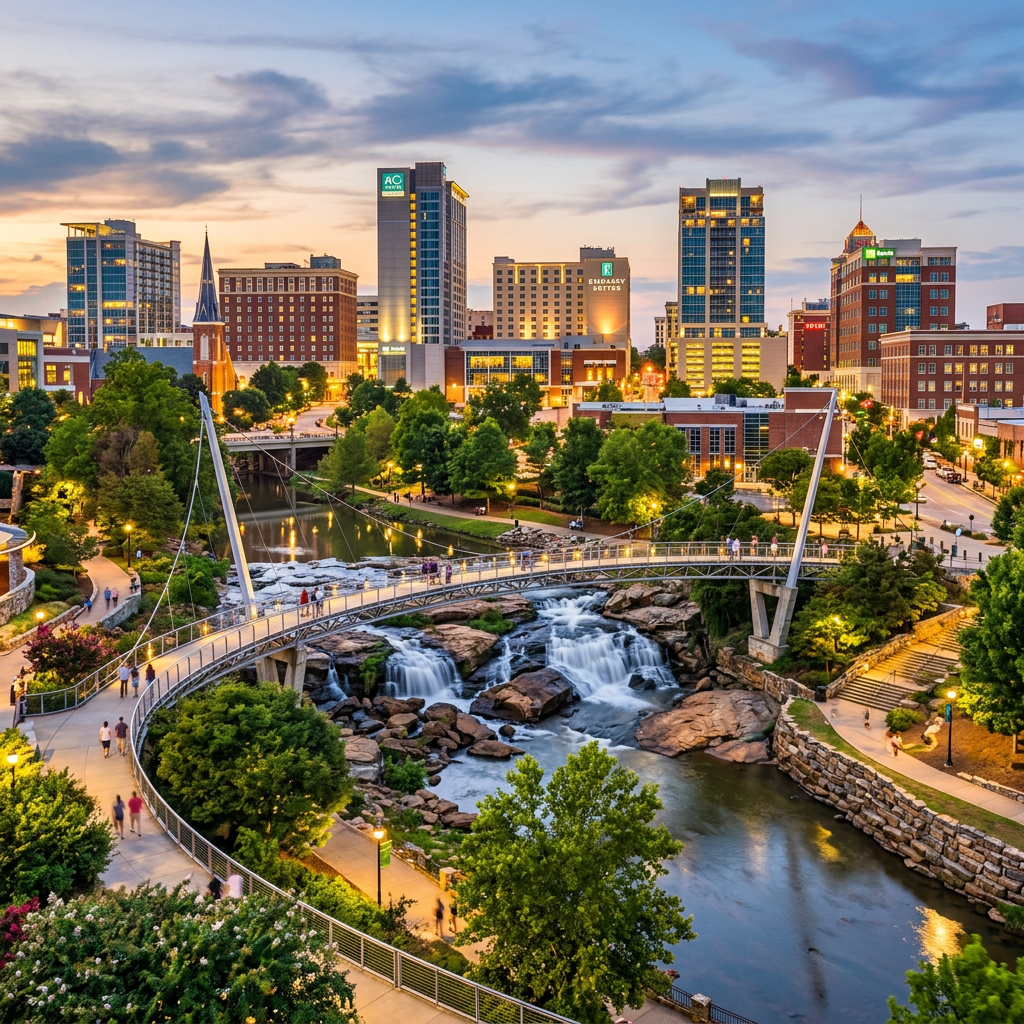
Greenville is a nice city.
That’s not sarcasm. It’s not a setup. It’s just true.
It’s clean. It’s welcoming. It’s easy to enjoy. People are generally friendly. The parks are good. The downtown is polished. The trail system is something most cities would love to have. If someone comes to visit, it’s not hard to show them a good time and feel proud of where you live.
Greenville has worked hard to become that kind of place.
And that matters.
But there’s a difference between a city being nice and a city being kind. And the two don’t always move in the same direction.
Nice is about experience. It’s about how a place feels when you move through it. It’s the surface layer—the part you see, the part you photograph, the part that makes things comfortable and appealing.
Kind is something else.
Kind is about what a place asks of people and what it gives back. It’s about whether people can build a life there, not just enjoy an afternoon. It’s about whether a city absorbs some of the cost of growth, or passes that cost along to the people least able to carry it.
Nice is easy to see.
Kind is harder to measure.
And that’s where things get complicated.
Because Greenville has become very good at being nice. We know how to build spaces people enjoy. We know how to improve areas that were once overlooked. We know how to create environments that feel modern, connected, and well-designed.
But this isn’t the first time Greenville has been good at creating something that looked right on the surface.
The mill villages were orderly. Structured. In some ways, even self-contained communities. But they were also systems of control—where housing, work, and daily life were tied together in ways that made it difficult for workers to move freely or build wealth outside the system.
Later, as the city grew, entire neighborhoods were shaped—and in some cases separated—by decisions that prioritized order and image over inclusion. The lines weren’t always obvious if you didn’t know where to look. But they were there, built into how the city developed.
Nice has a long history here.
So does the question of who benefits from it.
That’s why the harder question now isn’t whether Greenville is improving.
It is.
The question is whether those improvements are translating into something deeper.
Are more people able to stay here as the city improves? Or are more people finding themselves pushed farther out as costs rise?
Are we building systems that work for the full range of people who live here? Or systems that work best for those already equipped to navigate them?
Are we creating a city that feels good to visit? Or one that remains livable for the people who have been here all along?
Those questions don’t have simple answers. And to be fair, Greenville hasn’t ignored them entirely. There are real efforts around planning, housing, and infrastructure. There are people thinking seriously about how to guide growth instead of just reacting to it.
But the results don’t always match the intention.
You can see it in small ways and large ones.
In the way walkability exists in pockets rather than as a fully connected system. In the way small businesses can struggle to navigate processes that larger companies handle more easily. In the way major corridors still function almost entirely around cars, even as the city talks about a different future.
And you can see it in how the city has had to correct itself before.
The Reedy River wasn’t always the centerpiece it is now. For decades, it was polluted—used and neglected as industry took priority over long-term environmental health. Cleaning it up transformed downtown. It made Greenville more attractive, more livable, more “nice.”
But that transformation didn’t happen automatically. It required recognizing that what worked economically at one moment had real costs over time—and that those costs had to be addressed.
We’re facing a similar kind of moment now.
Because a nice city builds places people want to be.
A kind city makes sure people can stay.
That’s where the real tension sits.
Growth makes Greenville more attractive. That’s the goal. But that same growth also makes the city more expensive, more competitive, and in some cases less accessible to the people who built their lives here before it became what it is now.
And that’s not a failure of intention. It’s a consequence of priorities.
Nice doesn’t require hard tradeoffs. Kind does.
Kind means allowing things that aren’t always as clean or as easy. It means being willing to adjust rules when they don’t fit real-world situations. It means investing in places that don’t already look good. It means making decisions that don’t always photograph well but matter more in the long run.
It means asking not just, “Does this improve the city?” but “Who does it improve the city for?”
That’s a harder question. And it doesn’t always have comfortable answers.
If Greenville continues on its current path, it will likely keep getting nicer. That part feels almost guaranteed. The city knows how to do that now.
What’s less certain is whether it will become more kind.
Whether the version of Greenville being built will still include the people who made it what it is. Whether the systems shaping the city will work for more than just those already positioned to succeed within them.
Because a city can become very easy to enjoy while quietly becoming harder to belong to.
And that’s the line Greenville is starting to walk.
Nice is good. There’s nothing wrong with it.
But kind is better.
And it’s a lot harder.

 Frank M. Anderson's Writing
Leave a comment