
Everyone who has seen Jaws 2 knows a few things: the shark is back and mad, and the same mayor is still in charge, doing the same damn things all over again.
That’s the feeling you get if you look at what’s happening on Laurens Road—and what could be coming next.
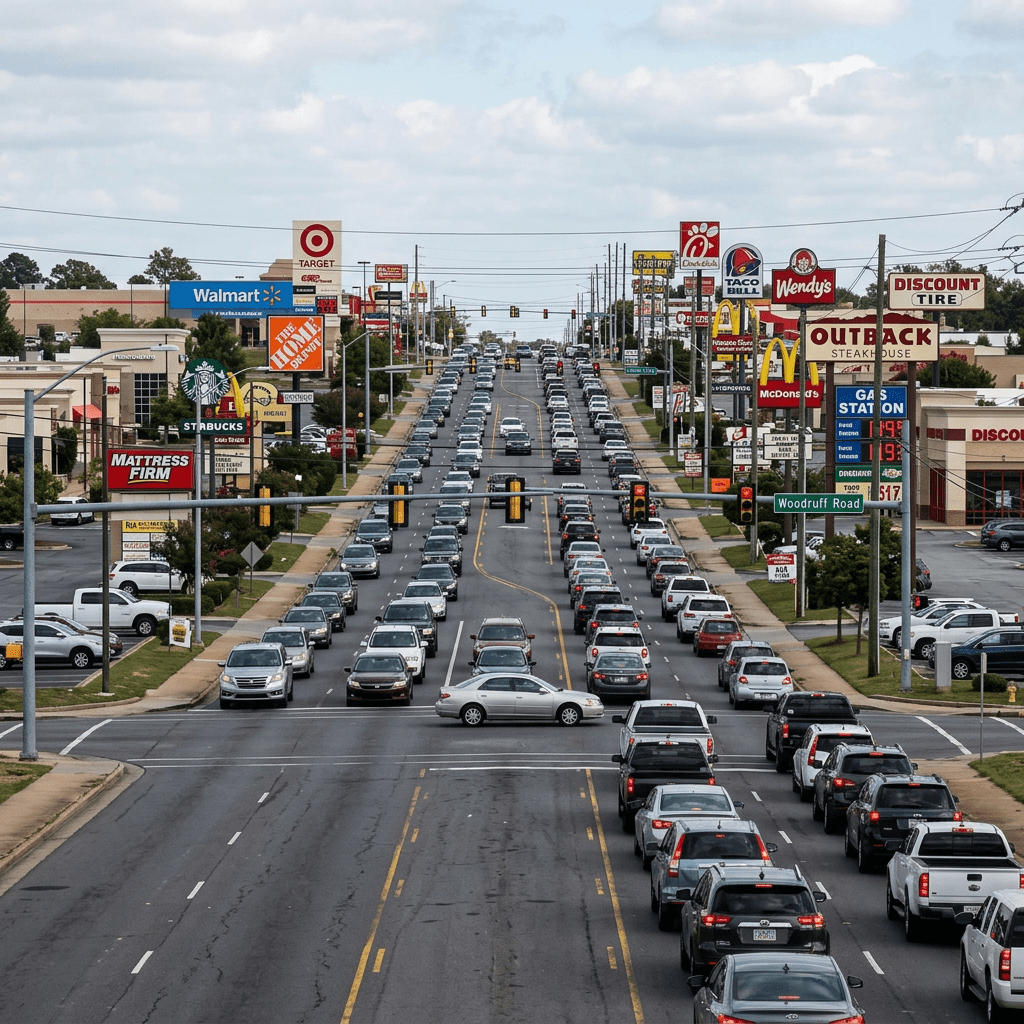
Because if we’re not careful, we’re setting ourselves up to build Woodruff Road… again.
Laurens Road used to be the place.
Before Woodruff Road took over, Laurens carried a huge share of Greenville’s commercial life. Big box stores, national chains, local spots—they were all there. It had traffic, sure, but it also had a kind of balance. It served the city without completely overwhelming it.
Then things started to shift.
As development pushed outward and access to Interstate 85 became more valuable, businesses began to move. Newer, larger retail centers—especially The Shops at Greenridge—offered space, visibility, and proximity to growing suburban neighborhoods. When stores like Best Buy relocated, it wasn’t just a move. It was a signal.
Others followed.
That’s how Woodruff Road became what it is today—not overnight, but through a steady pull of people, money, and attention. Over time, it turned into a corridor that tries to do everything at once: local errands, regional shopping, commuter traffic, interstate access.
And because it was built around that idea, it now struggles under the weight of it.
Woodruff didn’t fail.
It succeeded—at a model that eventually overloaded itself.
To be fair, that didn’t happen in a vacuum. Woodruff Road isn’t just a planning mistake—it’s a regional magnet, shaped by interstate access, population growth, and decades of car-first design. A lot of what happened there made sense at the time.
That’s the uncomfortable part.
Greenville doesn’t tend to make catastrophic planning decisions.
It makes small, reasonable ones—over and over—until the outcome becomes unavoidable.
And then there’s what happened behind it.
As Woodruff rose, Laurens Road lost its center of gravity. Some of those former retail spaces sat empty for years. Others were cleared as part of long-term redevelopment tied to areas like Verdae. For a while, Laurens felt like it was waiting—caught between what it used to be and whatever it might become next.
Now, we’re starting to see that “next” take shape.
The plans for Laurens Road look different on paper. More mixed-use development. More connectivity. More emphasis on walkability and design—the kind of language that sounds right, but depends heavily on where and how it’s applied.
And that all sounds good.
But there’s a harder reality underneath those ideas.
Corridors like Laurens Road, Pleasantburg, and Woodruff weren’t built as walkable environments. They’re wide, fast, car-dominated arteries that move a huge volume of regional traffic every day. That’s not just a design choice—it’s what they are right now.
And that matters.
Because when we talk about adding walkability and bikeability to places like this, we’re often talking about what we want them to become—not what they currently support.
There’s nothing wrong with that vision. In fact, it’s probably the right long-term direction.
But if the plan assumes people will suddenly move through these corridors differently—without fundamentally changing how they function—then it risks missing the reality on the ground.
You can’t just layer walkability on top of a road that still behaves like a high-speed regional connector and expect it to work the way it does on Main Street.
And if most people still have to drive to get there, still have to cross multiple lanes of traffic, still rely on the same limited access points…
Then the pressure doesn’t go away.
It just reshapes itself.
So what would “doing it differently” actually mean?
It probably starts with resisting the idea that one road has to carry everything.
Woodruff Road became what it is because it concentrates too much—too many uses, too many trips, too many expectations—into one place. Laurens Road has a chance to avoid that, but only if growth is spread out and connected rather than stacked on top of itself.
That means multiple smaller centers of activity instead of one dominant strip.
It means designing places people can stay in—not just drive through.
It means making sure new housing, retail, and office space are actually integrated, not just placed next to each other and labeled “mixed-use.”
And it means taking seriously the idea that not every trip should require getting onto the same road at the same time.
Doing it differently also means being honest about what a corridor can support today versus what it might become over time.
Not every road can—or should—try to function like a walkable downtown.
Some places need to be restructured gradually, with infrastructure leading the change, not just new buildings trying to force it.
Otherwise, you don’t get walkability.
You get the appearance of it—surrounded by the same traffic patterns that made it difficult in the first place.
This isn’t about stopping growth.
Greenville is going to grow. That’s not really in question.
Growth is good. Investment is good. New energy in old spaces is good.
The question is whether that growth is shaped—or whether it’s just allowed to accumulate wherever it’s easiest.
Because “easiest” is what built Woodruff Road.
Laurens Road is now sitting at a turning point.
It can become something more balanced—more distributed, less dependent on a single mode of movement, more integrated into the fabric of the city.
Or it can slowly become Woodruff Road 2.0.
Not because anyone planned it that way.
But because that’s the pattern we already know how to repeat.
In Jaws 2, the problem wasn’t that no one knew what could happen.
It’s that they knew—and did it anyway.
That’s the real question for Greenville now.
Not whether we can imagine something better.
But whether we’re willing to build it differently.
Because we’ve already seen what happens when we don’t.

 Frank M. Anderson's Writing
Leave a comment