
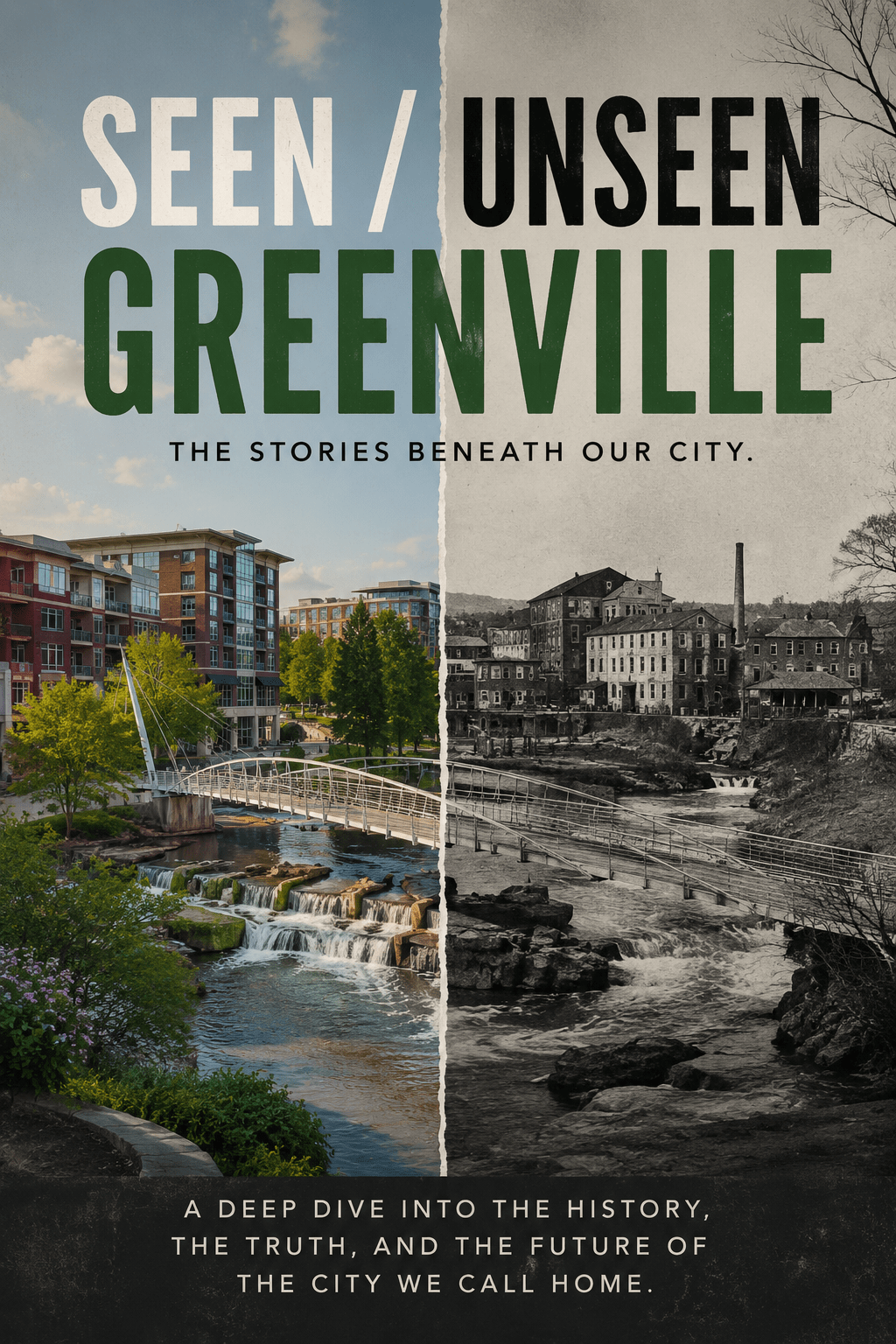
What It Looked Like Up Close
Growing up, I lived in the Augusta Road area near the Cleveland Street YMCA.
Just a few blocks away was Nicholtown—what people would have called “the Black side of town.”
It wasn’t far. Close enough to walk. Close enough that people moved through both areas every day.
But it might as well have been a different city.
They had their own parks. Their own streets. Their own spaces. And while people passed through, there wasn’t much connection beyond that.
We saw each other.
We just didn’t really talk.
No one sat me down and explained it directly. There wasn’t a moment where someone said, “stay away.”
It was quieter than that.
Something you absorbed.
A kind of unspoken understanding that this was a line you didn’t cross too easily.
And looking back, it wasn’t just coming from one side.
There was a mutual distance. A mutual suspicion.
We were told, in subtle ways, to be careful. To watch out. That it wasn’t safe.
I don’t remember my parents expressing anything overtly racist. But I do remember the feeling—that Nicholtown was “more dangerous,” that something about it was different in a way that required caution.
Now, looking back, it’s easier to see what was really underneath that.
What felt like instinct at the time was something built long before I was there to experience it.
The System Beneath the Feeling
Those lines weren’t accidental. And they weren’t invisible either—just rarely explained.
They were built—over time, through policy, law, and planning.
In 1895, South Carolina adopted a new state constitution that effectively stripped most Black citizens of their voting rights through poll taxes, literacy tests, and other barriers. Political power shifted almost entirely into white control, and that control shaped how cities like Greenville developed.
By the early 20th century, segregation wasn’t just social—it was structural.
Schools were legally separated. Public facilities were divided. Neighborhoods began to take on fixed racial identities, reinforced by lending practices, zoning decisions, and unequal investment.
Nicholtown became one of Greenville’s historically Black communities within that system—shaped both by exclusion and by the need for Black residents to build their own institutions inside the boundaries imposed on them.
Separate Growth
By the 1920s and 1930s, something more complex was happening.
Black Greenville wasn’t standing still.
Institutions were growing—schools, churches, businesses, and community organizations that created stability where the broader system did not.
Rosenwald Schools expanded educational access across the South, including in the Greenville area. Sterling High School became a central institution for Black education in the region. Community spaces like the Phillis Wheatley Center supported social and cultural life.
Growth was happening.
Just not on equal terms.
All of it mattered.
But all of it existed inside segregation.
This wasn’t equality.
It was growth within limits—what some historians describe as separate modernization.
Power and Resistance
By the 1930s and 1940s, those limits were being challenged more directly.
In 1938, a local chapter of the NAACP formed in Greenville, working to expand voting rights and civic access for Black residents.
The system pushed back.
Black voters faced white-only Democratic primaries, literacy tests, poll taxes, intimidation, and legal barriers. Organizing often had to happen quietly. People were taught how to pass literacy tests, how to interpret the Constitution, and how to register without drawing attention.
At the same time, white resistance intensified. The Ku Klux Klan re-emerged publicly in the region, with reports of marches, intimidation, and violence.
And still, people registered.
Even small numbers represented significant risk.
A Breaking Point
In 1947, Greenville became part of a national story.
A Black laborer named Willie Earle was taken from jail and lynched by a white mob.
The case drew national attention. The FBI investigated. Dozens of white men were arrested.
All were acquitted.
The trial exposed something that had always been there—but was now harder to ignore.
A system that protected itself.
Not quietly. Not subtly. But in a way that made the limits of accountability clear.
And a city under increasing pressure to change.
The Shift Begins
By the 1950s and 1960s, that pressure became harder to contain.
Black residents and students in Greenville challenged segregation directly through protest, legal action, and organized resistance.
In 1960, students staged sit-ins at segregated lunch counters downtown.
Library protests followed. Lawsuits emerged. Public demonstrations increased.
And in one widely reported moment, Jackie Robinson was arrested at the Greenville airport for refusing to move from a whites-only waiting area—an incident that helped spark broader protest activity.
Legal segregation began to break down.
But the structures behind it did not disappear.
Where People Could Live
Segregation wasn’t just about schools or public spaces.
It was about land.
Where you could live—and where you couldn’t—shaped everything else.
Black residents were largely confined to specific neighborhoods. Some came from explicit policies. Some from lending practices and informal agreements that didn’t need to be written down to be effective.
Neighborhoods like Nicholtown didn’t form randomly.
They formed because options were limited.
White neighborhoods received more consistent infrastructure and investment. Black neighborhoods were often left with less—even as they grew.
And over time, those differences compound.
A road that doesn’t get paved.
A school that doesn’t get funded.
A neighborhood that doesn’t attract investment.
Each decision seems small.
Together, they shape the map.
Equal—but Not Equal
By the mid-20th century, pressure to address inequality was growing.
But instead of dismantling segregation, many Southern cities—including Greenville—pursued “equalization.”
Improve Black facilities just enough to defend segregation.
Not integration.
Not equal access.
Improvement within separation.
Studies in the 1940s—often supported by organizations like the Rockefeller Foundation—documented major disparities in housing, education, and public health.
Some improvements followed.
But they were controlled.
The system wasn’t being replaced.
It was being maintained—just with better conditions inside it.
And many Black residents saw that clearly.
They weren’t asking for better segregation.
They were asking for something else entirely.
The Cost of the Map
When legal segregation began to break down, the structures that shaped the city didn’t reset.
Neighborhoods that had been underinvested for decades didn’t suddenly receive equal opportunity.
Wealth gaps persisted. School systems remained uneven. Infrastructure differences reflected earlier decisions.
Because housing is one of the main ways wealth is built in America, those patterns carried forward.
Who owned property—and where—mattered.
The map wasn’t just geography.
It was history made visible.
The system changed.
But the map it created didn’t.
The Modern Shift
Today, Greenville looks very different on the surface.
Downtown has been revitalized. Development continues. Investment flows into certain areas quickly and visibly.
And in many ways, that’s a success story.
But growth isn’t even.
Some neighborhoods change rapidly.
Others wait.
Some attract attention and resources.
Others struggle to be seen.
And sometimes, the same neighborhoods that were historically overlooked are now the ones changing fastest.
When Investment Returns
This is where the story becomes more complicated.
Places that were once underinvested can become valuable again.
Development follows.
That can bring new housing, new businesses, new energy.
But it can also bring displacement.
Rising costs. Increasing taxes. Pressure on long-time residents.
What was once exclusion can become a different kind of instability.
Not being allowed in—and then not being able to stay.
The Pattern
None of this is the result of a single decision.
It’s the result of layers.
Segregation shaped where people lived. Unequal investment shaped what those places became. Economic change reshaped which places became valuable.
Modern development continues to follow those lines—sometimes reinforcing them, sometimes shifting them, but rarely ignoring them.
That’s what makes it difficult to talk about.
Because it’s not just about the past.
And it’s not just about the present.
It’s about how the two connect.
What We Carry Forward
It would be easy to tell this story as something finished.
Something that belonged to a different Greenville.
But cities don’t reset like that.
They carry things forward—sometimes intentionally, sometimes without realizing it.
The lines that shaped Greenville weren’t just drawn once. They were reinforced over decades through policy, investment, and perception.
So when we see differences today—in neighborhoods, in schools, in where growth happens—it’s not always something new.
Sometimes it’s something older, still working beneath the surface.
Final Thought
Greenville has changed.
But change doesn’t erase structure.
It builds on top of it.
The lines that once divided the city aren’t always visible anymore.
But they’re still there—in distance, in investment, in who moves in and who moves out.
You can still feel them.
Sometimes just a few blocks apart.
Part 1: A City Divided
https://fulcrumandaxis.com/2026/05/09/seen-unseen-greenville-a-city-divided/Part 2: The Hidden Origins of Segregation
https://fulcrumandaxis.com/2026/05/09/seen-unseen-greenville-the-hidden-origins-of-segregation/Part 3: The Map of Schools
https://fulcrumandaxis.com/2026/05/09/seen-unseen-greenville-the-map-of-schools/

 Frank M. Anderson's Writing
Leave a comment