
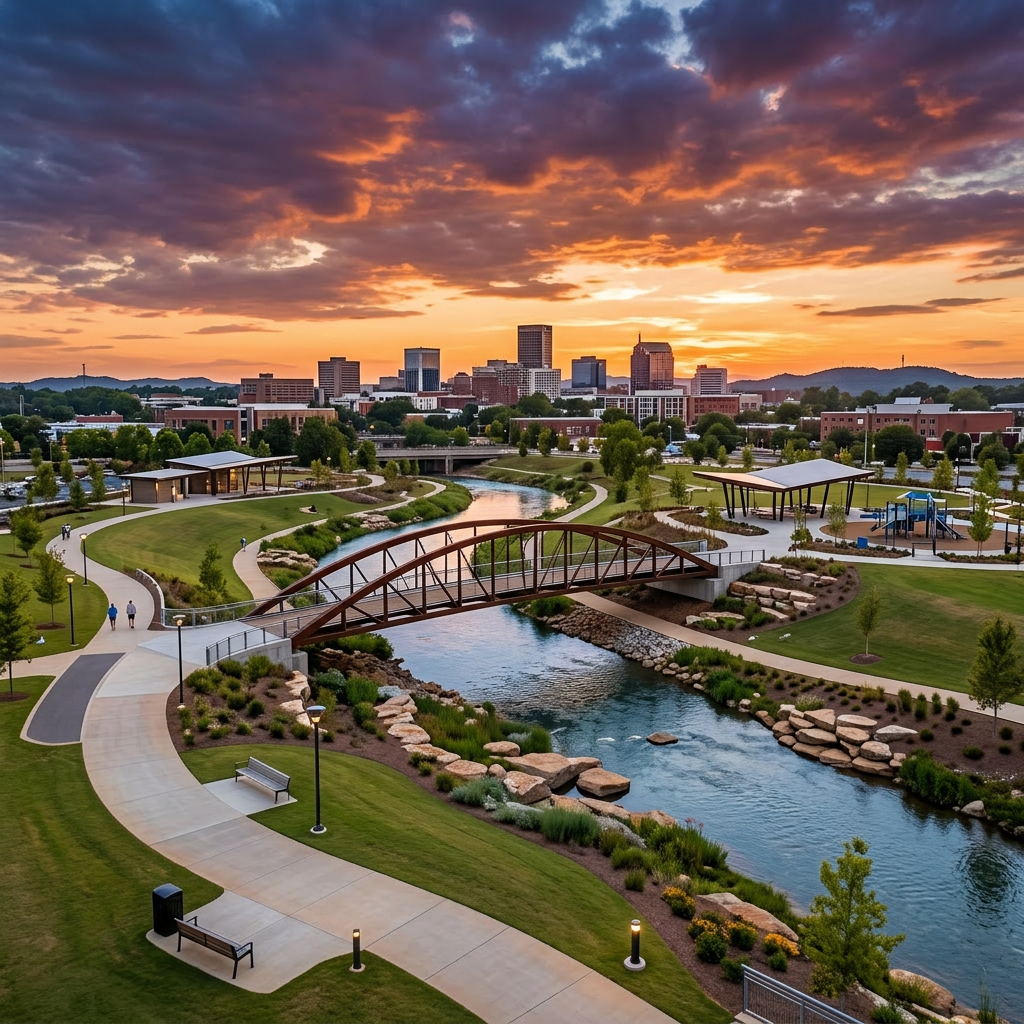
There is a lot to admire about Unity Park. It is beautiful, spacious, and full of life. It transformed long-overlooked land near the Reedy River into one of Greenville’s most impressive public spaces. Families gather there, kids play there, people walk and rest there, and for many residents it has become a genuine source of pride. Greenville deserves credit for building something ambitious instead of settling for something forgettable.
Cities need parks. They need shared space. They need places where people can exist together without having to buy something first. On the surface, Unity Park reflects a lot of what Greenville says it wants to be: welcoming, modern, thoughtful, connected.
But names matter. Symbols matter. History matters. And outcomes matter most of all.
Unity Park is not just a park. It is also a statement. That means it deserves to be looked at honestly.
Before it was called Unity Park, this land carried a very different kind of story. In the 1920s, part of this low, river-adjacent area became Mayberry Park, a recreational space for Black children during segregation. At the same time, Greenville’s more desirable park spaces were reserved for white residents. Not only were people separated, but the land itself reflected that separation. Black children were given access to marshy, flood-prone ground near the river, while better-resourced areas of the city were maintained elsewhere.
Nearby, Meadowbrook Park served as a white baseball venue. Two recreational spaces, side by side, but not equal. Even the layout of leisure reflected the hierarchy of the time.
And that wasn’t the end of it. Over the decades, the broader area absorbed the kinds of uses cities tend to place where political resistance is lowest. Industrial edges, dumping grounds, an incinerator, a police firing range, a prison facility—these were not the kinds of amenities that ended up in Greenville’s most powerful neighborhoods. They were placed here, near communities that had less ability to push back.
That pattern is not unique to Greenville. It is part of a broader American habit: placing burden in one set of neighborhoods while placing beauty in another.
What’s important is that this land was not empty or neutral. It was shaped by decisions about who mattered, who didn’t, and where different kinds of people were expected to live, work, and spend their time.
As the decades passed, industry declined, rail use shifted, and the area became fragmented and underutilized. It sat close to downtown, but not fully part of it. Close to investment, but not prioritized by it. It existed in that in-between space where cities often leave things until they become valuable again.
And eventually, it did become valuable again.
Greenville grew. Downtown improved. Demand increased. And land once overlooked became land worth reimagining. That is when the city returned with vision, funding, and a new story.
To be fair, some of that return is meaningful. Turning neglected land into a shared public space is not nothing. Reconnecting parts of the city is not nothing. Creating a park that is open and accessible is not nothing. These are real improvements, and they should be recognized as such.
But history does not disappear just because new grass is laid over it.
Unity is a powerful word. It suggests more than proximity. It suggests repair. It suggests belonging. It suggests that the people connected to a place’s past have a real stake in its future.
That is where the questions become more difficult.
Because if you look at Greenville not just through its parks and branding, but through its patterns over time, a certain rhythm starts to appear. For much of its history, decisions about land, investment, and development have tended to be shaped by those with the most access, the most resources, and the most influence. That is not shocking. It is, in many ways, how most cities operate.
Planning requires time, knowledge, and participation. And the people most able to engage in those processes are often the people already positioned comfortably within the system.
That does not make the outcomes malicious. But it does shape them.
It means that even well-intentioned plans can reflect a partial picture of the city—one that includes some voices more clearly than others.
So when Greenville builds something like Unity Park and speaks the language of connection and inclusion, it is fair to ask whether the full range of people connected to that history are meaningfully part of the future being created.
Who gets to remain near the center of Greenville as values rise? Who benefits most when formerly overlooked land becomes desirable land? Who gets the new amenities, and who gets pushed farther out by the costs that often follow improvement?
A city can create a park where everyone is welcome for the afternoon while becoming less affordable for many people who might once have lived nearby. That tension is not unique to Greenville, but it is very real here.
Greenville has become very good at visible progress. We know how to build trails, attractive districts, destination parks, polished corridors, and civic showpieces. We know how to market quality of life. We know how to create places people photograph and praise.
Those things are not meaningless. They improve daily life and make the city more enjoyable.
But visible progress can exist beside invisible pressure. Rents rise quietly. Starter homes disappear quietly. Working families move farther out quietly. Service workers commute longer quietly. Longtime residents begin to wonder whether the future being built still has room for them.
Then came the tower.
The Thomas and Vivian A. Wong Honor Tower now rises over Unity Park as a new landmark and observation point. Some people will enjoy it. Some already do. It honors philanthropy and public service, and there is nothing inherently wrong with wanting to build something memorable.
But it is hard not to notice what it represents in this moment.
At a time when Greenville is facing real pressure around affordability and displacement, the city still found the energy and resources to build something symbolic, something visible, something easy to celebrate. In a way, it feels like a continuation of a long-standing pattern—strong on presentation, less decisive on the harder, less visible work.
We built something tall to look out over the city. We have been slower to build the conditions that allow more people to remain within it.
A tower is easier to celebrate than a housing strategy. A ribbon-cutting is easier than structural fairness. An overlook photographs better than inclusion.
And again, to be fair, Greenville has not ignored housing entirely. But the scale and urgency of affordable housing efforts have not matched the scale and urgency of growth pressures. That gap is becoming harder to ignore.
Real unity would look like more than a name. It would look like housing teachers, servers, retail workers, young families, and retirees can realistically afford. It would look like preserving older affordable units before they vanish. It would look like growth that does not quietly push the people who carried Greenville through its less polished years further away from its center.
Unity Park is worth having. It is a good thing.
But Greenville should be careful not to mistake symbolism for completion. The city has shown it can build beautiful places. The harder challenge now is building a future where more people can still afford to belong in them.
Timeline of the Unity Park Area
Before Unity Park
This land near the Reedy River west of downtown was not empty space waiting to be saved.
It carried a long history tied to race, class, recreation, neglect, and unequal civic priorities.
1920s: Mayberry Park
In the 1920s, Greenville created Mayberry Park on marshy land for Black children who were excluded from white parks elsewhere in the city. It became an important gathering place for nearby Black communities.
That fact matters deeply:
When Greenville’s white residents had better parks, Black children were given lower, flood-prone land by the river.
1930s: Meadowbrook Park
Later, the city used part of that same land for Meadowbrook Park, a baseball stadium for a white team. The two parks existed side by side in segregated fashion.
Even the landscape reflected separate civic value.
Mid-Century Burdens
The broader property also hosted uses many cities placed near marginalized areas:
- dumping grounds
- incinerator uses
- police shooting range
- prison facilities
These details are documented in local historical accounts.
That means this was not simply parkland—it was land carrying burdens wealthier areas often avoided.
Later Decline / Underuse
As decades passed, the area declined, became fragmented, and remained less celebrated than other Greenville spaces.
2018–2022: Unity Park
Greenville transformed the zone into a large modern signature park intended to reconnect neighborhoods, honor history, and create shared civic space. It opened in 2022.

 Frank M. Anderson's Writing
Leave a comment