
Over the last few months, I’ve watched the internet turn the AI conversation into a war between extremes.
Either:
- AI is the death of creativity,
- or it’s the future of everything.
Either:
- using it makes you a fraud,
- or refusing it makes you obsolete.
Most of the conversation skips over the messy middle where real artists and real people actually live.
As someone actively writing a novel while openly using AI in the process, I’ve found myself in a strange position:
defending the humanity of a book that is partially about the exact fears people now have about technology, identity, memory, and authorship.
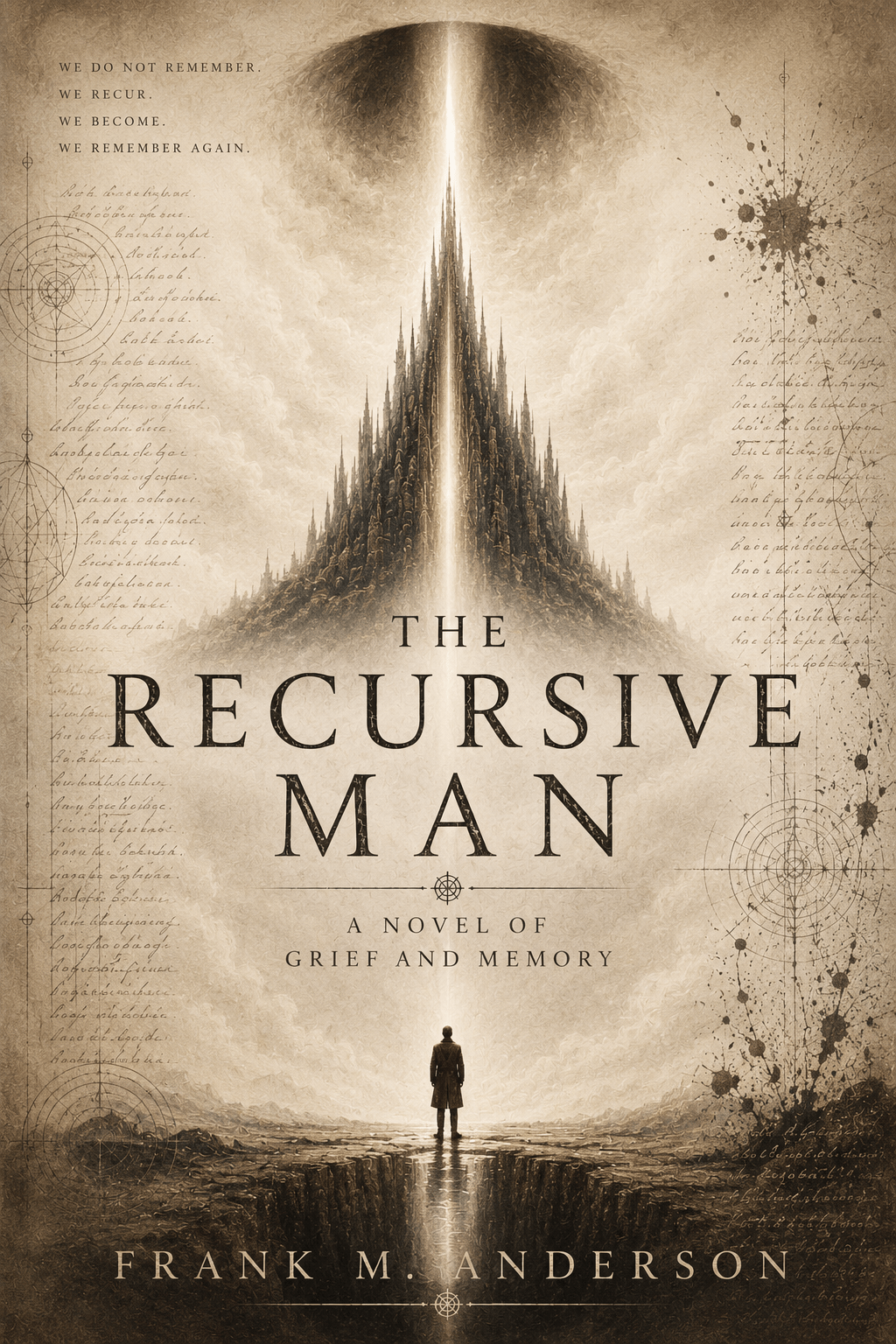
That book is The Recursive Man: A Novel of Grief and Memory.
And it releases July 16.
So What Is The Recursive Man?
At its core, The Recursive Man is a literary/metaphysical novel about grief, memory, identity, and the strange loops human beings get trapped inside.
It follows Caldwell, a man existing inside a surreal archive-like space known as the White Room, where unfinished stories, abandoned drafts, memories, and recursive realities begin collapsing into one another. As the boundaries between fiction, memory, and authorship deteriorate, Caldwell becomes obsessed with uncovering what is actually real — and whether reality itself may simply be another narrative structure endlessly rewriting itself.
Alongside Caldwell’s journey runs another story:
a recursive reimagining of Edgar Allan Poe and Aleister Crowley, two men spiraling through obsession, grief, ego, language, and the seductive danger of trying to transcend ordinary human limits.
But beneath all the metaphysical weirdness, recursive systems, mirror imagery, and existential horror, the book is really about something very human:
the struggle to survive loss without disappearing inside it.
It’s about:
- grief after death,
- inherited emotional patterns,
- loneliness,
- obsession,
- memory,
- shame,
- acceptance,
- and the fear that we are becoming strangers to ourselves.
The deeper I got into writing it, the more the novel slowly absorbed pieces of my own life:
my brother’s death,
my cancer diagnosis,
mental health struggles,
failed relationships,
creative obsession,
the need to prove I existed,
and the long process of trying to make peace with things that cannot be fixed.
Eventually, the line between memoir, fiction, philosophy, horror, and metafiction started dissolving entirely.
Which, honestly, became part of the point.
Why AI Became Part of the Process
Here’s the part that seems to make people uncomfortable:
AI genuinely helped shape this book.
Not because I typed:
“Write me a novel.”
I didn’t.
What AI became for me was something stranger:
a recursive mirror.
A collaborator.
A structural editor.
A philosophical sparring partner.
A system that allowed me to interrogate ideas more deeply and more rapidly than I could entirely alone.
The actual work still involved:
rewriting,
deleting,
restructuring,
mining old journals,
pulling from memoir,
revisiting painful memories,
obsessing over themes,
rethinking entire chapters,
and slowly discovering what the story was actually trying to become.
The AI did not live my life.
It did not lose my brother.
It did not experience cancer.
It did not survive heartbreak.
It did not wake up at 3 a.m. wondering whether memory itself is just another haunted room we keep wandering back into.
But it did help me see connections.
Sometimes it accelerated ideas.
Sometimes it exposed weak thinking.
Sometimes it amplified nonsense.
Sometimes it forced me to clarify what I actually believed.
In other words:
it behaved less like a ghostwriter and more like a mirror that talked back.
The Strange Irony of All This
The funny thing is that The Recursive Man gradually became partially about the exact anxieties people now argue about online:
- authorship,
- recursive identity,
- mediated consciousness,
- collaborative thought,
- artificial systems,
- memory loops,
- and the fear of becoming unreal.
The deeper I got into the project, the more I realized that human creativity itself is already recursive.
Every writer is assembled from:
books they loved,
people they lost,
movies they watched,
music they replayed,
arguments they overheard,
religion,
advertising,
internet noise,
trauma,
hope,
language,
and the emotional residue of thousands of other lives.
Human beings are already remix engines.
We just use more romantic language for it.
That doesn’t mean AI and human creativity are the same thing.
They aren’t.
But I do think the conversation becomes less honest when we pretend creativity has ever existed in total isolation.
Why This Book Matters to Me
More than anything else, The Recursive Man became a way for me to process grief.
Not solve it.
Not cure it.
Not transcend it.
Just survive it honestly.
The book started as an exploration of metaphysics, language, recursion, and occult ideas. But somewhere along the way it transformed into something more personal:
a long meditation on memory,
continuation,
identity,
and the strange ways human beings keep rebuilding themselves after devastation.
Underneath all the recursive architecture and surreal imagery, I think the book ultimately arrives at a simple idea:
The past never fully disappears.
But maybe we can learn to live beside it instead of inside it.
And maybe that’s enough.
The Recursive Man: A Novel of Grief and Memory releases July 16 through Fulcrum & Axis Press.
 Frank M. Anderson's Writing
Leave a comment