
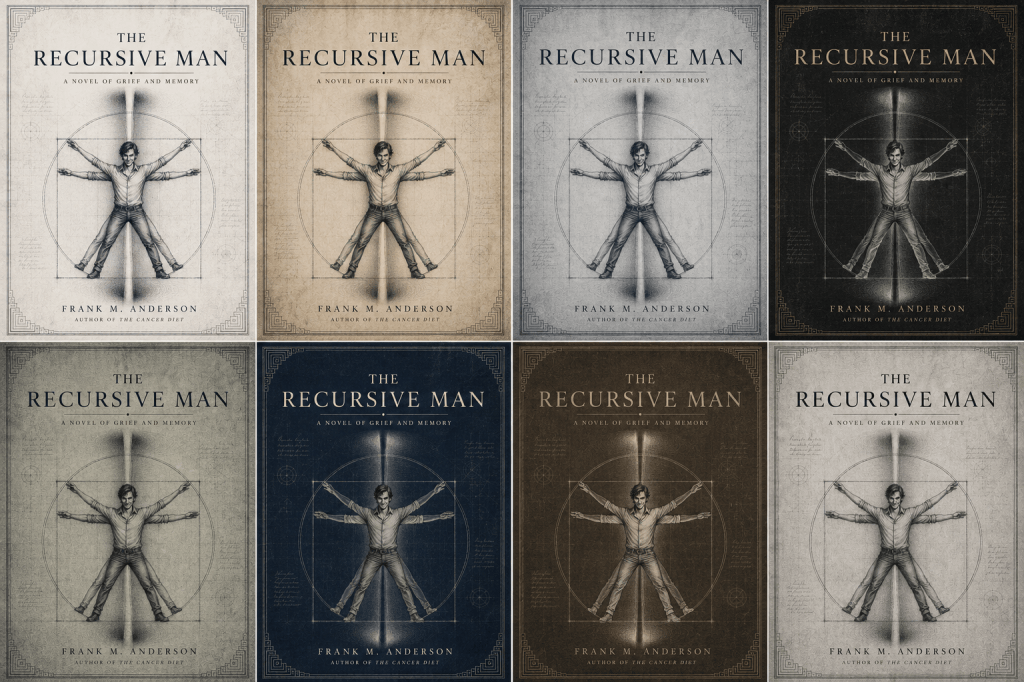
Recently, I outlined more than 80 potential articles and story ideas for the Seen / Unseen Greenville project I’ve been working on.
You may have noticed that I haven’t posted much over the last few weeks. You may not have noticed at all. Either way, it’s been intentional.
Part of it is that I needed a little breathing room after a remarkably productive stretch. During that time, ideas seemed to arrive faster than I could write them down. What started as a handful of articles became dozens of outlines, observations, interview ideas, historical rabbit holes, local mysteries, forgotten stories, and potential projects that I want to explore over time.
I don’t know if I would say that I slowed down, though.
What actually happened is that I transferred a lot of that energy into The Recursive Man. I finally found the hook I needed to connect my fiction work to the memoir world I’ve been building for years, and it happened much faster than I expected. Once I found that connection, I wanted to follow it as far as it would go.
The result is a book that became much larger, stranger, and more personal than I originally intended.
Seen / Unseen Greenville isn’t going away. If anything, I want it to become better. Going forward, I plan to publish at a slower pace, with more research, more interviews, more fact-checking, and more intentionality behind each piece. Greenville deserves that level of care, and honestly, so do the people taking the time to read it.
Part of the reason for the pause is that I’ve also been focusing on several larger projects.
I’m currently working with a friend on the concept for a smaller hyperlocal Greenville book. We’re also discussing a much larger coffee table book centered on Greenville’s people, places, history, culture, architecture, and hidden stories. Both projects are still taking shape, but they represent the kind of long-form local storytelling that has always interested me. I love articles, but I also love building things that can preserve stories for years.
I’ve also been spending a great deal of time preparing The Recursive Man for publication.
One thing I’ve talked about a lot over the last year is my use of AI in the writing process. What I haven’t talked about enough is the growing number of actual people who have become part of these projects.
One of the most important has been Qareen Ahmed, whom I originally found through Fiverr.
Qareen handled the interior formatting of The Recursive Man and helped shape its exterior presentation as well. If you’ve seen the cover recently, or if you’ve looked through one of the formatted interior proofs, you’ve seen her work firsthand. She has also worked with me on a new cover for Empire, Nevada and helped with several unreleased projects that are still in development.
What started as hiring someone for a specific task gradually became a genuine creative working relationship.
We spend a surprising amount of time testing ideas, revising layouts, comparing options, solving problems, trying things that don’t work, and then trying something else. We push projects well beyond their first drafts. Neither of us is particularly interested in settling for “good enough.”
In many ways, we’re both building at the same time. I’m growing as a writer, publisher, and creative director of my own projects. She’s continuing to expand her portfolio, skills, client base, and capabilities as a designer and formatter. The work improves because we’re both committed to improving.
The finished version of The Recursive Man is significantly stronger because of her contribution, and I wanted to make sure she received some credit for that.
That collaboration is important to me because it points toward something I’ve been thinking about a lot lately.
I’ve talked extensively about how I use AI.
What I haven’t talked about enough is how I hope to use it less over time.
Not because I dislike it. Quite the opposite.
I genuinely enjoy experimenting with AI. I enjoy drafting with it, exploring ideas, testing structures, brainstorming possibilities, and seeing where unexpected paths lead. It has helped me complete projects that might otherwise have remained unfinished.
But AI is not the same thing as collaboration.
Real collaboration involves disagreement, perspective, lived experience, trust, vulnerability, and shared investment in the outcome. It involves people bringing different strengths to the table and creating something together that neither could have made alone.
AI tends to encourage. Human beings challenge.
AI can help me explore possibilities. People help me become better.
The goal was never to replace people.
The goal has always been to build enough momentum to work with more people.
More editors. More artists. More designers. More filmmakers. More local historians. More photographers. More readers. More collaborators.
That’s the future I’m interested in building.
On the fiction side, I’m also working with a friend on developing a toy and collectible figure based on Ollie, one of the characters from The Recursive Man. He’s a relatively small character in the first book, but readers may discover that his importance grows considerably as the larger story unfolds.
In fact, there is already far more material connected to The Recursive Man than most people realize.
Over the years, the project went through numerous versions, rewrites, expansions, collapses, and reinventions before becoming the book that will be released this July. Along the way, I accumulated enough material that there is easily enough content for at least two potential sequels, a film concept, and another novel called Mortal Errors, which will likely end up connected to the same larger world.
The film idea is probably the strangest.
Right now, the concept is called Ollie Takes Greenville.
The story follows Ollie as he arrives in Greenville and attempts to make his way from downtown to my house. Along the journey, he visits many of the city’s recognizable locations and experiences Greenville through the eyes of someone who doesn’t entirely belong here.
The goal isn’t simply to get across town.
The goal is to find me.
Ollie is trying to convince me to return with him.
Not to another planet exactly, but to the fictional landscape that exists beyond the novel itself.
Depending on who is telling the story and where they are standing, that place is called the Valley, the Archive, the White Room, or the world beyond the Spire. It is the setting where many of the metaphysical portions of The Recursive Man take place and where many unfinished stories continue to wait.
Whether any of these projects become books, films, collectibles, or something else entirely depends largely on whether people connect with the world enough to want more of it.
I’m not interested in producing sequels simply because sequels are expected.
I’d rather continue exploring the world because there is something meaningful left to discover there.
That said, I intentionally wrote The Recursive Man to stand on its own.
I wanted readers to receive a complete experience rather than a setup for an endless franchise. The story reaches a conclusion that I genuinely believe works.
If no sequel were ever written, I would still feel comfortable handing someone the book.
At the very least, I have a substantial archive of earlier drafts, abandoned versions, alternate scenes, and developmental material that could eventually be shared with interested readers.
I would have a difficult time selling those drafts as books. I kept rewriting them for a reason.
But as a record of the creative process, they are fascinating.
They show how characters changed, how ideas evolved, how entire storylines appeared and disappeared, and how a very different book slowly transformed into The Recursive Man.
For readers interested in writing, revision, AI collaboration, worldbuilding, or simply how stories change over time, those drafts may eventually be just as interesting as the finished novel itself.
Some worlds have a way of lingering after the final page.
The world of The Recursive Man is one of those worlds.
For now, I’m focused on improving my craft, building stronger collaborations, telling better stories, and creating work that’s worthy of the people who spend their time reading it.
There’s a lot more coming.
 Frank M. Anderson's Writing
Leave a comment