
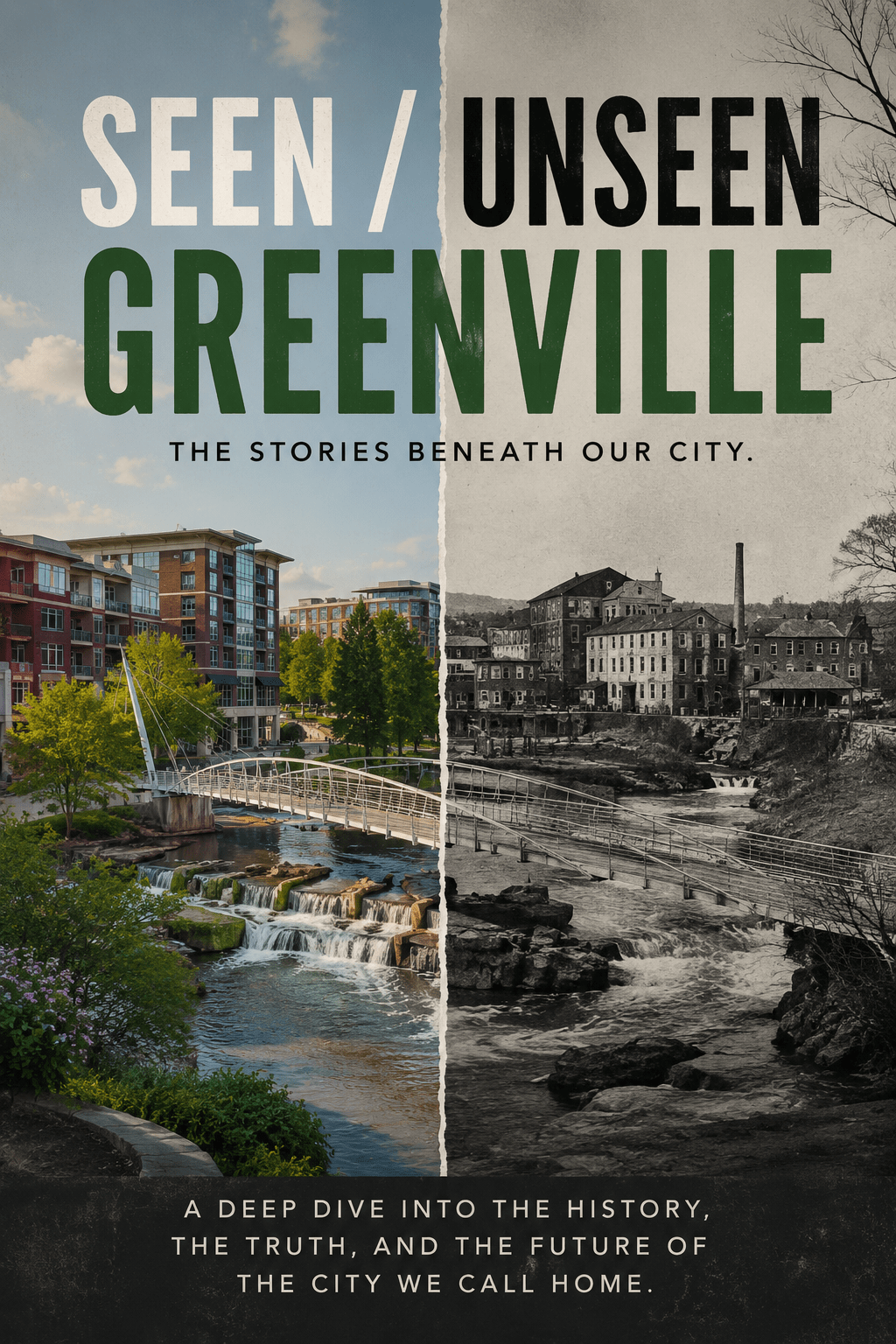
Greenville, South Carolina sits in the foothills of the Blue Ridge Mountains, tucked between Charlotte, Asheville, Atlanta, Charleston, and Columbia — close enough to all of them to feel their influence, but increasingly its own thing entirely.
Once known primarily as a textile mill town, Greenville has reinvented itself repeatedly throughout its history: from frontier settlement, to resort town, to manufacturing hub, to struggling post-industrial Southern city, to one of the fastest-growing and most talked-about small cities in America.
Over the last several years, Greenville has appeared on countless “Best Places to Live” lists. Its downtown has won awards. Falls Park and the Swamp Rabbit Trail are nationally recognized. Major companies like BMW and Michelin helped reshape the region’s economy. Tourism exploded. New apartments, restaurants, hotels, breweries, and developments continue to appear at a staggering pace.
To some people, Greenville represents one of America’s great modern success stories.
To others, it feels increasingly expensive, crowded, curated, or disconnected from the people who built it.
And honestly, I think both perspectives can be true at the same time.
Because the truth about Greenville, South Carolina is that there is no one truth about Greenville.
There is no single Greenville experience.
There are only overlapping versions of the same city:
the Greenville someone moves to,
the Greenville someone remembers,
the Greenville someone struggles to afford,
the Greenville someone feels trapped in,
the Greenville someone cannot believe they get to call home.
That may sound overly philosophical, but the more I work on this project, the more convinced I become that Greenville is not one city experienced one way. It is layers of experiences, histories, neighborhoods, classes, memories, opportunities, frustrations, myths, and realities all existing beside each other at the same time.
Greenville can feel hopeful to one person and suffocating to another.
I have a friend — let’s call her Kay — who hates Greenville. Truly hates it. She wants to leave. She talks about California constantly. She works in the service industry, feels stuck financially, feels like Greenville has become too expensive, too polished, too disconnected from the kind of life and people she wants around her.
And honestly? I sympathize with a lot of what she says.
There are absolutely people in Greenville who feel like the city’s growth happened around them rather than for them. There are people who feel priced out, culturally disconnected, exhausted, or invisible in the middle of all this “Top Places to Live” energy.
At the same time, I also genuinely love a lot about Greenville.
I love that this city somehow still manages to have mountains nearby, old churches downtown, weird local history, festivals, independent businesses, parks, trails, music, art, and people trying to build meaningful things. I love that Greenville still feels — at least to me — like a place where someone can carve out a life if they are willing to look for it.
But that’s my experience.
It may not be Kay’s.
And that tension matters.
Because I think one of the biggest mistakes people make when talking about cities is assuming there is one “correct” version of them. Greenville to a downtown developer is not Greenville to a server working doubles. Greenville to a transplant from New York is not Greenville to someone whose family worked in the mills. Greenville to someone making six figures is not Greenville to someone barely covering rent.
All of them are experiencing a real Greenville.
That realization is honestly part of what started this entire Seen / Unseen project.
Originally, I wasn’t trying to become some kind of civic commentator or local historian. I was simply trying to learn more about the place I live. I started searching for videos and information about Greenville history, and what I mostly found were realtor videos.
“Top 10 Reasons to Move to Greenville.”
“Pros and Cons of Living in Greenville.”
“Is Greenville Overrated?”
Drone shots. Rankings. Restaurants. Real estate.
Some of that content is useful. Some of it is even pretty good. But I kept feeling like something was missing.
Where were the stories about the mills?
The labor strikes?
The old roads?
The neighborhoods that disappeared?
The churches?
The racial history?
The planning battles?
The people who got left behind?
The strange contradictions that make Greenville Greenville?
That search slowly pushed me deeper.
I started reading books by local historians like Judy Bainbridge. I started digging through the Greenville County Historical Society website, which honestly can feel a little fragmented and difficult to navigate if you don’t already know what you’re looking for. I want to spend more time at the Upcountry History Museum. I’ve started joining local Facebook groups just to see how people actually communicate and share information now.
And the more I look, the more I realize Greenville is still talking constantly.
The conversation is just happening in a hundred different rooms.
Some of it happens through traditional institutions like The Greenville News, the Greenville Journal, WYFF, or the Post and Courier’s Greenville coverage. Some of it now happens through independent local voices like Cody Alcorn and other emerging creators trying to build new forms of local journalism and civic awareness.
But huge parts of Greenville’s actual civic conversation now happen through Facebook groups, Reddit, Instagram, church newsletters, nonprofits, community calendars, city social media pages, and ordinary people sharing information with each other online.
That fragmentation changes how people experience the city.
People say nobody gets involved anymore, but involvement itself has become harder to discover. Volunteer opportunities, historical resources, neighborhood conversations, public meetings, local events, and civic discussions all exist — but often in disconnected silos scattered across the internet.
And to be fair, I think the City of Greenville itself has actually done a surprisingly decent job trying to fill some of that gap lately. Their social media presence has improved noticeably. They’re sharing events, volunteer opportunities, public meetings, city projects, and updates far more actively than they used to.
But there’s also a limit to what city government can be expected to do. Government communication is not the same thing as independent journalism. Nor should it be.
At the same time, local journalism everywhere has been economically gutted over the last twenty years. Newsrooms shrank. Local coverage weakened. The business model collapsed. And now many important local stories end up behind paywalls because newspapers are trying to survive financially.
I understand why those paywalls exist.
Journalism costs money. Reporters deserve to be paid. Local newspapers are struggling all over the country.
But I also think there’s a real civic problem when the most important local information becomes difficult to access unless you pay for it. I don’t think local journalism should be forced to work for free, but I do think we need better systems that incentivize support rather than locking civic awareness behind a wall.
Because informed citizens matter.
Connected citizens matter.
And honestly, I think many people want to feel more connected than they currently do.
This is also why I want to be careful with this project moving forward.
I’m not trying to make final declarations about Greenville. I’m trying to better understand the place I live — and invite other people into that process with me.
I’m not a historian.
I’m not a planner.
I’m not an authority.
I’m someone from here who started paying closer attention.
And once you start paying attention to a place, it becomes harder not to notice the contradictions inside it.
Greenville is beautiful in some places, strained in some places, hopeful in some places, and unfair in some places.
Like most real cities.
And maybe that’s part of what makes Greenville worth writing about in the first place.
Not because it is perfect.
Not because it is uniquely broken.
But because so many of the tensions playing out here are happening all across America right now:
growth and displacement,
connection and isolation,
reinvention and memory,
visibility and invisibility,
prosperity and precarity,
branding and reality.
Greenville is not one story.
It is a collection of overlapping stories, many of them existing side by side without fully understanding each other.
A server trying to survive rising rent.
A transplant convinced they found paradise.
A developer imagining the next version of downtown.
A family that has been here for generations wondering where their version of the city went.
A teenager who cannot wait to leave.
A newcomer who cannot believe they get to stay.
All of them are experiencing a real Greenville.
That’s what I want this project to explore.
Not the definitive Greenville.
Not the marketed Greenville.
Not the doomed Greenville.
Not the “greatest city in America” Greenville.
Just the real one.
Or at least as much of it as any of us can honestly see from where we stand.
Because cities are not static things.
They are living conversations.
And right now, Greenville is still deciding what kind of conversation it wants to become.
 Frank M. Anderson's Writing
Leave a comment